
Perimeter and Area Calculation Made Simple With Tricks (Class 4)
 Nikita Aggarwal30 May, 2026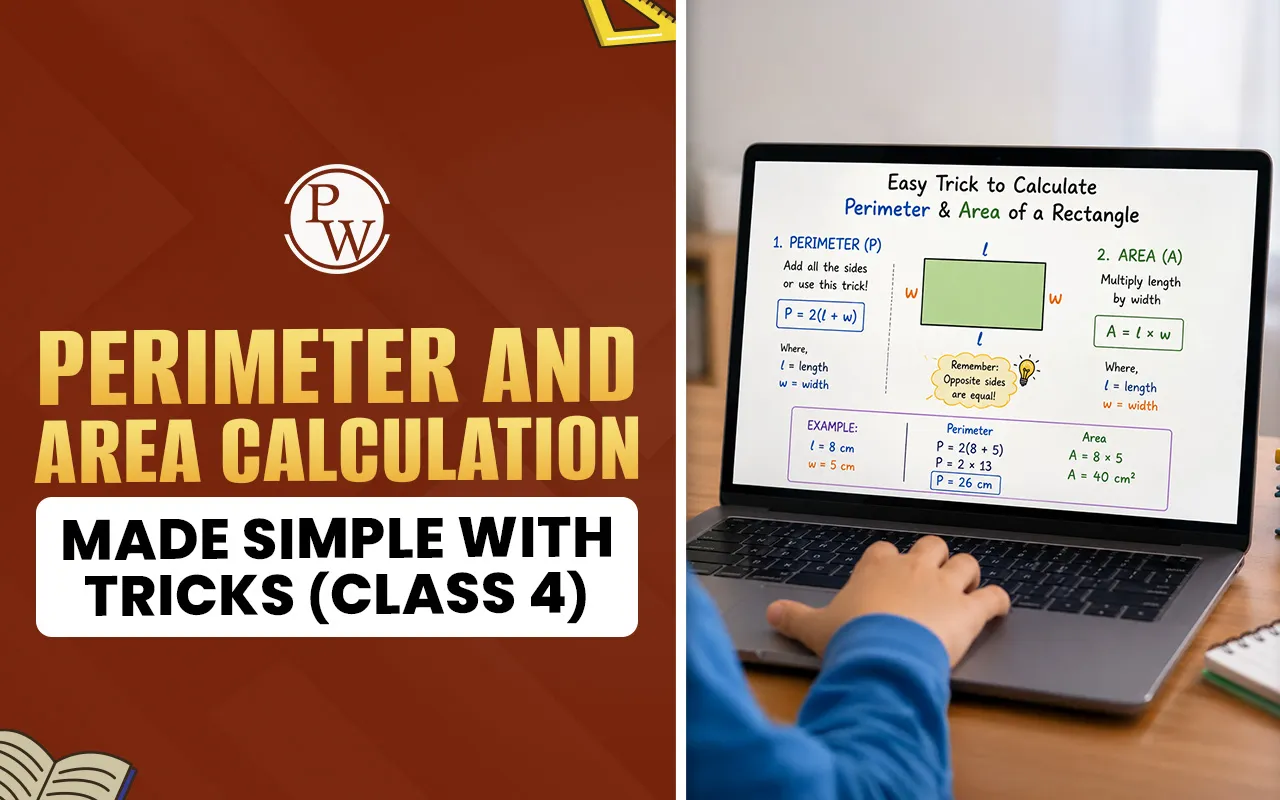
Why Use Perimeter and Area Calculation Tricks in Class 4?
Starting with the right techniques makes a huge difference in how students handle 2D shapes. When children understand the "why" behind the numbers, they stop memorising and start visualising. Using specific tricks helps in reducing the time spent on long additions or multiplications.
These tricks are helpful because they:
-
Build a strong foundation for geometry basics kids will use in higher grades.
-
Reduce errors caused by repetitive addition.
-
Make mental maths class 4 exercises more engaging and less stressful.
-
Help students identify which formula to use just by looking at the shape.
The following table compares the two main concepts to help you identify which measurement you need for a specific problem.
|
Feature |
Perimeter |
Area |
|
Definition |
The total length of the boundary. |
The total space inside the shape. |
|
Unit Type |
Linear units (cm, m, km). |
Square units (sq cm, sq m). |
|
Real-life Example |
Fencing a garden. |
Painting a wall. |
Perimeter and Area Calculation Tricks for Squares
A square is the simplest shape to work with because all its sides are equal. Instead of adding the same number four times, you can use multiplication to find the boundary. This is one of the most effective class 4 maths tricks for saving time during exams.
To find the perimeter of a square, simply multiply the length of one side by four. For example, if a square has a side of 5 cm, the calculation is 5 multiplied by 4, which equals 20 cm.
When it comes to the space inside, the area perimeter formulas change slightly. For the area of a square, you multiply the side by itself. Using the same 5 cm square, the area would be 5 times 5, resulting in 25 square cm.
Consider these quick steps for mental calculation:
-
Perimeter: Double the side, then double it again.
-
Area: Imagine the square as a grid and count the total blocks.
-
Check: Always ensure your area answer is in "square" units.
Perimeter and Area Calculation Tricks for Rectangles
Rectangles can be slightly trickier because they have two different measurements: length and width. However, you can still use fast geometry solving methods to get the answer in seconds. The key is to group the sides together before doing the final calculation.
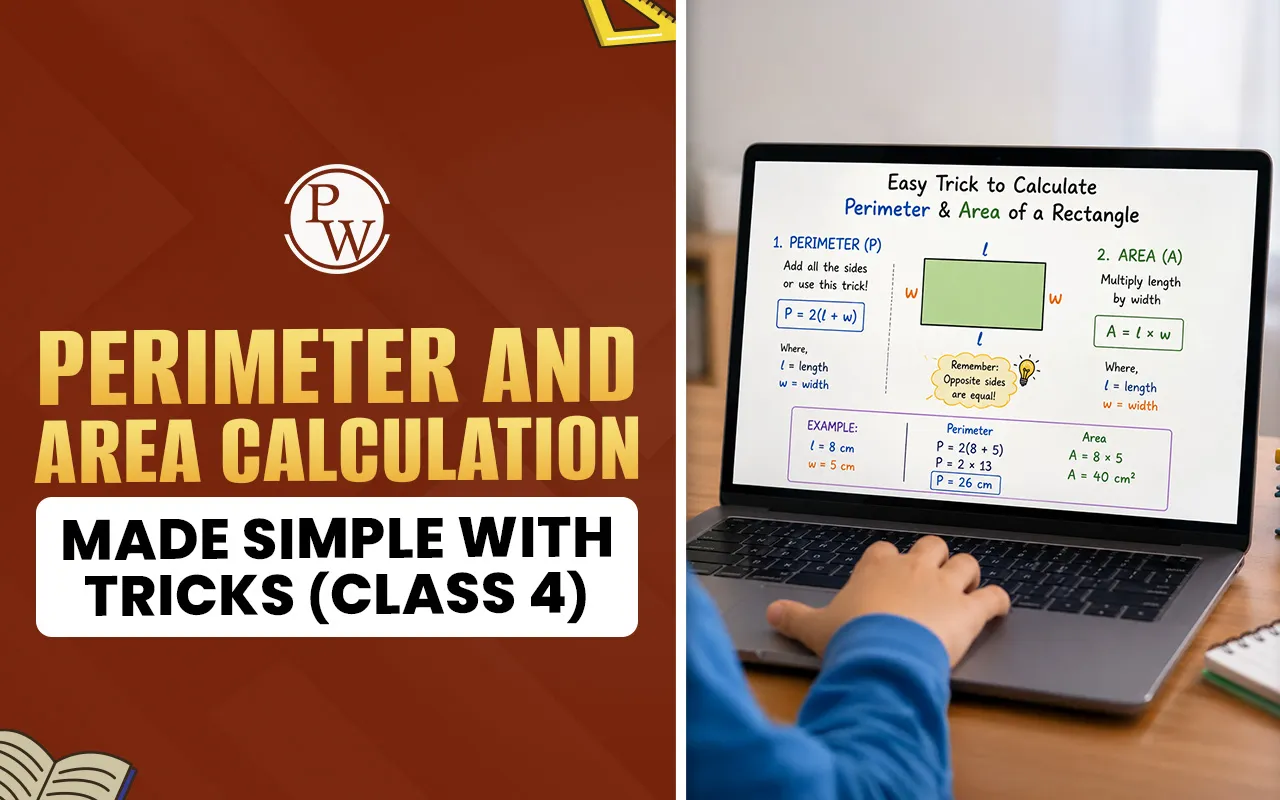
For the perimeter, instead of adding length + width + length + width, try this: add the length and width together first, then multiply the total by two. If a rectangle is 8 cm long and 4 cm wide, add 8 and 4 to get 12, then double it to get 24 cm.
The area of a rectangle is found by multiplying the two different sides. These measurement techniques are vital for everyday tasks like measuring a desk or a notebook. In our example, 8 times 4 gives an area of 32 square cm.
Here is a quick reference for rectangle calculations:
-
Identify the long side (length) and the short side (width).
-
For perimeter: (Length + Width) x 2.
-
For area: Length x Width.
-
Notice how the perimeter is a distance, while the area is a surface.
Perimeter and Area Calculation Tricks to Improve Measurement Skills
Developing strong measurement techniques is not just about using a ruler; it is about understanding how shapes occupy space. When students practice these concepts, they develop a better sense of estimation. They can look at a rug or a window and guess the dimensions with surprising accuracy.
This spatial awareness is a core part of geometry basics kids need to develop early on. When a student can visualise a square centimetre, they find it much easier to understand why we multiply sides to find the area. It turns abstract numbers into physical objects they can imagine.
Try these mental exercises to sharpen your skills:
-
Find the perimeter of your textbook using only your thumb width as a guide.
-
Estimate how many square tiles would cover your study table.
-
Compare two different rectangles and guess which has a larger area.
Read More - Time and Calendar Problem Solving Made Easy (Class 4)
Perimeter and Area Calculation Formulas for Class 4
Having a "cheat sheet" of area perimeter formulas helps students verify their work. While tricks are great for speed, knowing the standard formula ensures accuracy in formal tests. In Class 4, we focus primarily on the square and the rectangle as the building blocks for all other shapes.
The formulas are straightforward and easy to memorise if you practice them daily.
|
Shape |
Perimeter Formula |
Area Formula |
|
Square |
4 x Side |
Side x Side |
|
Rectangle |
2 x (Length + Width) |
Length x Width |
Before you start solving, always check if the units are the same. If the length is in centimetres and the width is in millimetres, you must convert them to the same unit first.
Perimeter and Area Calculation Tricks Using Grid Methods
If you find formulas confusing, the grid method is a fantastic way to visualise fast geometry solving. Imagine the shape is drawn on graph paper. Each small square on the paper represents one square unit. This method makes it impossible to forget the difference between the "inside" and the "outside" of a shape.
For area, you simply count all the full squares inside the boundary. For perimeter, you count the number of unit lines along the edge. This visual approach is one of the best class 4 maths tricks for students who prefer drawing over calculating.
Benefits of using the grid method include:
-
It provides a physical representation of "square units."
-
It helps in understanding irregular shapes later on.
-
It reinforces the connection between addition and multiplication.
-
It makes mental maths concepts feel like a game.
Read More - Vertical & Crosswise Multiplication Vedic Maths Tricks for Class 4
Perimeter and Area Calculation Tricks for Mental Maths
Learning mental maths class 4 requires consistent effort and a bit of curiosity. You don't always need a pen and paper to practice geometry. You can calculate the perimeter of your sandwich or the area of a chocolate bar just for fun. These small moments of practice build "maths muscles."
When you use these tricks in real life, the concepts stick better. Ask yourself: "If I want to put a border around my drawing, how much ribbon do I need?" That is a perimeter question. "If I want to cover my book with brown paper, how much paper do I need?" That is an area question.
To get better at mental calculations:
-
Practice your 1 to 12 times tables regularly.
-
Try doubling numbers in your head.
-
Break large shapes into smaller squares or rectangles.
-
Explain the concept to a friend or a sibling to test your own understanding.
Applying Perimeter and Area Calculation Tricks with CuriousJr
Learning these concepts becomes much more exciting when you can see them in action through interactive tools. By applying these tricks, students can move beyond textbooks and see how geometry fits into the digital world. Developing these skills early on allows for a much smoother transition into more complex topics like coding or design.
CuriousJr online mental maths class provides a platform where these fundamental skills are transformed into fun, logic-based activities. As students explore how to build shapes or calculate distances in a virtual environment, they reinforce their classroom learning. Engaging with CuriousJr helps Class 4 students see the practical side of maths, making every formula feel like a tool for creation.





Perimeter and Area Calculation Made Simple With Tricks (Class 4) FAQs
What is the simplest way to remember the difference between area and perimeter?
Can two different shapes have the same perimeter but different areas?
What unit should I use for area calculation?
Why do we multiply by 4 for the perimeter of a square?







Get Free Counselling Today
and Clear up all your Doubts
 Live & recorded classes available at easeDashboard for progress trackingLakhs of practice questions

