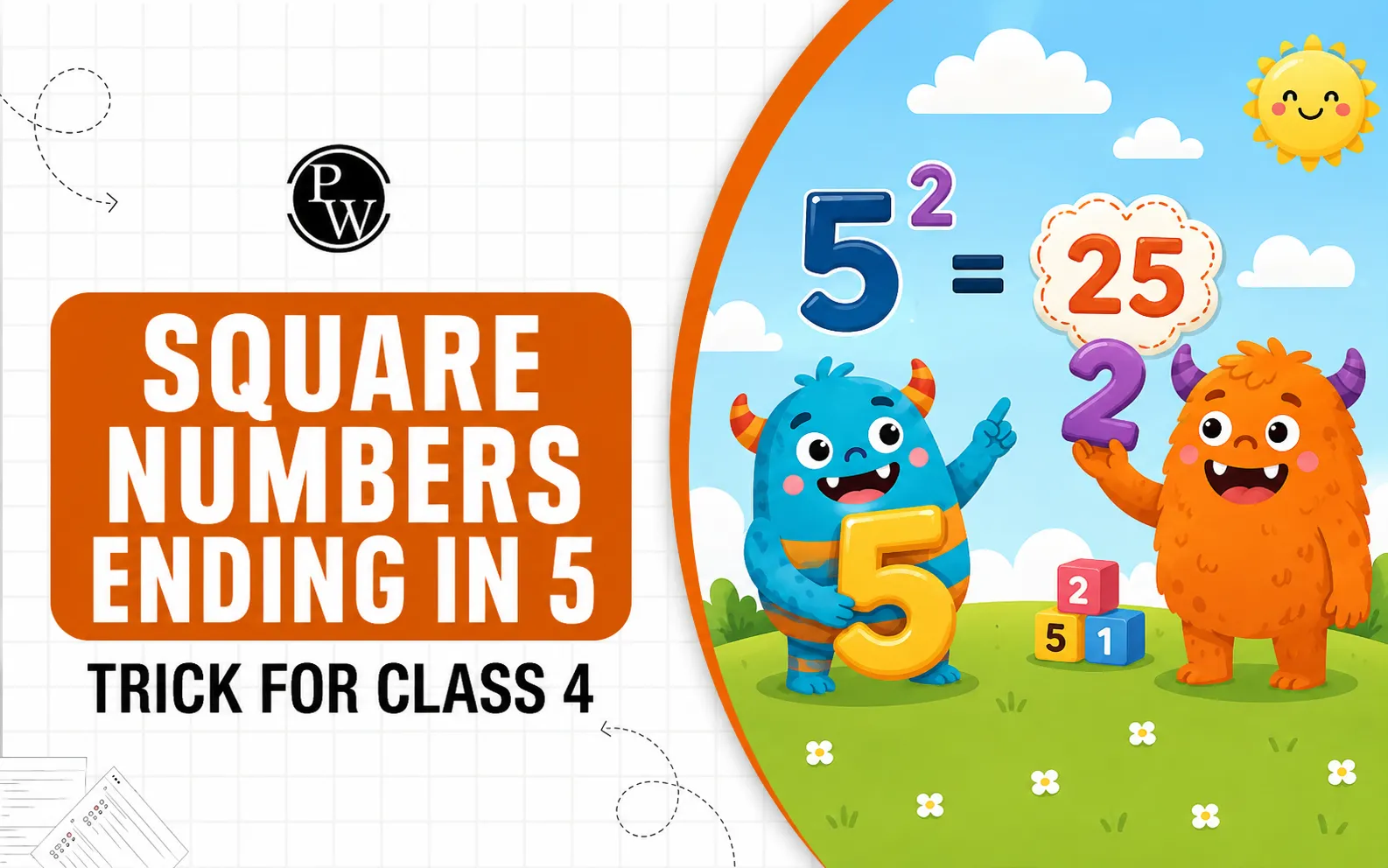
Square Numbers Ending in 5 Trick for Class 4
 Nikita Aggarwal30 May, 2026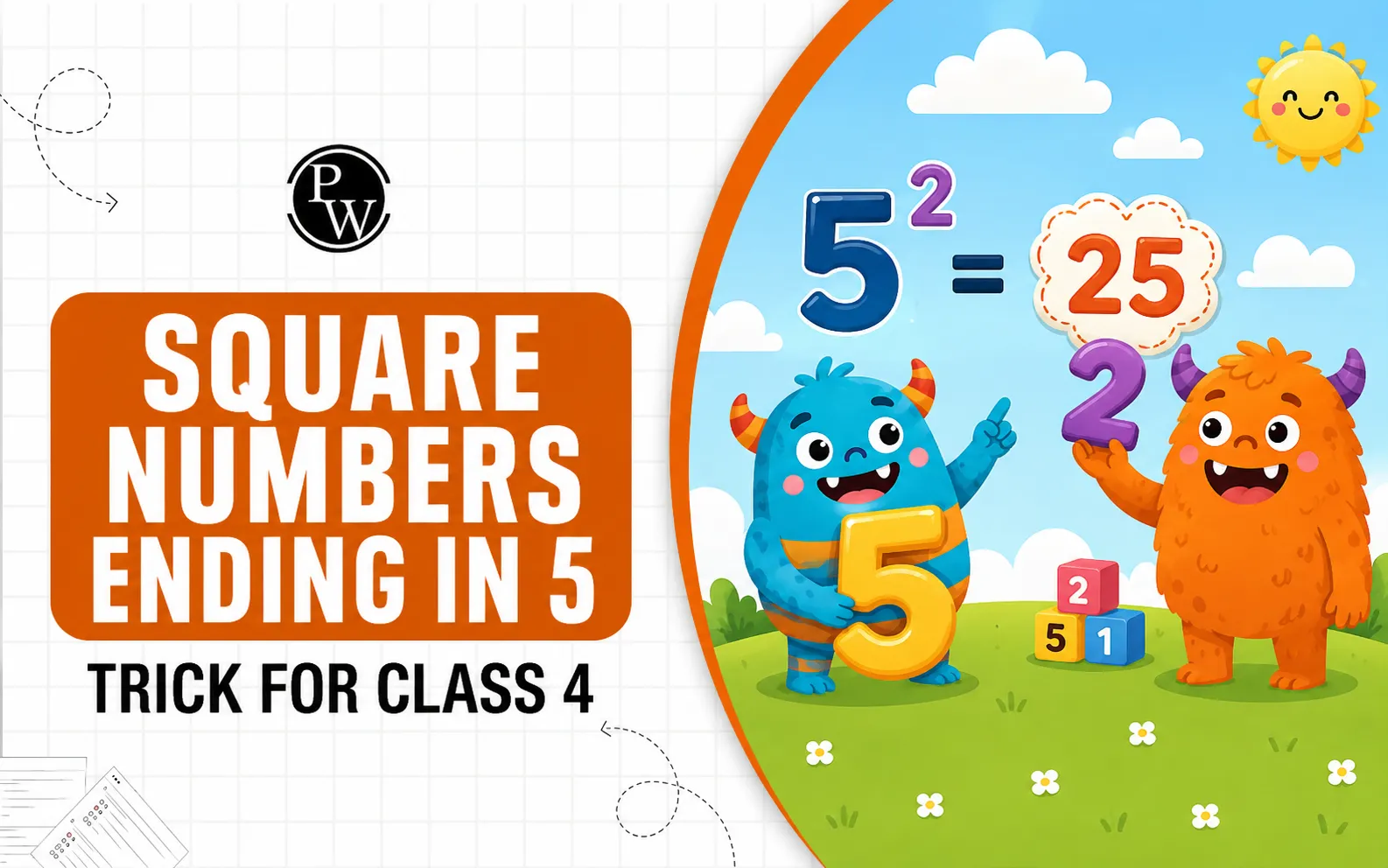
Square Numbers Ending in 5 Tricks Overview
Before we jump into the steps, it is important to understand what a square number actually is. A square is the result of multiplying a number by itself. For example, the square of 5 is 25 (5 \times 5 = 25). When we talk about square numbers ending in trick 5, we are looking at a pattern that appears every time we multiply numbers like 15, 25, 35, or even 95 by themselves.
The beauty of this trick is that it works because of the way our number system is built. Instead of doing three rows of multiplication, you only need to perform one small multiplication and one simple placement. This is why it is one of the most popular maths tricks used by students globally.
Steps to Square Numbers Ending in 5
To use the square numbers ending in trick 5 effectively, you only need to remember a two-part rule. Let us use the number 65 as our primary example.
Part 1: The First Digit
Look at the first digit of the number you want to square. In the case of 65, the first digit is 6. Now, think of the number that comes right after it when you are counting. The next number after 6 is 7. Multiply these two together:
-
6 multiplied by 7 equals 42.
Part 2: The Final Two Digits
This is the easiest part of the fast square 5 trick. Because the number ends in 5, the square will always end in 25. You do not even need to calculate this part; just know it is a constant rule.
The Final Result
Now, simply put the two parts together. Place 42 at the front and 25 at the back.
-
The square of 65 is 4225.
Why Class 4 Students Should Learn This Trick
In Class 4, the curriculum starts moving from basic addition toward more complex arithmetic. Learning square ending 5 tricks early gives students a significant advantage. It helps in several ways:
-
Saves Time: You can solve questions much faster than traditional multiplication methods.
-
Reduces Stress: Knowing a shortcut makes maths tests feel much less intimidating.
-
Better Accuracy: Since there are fewer steps, there is less chance of making a "carrying" error.
-
Mental Sharpness: It encourages students to practice maths squares without needing a pencil.
Using a square ending shortcut 5 isn't just about the answer; it is about training your brain to see patterns in numbers, which is a vital skill for higher-level mathematics.
Read More - Perimeter and Area Calculation Made Simple With Tricks (Class 4)
Square Numbers Ending in 5 Tricks Practice Questions
Let us apply the square ending 5 tricks to various numbers. This will help you get comfortable with the rhythm of the calculation.
Squaring 25
-
The first digit is 2.
-
The next number is 3.
-
2 times 3 is 6.
-
Add 25 at the end.
-
Answer: 625.
Squaring 45
-
The first digit is 4.
-
The next number is 5.
-
4 times 5 is 20.
-
Add 25 at the end.
-
Answer: 2025.
Squaring 85
-
The first digit is 8.
-
The next number is 9.
-
8 times 9 is 72.
-
Add 25 at the end.
-
Answer: 7225.
By repeating these steps, you will soon find that you don't even need to say the steps out loud. You will see "35" and immediately think "1225" because your brain has mastered the maths squares pattern.
Read More - Finger Multiplication Vedic Maths Tricks for Class 4
Square Numbers Ending in 5 Short Summary
To truly excel at mental maths class 4, you should try to understand the logic behind the results. Below is a structured table that shows how the square ending 5 tricks apply to all two-digit numbers ending in five.
|
Number |
The First Digit (n) |
The Next Number (n+1) |
Multiply (n x n+1) |
Add 25 at end |
Result |
|
15 |
1 |
2 |
2 |
25 |
225 |
|
25 |
2 |
3 |
6 |
25 |
625 |
|
35 |
3 |
4 |
12 |
25 |
1225 |
|
45 |
4 |
5 |
20 |
25 |
2025 |
|
55 |
5 |
6 |
30 |
25 |
3025 |
|
65 |
6 |
7 |
42 |
25 |
4225 |
|
75 |
7 |
8 |
56 |
25 |
5625 |
|
85 |
8 |
9 |
72 |
25 |
7225 |
|
95 |
9 |
10 |
90 |
25 |
9025 |
This table acts as a perfect cheat sheet for practicing class 4 maths tricks. You can test yourself by covering the "Result" column and trying to calculate the answer mentally using the square ending 5 tricks.
How Square Numbers Ending in 5 Tricks Work for Bigger Numbers
Once you are comfortable with two-digit numbers, you might wonder if you can use the fast square trick for even larger numbers. The answer is yes! While it gets a bit harder to do in your head, the rule for the square ending shortcut 5 remains identical.
Imagine you want to square 105.
-
The digits before the 5 are 10.
-
The next number after 10 is 11.
-
10 multiplied by 11 is 110.
-
Add 25 at the end.
-
The result is 11025.
Even though Class 4 students usually stick to numbers up to 100, knowing that this fast square trick 5 works for any number makes you a maths superstar. It shows that the logic of mental maths squares is universal.
Common Mistakes in Square Numbers Ending in 5 Tricks
While the fast square 5 tricks are quite simple, students sometimes make small errors. Keep these points in mind to ensure you get the right answer every time:
-
Using the wrong "next number": Make sure you are actually using the number that comes after the first digit. For 75, don't multiply 7 by 7; multiply 7 by 8.
-
Forgetting the 25: Some students calculate the first part correctly (e.g., 56 for 75 squared) but forget to write the 25 at the end.
-
Applying it to other numbers: Remember, this specific square ending shortcut 5 only works for numbers that end in 5. You cannot use it for 74 or 76.
-
Multiplication Errors: Ensure your basic 1 to 10 tables are strong. If you think 6 times 7 is 48 instead of 42, your answer will be wrong.
Fun Activities to Practice Square Numbers Ending in 5 Tricks
To make these fast square 5 tricks stick, you should try to turn practice into a game. Here are some fun ways to improve your speed:
-
Flashcard Practice: Write numbers like 15, 25, 35, etc., on cards. Flip them over and see how fast you can shout the square using the fast square trick 5.
-
Parent vs Student Challenge: Ask your parents to give you a number ending in 5. Try to beat them while they use a calculator!
-
Timed Grid Method: Draw a 3x3 grid and fill it with different numbers ending in 5. Race against a timer to fill in the squares using the square ending shortcut 5.
-
Shopping Maths: If you see something priced at 25 or 45 in a shop, mentally square it just for fun.
Regular practice with class 4 mental maths tricks ensures that these patterns become permanent in your memory.
Why Do Square Numbers Ending in 5 Tricks Work?
If you are curious about why the fast square 5 tricks work, it comes down to basic algebra. Any number ending in 5 can be written as (10x + 5). When you square this, you get (100x^2 + 100x + 25). If you factor out the 100, it looks like 100(x(x+1)) + 25.
This formula proves that you take the first digit, multiply it by the next one, and the "100" puts it in the hundreds place, leaving the 25 at the end. Even if you don't use this algebra yet, knowing there is a solid reason for the square ending in 5 shortcut helps you trust the method. This logic is the foundation for many other class 4 mental maths tricks.
How CuriousJr Helps Improve Mental Maths Skills for Class 4 Students
Learning square numbers ending in 5 tricks becomes much easier when students practice through interactive activities instead of only memorising formulas. Platforms like CuriousJr help Class 4 students strengthen mental maths skills with engaging exercises, logic-building tasks, and quick calculation techniques.
1. Interactive Mental Maths Practice
Students solve fun exercises that improve speed, accuracy, and confidence in solving square numbers and other arithmetic problems mentally.
2. Step-by-Step Visual Learning
Complex maths tricks are broken into simple visual explanations so children can understand the logic behind the shortcut instead of just memorising it.
3. Gamified Learning Activities
Puzzle-based learning and timed quizzes make maths enjoyable and encourage students to practice square ending shortcut 5 tricks regularly.
4. Stronger Logical Thinking
Mental maths activities improve pattern recognition, concentration, and problem-solving skills, which are important for higher-level mathematics.
5. Confidence Building Through Practice
Regular practice with guided activities helps children solve calculations faster and reduces fear during school tests and competitive exams.
This kind of structured mental maths practice helps students build strong numerical foundations while making learning enjoyable and stress-free.
Join online CuriousJr kids mental maths class now!!





Square Numbers Ending in 5 Trick for Class 4 FAQs
How do fast square 5 tricks help in Class 4?
What is the square ending 5 shortcut for 95?
Can I use mental maths squares tricks for 35?
Why is it called a fast square 5 trick?

Get Free Counselling Today
and Clear up all your Doubts
 Live & recorded classes available at easeDashboard for progress trackingLakhs of practice questions