Obtuse Triangle - Definition, Rules, Properties, Examples
 Nikita Aggarwal20 Jan, 2026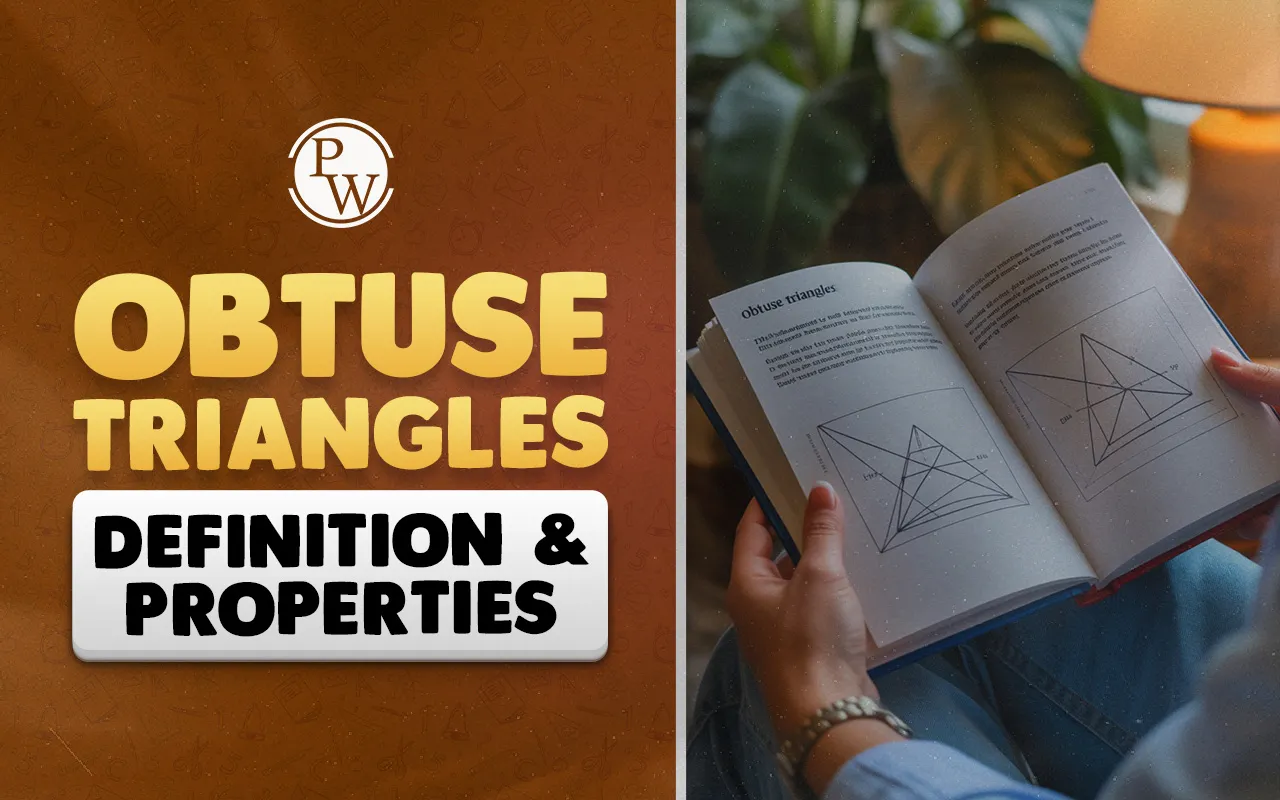
What is Obtuse Triangle?
An obtuse triangle is one of a kind in the wide world of triangles. What does that mean, precisely? It's simply a triangle where one of its interior angles is greater than 90 degrees. In fact, this feature makes it different from an acute or right-angled triangle. Basically, a study of these basic shapes is crucial when studying geometry; let's examine its definition, obtuse angled triangle formula, and distinctive characteristics.
Obtuse Triangle Definition
By definition, an obtuse triangle, otherwise known as an obtuse-angled triangle, is a triangle that contains one interior angle measuring more than 90 degrees. In any obtuse triangle, the other two angles must be acute, that is, less than 90 degrees. Significantly, the sum of these two acute angles in an obtuse triangle is always less than 90 degrees. The side opposite the obtuse angle of the triangle is always its longest side. For instance, in every triangle with sides a, b, and c, if c represents the longest side opposite the obtuse angle, then a² + b² < c².
It's important to remember that an equilateral triangle can never be obtuse, for its angles are all 60 degrees. On the same lines, an obtuse triangle cannot be a right-angled triangle simultaneously, because a right triangle has only one angle at 90 degrees and not any angle greater than 90 degrees.
Read More - Right Angled Triangle - Formula, Definition, and Examples
Perimeter of Obtuse Triangle
The perimeter of an obtuse triangle, like any other triangle, is simply the total length around its boundary. It is found by adding the measures of all three of its sides.
Obtuse Triangle Perimeter Formula
If a triangle has side lengths a, b, and c, then its perimeter is calculated as:
Perimeter = (a + b + c) units
Area of Obtuse Triangle
Calculating the area of an obtuse triangle often requires a slight adjustment compared to acute triangles because the height (or altitude) corresponding to an acute-angled vertex may fall outside the triangle. To find the area, one typically extends the base and draws a perpendicular from the opposite vertex to this extended base.
Obtuse Triangle Area Formula
The general formula for the area of any triangle, including an obtuse one, is:
Area = 1/2 × Base × Height
Here, 'Base' refers to one of the triangle's sides, and 'Height' is the perpendicular distance from the opposite vertex to that base (or its extension).
Obtuse Triangle Area Using Heron's Formula:
Heron's formula offers another way to find the area if all three side lengths are known.
Let a, b, and c be the side lengths of the obtuse triangle.
First, calculate the semi-perimeter (s):
s = (a + b + c) / 2
Then, the area is given by:
Read More - 30-60-90 Triangle - Sides, Formula, Examples
Obtuse Angled Triangles Properties
Obtuse triangles possess distinct properties that make them unique. Knowing these helps in their identification and problem-solving.
-
Longest Side Opposite Obtuse Angle: The side that faces the obtuse angle is invariably the longest side of the triangle. Does this make sense intuitively? Think about it, the wider the angle, the 'further away' the opposite side must stretch.
-
Only One Obtuse Angle: A triangle can only contain one obtuse angle. Why is this so? The sum of angles in any triangle is 180 degrees. If you had two angles greater than 90 degrees (e.g., 91° + 91° = 182°), their sum alone would exceed 180 degrees, which isn't possible for a triangle.
-
Sum of Other Two Angles is Less Than 90 Degrees: Following from the previous property, if one angle is greater than 90 degrees, the sum of the remaining two angles must be less than 90 degrees. For instance, if one angle is 100°, then the other two angles must add up to 80° (180° - 100° = 80°).
-
Circumcenter and Orthocenter Lie Outside: Unlike acute triangles, the circumcenter (the center of the circumscribed circle) and the orthocenter (the intersection point of the altitudes) of an obtuse triangle always lie outside the triangle itself. The centroid and incenter, however, remain inside.
Obtuse Triangles Rules
These rules explain how to identify an obtuse triangle using either its angles or its side lengths. They help you quickly check whether a triangle has one angle greater than 90° or satisfies the side-length condition for being obtuse.
Identifying an Obtuse Triangle by Angles
To determine if a triangle is obtuse baed on its angles, simply check if one of its interior angles measures greater than 90 degrees. If such an angle is present, and the sum of all angles is 180°, it's an obtuse triangle.
Identifying an Obtuse Triangle by Side Lengths
You can also identify an obtuse triangle by examining its side lengths. Let a, b, and c be the lengths of the three sides, with c being the longest side. If the square of the longest side is greater than the sum of the squares of the other two sides, the triangle is obtuse.
Rule: If a² + b² < c², then the triangle is obtuse.
Obtuse Triangle Examples
These obtuse angled triangle examples help you understand how to identify obtuse triangles using angles, side lengths, and basic formulas. Each question shows a practical method to check whether a triangle is obtuse and how to apply related concepts.
1.Identify which set of angles can form an obtuse triangle.
Options:
(a) 60°, 70°, 50°
(b) 95°, 30°, 55°
(c) 89°, 45°, 46°
(d) 90°, 60°, 30°
Solution: Option (b) because 95° is greater than 90°, so the triangle is obtuse.
2. Find the height of an obtuse triangle.
Given: Area = 60 square inches, Base = 8 inches
Use the formula: Area = 1/2 × base × height
Height = (2 × Area) / Base = (2 × 60) / 8 = 15 inches
So, the height is 15 inches.
3. Check if sides 3 in, 4 in, and 6 in form an obtuse triangle.
Let the longest side be 6.
Calculate: 3² + 4² = 9 + 16 = 25
Longest side squared: 6² = 36
Since 25 is less than 36, the triangle is obtuse.
Read More -Congruence in Triangles - Meaning, Conditions, Examples
4. Show the relation for an obtuse triangle.
In triangle ABC, if it is obtuse at B and AD is perpendicular to CB, then:
AC² = AB² + BC² + 2 × BC × BD
This is proved using the Pythagorean theorem in the smaller right triangles formed.
5. Check whether sides 10, 24, and 30 form an obtuse triangle.
Longest side = 30
Calculate: 10² + 24² = 100 + 576 = 676
Longest side squared = 30² = 900
Since 676 is less than 900, the triangle is obtuse.
6. Determine if a triangle with sides 5, 7, and 11 is obtuse.
Longest side = 11
Calculate: 5² + 7² = 25 + 49 = 74
Longest side squared = 11² = 121
Since 74 is less than 121, the triangle is obtuse.
Join Online Maths Classes for Kids Now!!