Uppercase Letters – Definition, Uses, Examples
 Nikita Aggarwal23 Apr, 2026
What are Uppercase Letters?
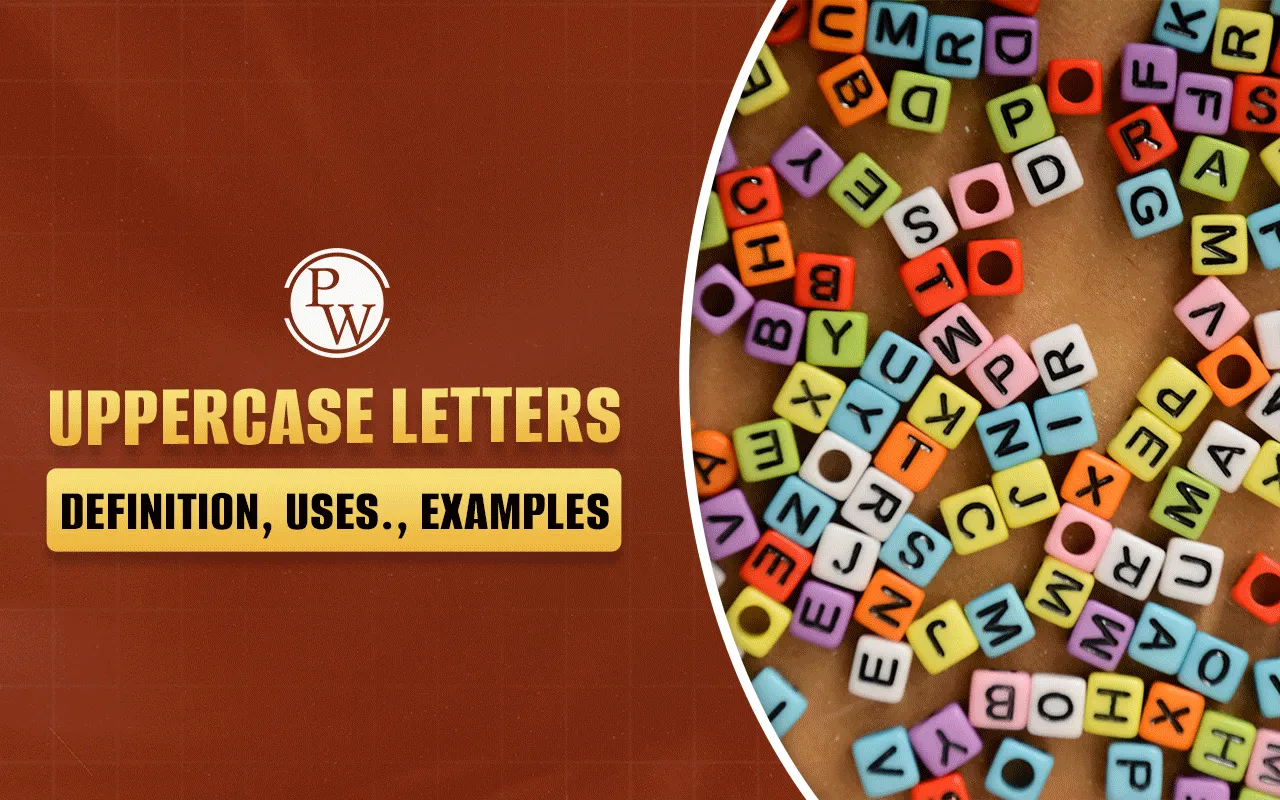
Uppercase letters are the capitalised versions of the letters we use. We have 26 letters in the alphabet. Each of these letters has two forms - uppercase and lowercase. The lowercase letters are small, while the uppercase letters are big. Even though both letters make the sound, they do different things in a sentence.
An uppercase letter's definition usually describes them as "capital letters" or "majuscule" characters. These letters are taller and often shaped differently than their lowercase counterparts. For example, the lowercase "a" looks quite different from the uppercase "A". Using them correctly is a fundamental part of English orthography, ensuring that text is readable and organised.
In the English language, there are 26 letters. Here is how they look:
A, B, C, D, E, F, G, H, I, J, K, L, M, N, O, P, Q, R, S, T, U, V, W, X, Y, Z.
Uppercase Letters Uses
Knowing when to use a capital letter is just as important as knowing how to write one. If you use them too much, your writing looks like you are shouting; if you use them too little, your writing looks messy. Here are the primary uppercase letters uses that every student should know.
1. Starting a Sentence
The most basic rule in English grammar is that the first letter of every new sentence must be an uppercase letter. This acts as a visual cue for the reader, letting them know that a previous thought has ended and a new one is starting.
-
Example: The sun rises in the east. It sets in the west.
2. Proper Nouns
Proper nouns refer to specific people, places, or things. Unlike common nouns (like "city" or "boy"), proper nouns always require an uppercase letter.
-
Names: John, Sarah, Mr Smith.
-
Places: London, India, Mount Everest.
-
Days and Months: Monday, January.
-
Holidays: Christmas, Diwali, Easter.
Read More - Silent Letters in English – Meaning, Rules & Examples
3. The Pronoun "I"
Regardless of where it appears in a sentence—at the beginning, middle, or end—the pronoun "I" is always written as an uppercase letter.
-
Example: My friend and I went to the park.
4. Titles of Books, Movies, and Songs
When you name a creative work, the main words should be capitalised. This helps the title stand out from the rest of the text.
-
Example: Harry Potter and the Philosopher’s Stone.
5. Acronyms and Abbreviations
When we shorten long names into a few letters, we use upper letters.
-
Examples: NASA, the UK, UNICEF, and the BBC.
Uppercase Letters Examples
To better understand what uppercases are and how they function, let’s look at some side-by-side comparisons.
|
Scenario |
Incorrect Usage |
Correct Usage |
|
Start of sentence |
apples are red. |
Apples are red. |
|
Proper Names |
i met rahul in delhi. |
I met Rahul in Delhi. |
|
Days of the week |
we play on friday. |
We play on Friday. |
|
The pronoun "I" |
can i come with you? |
Can I come with you? |
In these uppercase letters examples, you can see how the capitalisation makes the sentence look professional and easier to navigate. Without the capital "R" in Rahul, a reader might not immediately recognise it as a person's name.
Read More - Letter Writing - How to Write Any Type of Letter?
Importance of Uppercase Letters
Why do we bother with two different sizes for the same letter? These letters play a crucial role in our writing, performing several "heavy lifting" tasks.
-
Visual organisation: They act as visual anchors. When a reader sees a capital letter, their brain automatically registers that a new sentence or a specific name is appearing.
-
Preventing ambiguity: These letters help us tell the difference between something that people use every day and a specific brand or person. For example, "apple" is a fruit that we eat. Whereas 'Apple' is also a very well-known technology company that makes computers and phones.
-
Professionalism: Proper use of capitals shows that the writer is attentive and understands formal grammar. It builds trust with the reader.
-
Emphasis and hierarchy: Capitals help titles stand out, ensuring that the name of a book or headline is immediately recognisable.
Rules for Using Uppercase Letters in English
While we have covered the basics, there are a few more specific rules that help perfect your writing:
-
Nationalities and Languages: Always capitalise words like English, French, Indian, or Japanese.
-
Historical Periods: Eras like the Stone Age or the Renaissance require capitals.
-
Directions (when used as regions): You don't capitalise "turn west", but you do capitalise "the West" when referring to a specific part of the world.
Build Your Child’s Confidence in English Speaking with CuriousJr
Does your child hesitate to speak in English or find it difficult to form correct sentences? This can impact their confidence, classroom participation, and overall communication skills. CuriousJr’s online English classes are designed to make learning easy, interactive, and effective.
The program covers essential grammar, clear pronunciation, vocabulary development, and basic writing skills. Through live interactive sessions, children get regular speaking practice with experienced mentors. Engaging activities like games, storytelling, and writing tasks make the learning process fun and enjoyable. Parents also receive regular updates to monitor their child’s progress.
With well-structured levels suited to different learning speeds, CuriousJr supports children step by step in building a strong foundation in English. Book a demo class today.