Methods to Draw a Line Segment with Examples
 Nikita Aggarwal23 Apr, 2026
What is a Line Segment?
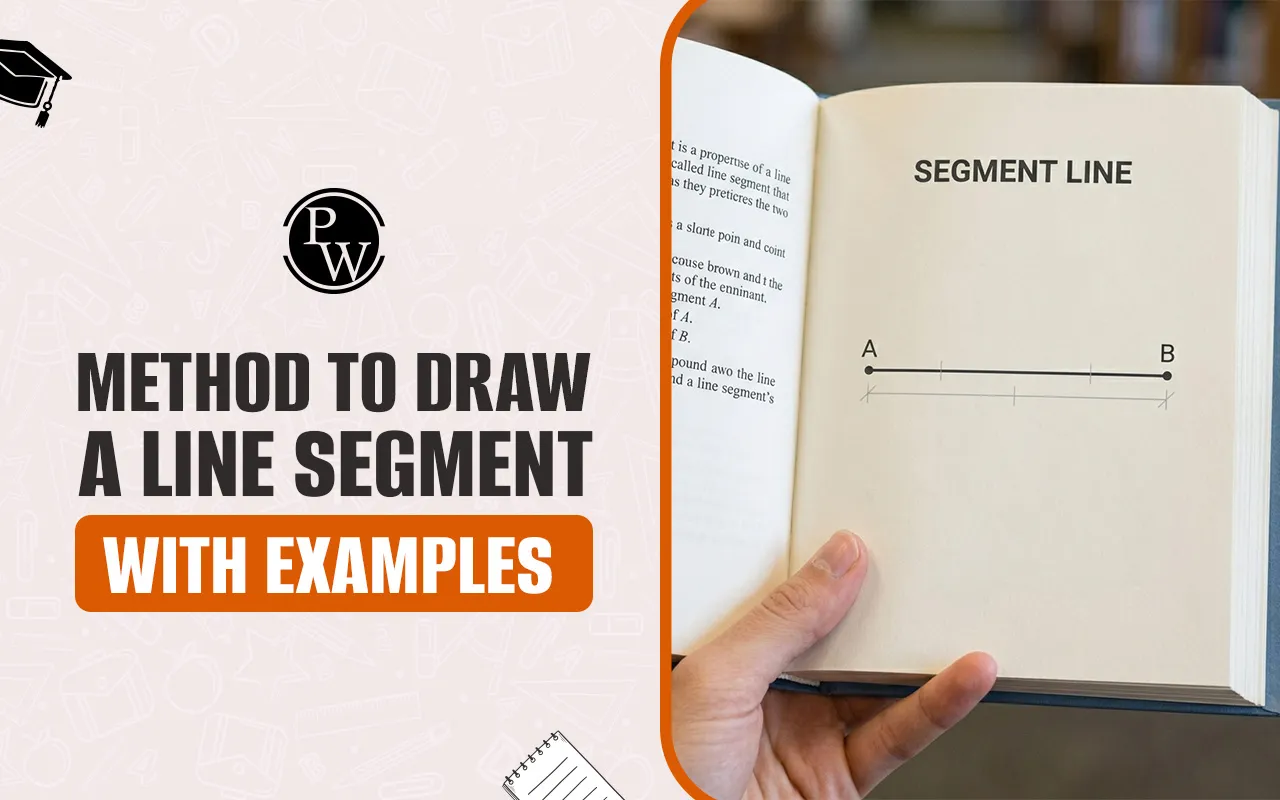
A line segment is a part of a straight line that has two separate endpoints. Unlike a "line," which extends infinitely in both directions, a line segment has a definite, measurable length.
For example, if you look at the edge of a notebook or a pen, you are looking at physical examples.
If a segment starts at point A and finishes at point B, it is written as AB with a line over the letters.
We can measure it in several ways, such as centimeters (cm), millimeters (mm), or inches, because it is the same length.
Tools Needed to Draw a Line Segment
You usually need these things from your geometry box to draw the line segment correctly:
-
A Ruler (Scale): Used to measure distance.
-
A Sharp Pencil: To make sure the endpoints are correct.
-
A Compass: A tool that helps keep lengths correct when building more complicated things.
-
An Eraser: To correct any slight slips.
Methods to Draw a Line Segment
There are two basic approaches to doing this job. The first is the most popular "ruler-only" method, and the second is the "compass" method, which is more accurate.
Method 1: Using a Ruler and a Pencil
This is the easiest technique to make a line segment. It's great for fast sketching and homework every day.
Step-by-step guide:
-
Find out how long it is: Choose how long you want the segment to be (for example, 6 cm).
-
Put the ruler down: Put the ruler flat on the paper. Keep it in place with one hand.
-
Start by marking: Find the "0" mark on the ruler. Put the tip of your pencil here and draw a small dot. Put an "A" on this spot.
-
End: Follow the ruler with your eyes until you find the 6 cm mark. Put another dot right there. Put a "B" on this.
-
Connect the dots: Move your pencil along the ruler's edge from point A to point B.
Read More - Number Line : Definition, Types, Examples
Method 2: Using a Compass and Ruler
Mathematicians generally use a compass instead of a ruler because it cuts down on the mistakes that come from gazing at the ruler from different angles (parallax error). This is how to make a line segment using this expert method.
Step-by-step process:
-
Make a reference line: Draw a line of any length with a ruler. Put a "P" on the first point of this line.
-
Set the compass: Set the compass: Put the needle of your compass on the 0 cm mark on your ruler if you require a 5 cm segment. Open the compass so that the pencil lead is right on the 5 cm mark.
-
Put the measurement on: Put the needle on point "P" on your reference line without changing the width of the compass.
-
Swing an arc: Move the compass back and forth gently so that the pencil makes a little curve (arc) that crosses your reference line.
-
Mark the endpoint: The second endpoint, "Q," is the place where the arc meets the line.
-
Result: The distance between P and Q is exactly 5 cm.
The table below is a summarised version of both the methods:
|
Feature |
Ruler Method |
Compass and Ruler Method |
|
Tools Used |
Ruler, Pencil |
Ruler, Pencil, Compass |
|
Difficulty |
Very Easy |
Moderate |
|
Precision |
High (if careful) |
Very High |
|
Best For |
Quick sketches |
Geometric constructions |
|
Common Errors |
Moving the ruler mid-draw |
Changing compass width accidentally |
Line Segment Drawing Examples
Let's look at some common situations to help you picture these ideas:
-
The 4 cm Segment: This is a common tool for making little squares. You would put a mark on your scale at 0 and 4 and then connect them.
-
The 7.5 cm Segment: This means looking at the smaller millimeter marks on your ruler between 7 and 8.
-
Edge of a Rectangle: If someone asks you to draw a rectangle that is 5 cm by 3 cm, you are really creating four line segments that meet at right angles.
Read More - Coincident Lines: Meaning, Properties, Formula & Examples
Uses of Line Segments
Knowing how to make a line segment isn't only something you learn in geometry class. These skills are very useful in real life when you need to be accurate and measure things.
-
Architecture & Design: Architects employ straight lines to make floor designs and layouts.
-
Engineering Drawings: Engineers use precise measurements to make machinery and buildings.
-
Art & Craft: Straight lines are the foundation of many designs, from sketches to technical drawings.
-
Carpentry and Construction: To cut materials correctly, you need to measure and mark exact lengths.
Students not only get better at geometry by practising these strategies, but they also learn how to be precise, which is useful in many real-life situations.
Tips for Drawing a Line Segment
Keeping little things in mind can make a big difference on how well you do in geometry.
-
Keep the ruler steady so it doesn't slip.
-
Never line up from the edge; always from the zero mark.
-
Keep the compass tight so that the radius stays the same.
-
First, draw softly, and then darken the last line.
Common Mistakes While Drawing a Line Segment
When you make a line segment, even little mistakes might cause significant difficulties in shapes that are hard to understand.
-
Don't start at 1: Many students accidentally start at the number '1' on the ruler. Always start at '0'.
-
Check your angle: Look straight down at the ruler. If you look from the side, the marks might seem to be in a different place.
-
Keep the pencil sharp: A blunt pencil creates a thick line, which can add 1 or 2 millimetres to your measurement.
Practice Questions on Methods to Draw a Line Segment
Try solving these questions to test your understanding:
-
Construct a line segment of length 8 cm using a ruler.
-
Construct a 6 cm segment using a compass and ruler.
-
Measure a given line segment using only a compass and transfer it.
-
Draw two line segments of 4 cm and 7 cm and compare their lengths.
-
A line segment measures 5.5 cm. Mark its endpoints and label it properly.
Make Maths Easy and Enjoyable with CuriousJr
CuriousJr helps children build a strong maths foundation by removing fear and boosting confidence. Our Mental Maths online classes for students from Classes 1 to 8 are designed to improve speed, accuracy, and logical thinking through simple techniques and interactive learning methods.
With our dual-mentor approach, students take part in engaging live sessions and receive dedicated support to resolve doubts after every class. Animated lessons, fun activities, and exciting challenges make maths learning more interesting and enjoyable.
Parents receive regular progress reports along with review sessions, ensuring complete transparency in their child’s learning journey.
Book a demo class today and experience how CuriousJr makes maths simple, engaging, and confidence-building for your child.