Congruence in Triangles - Meaning, Conditions, Examples
 Nikita Aggarwal19 Jan, 2026
Congruence in Triangles
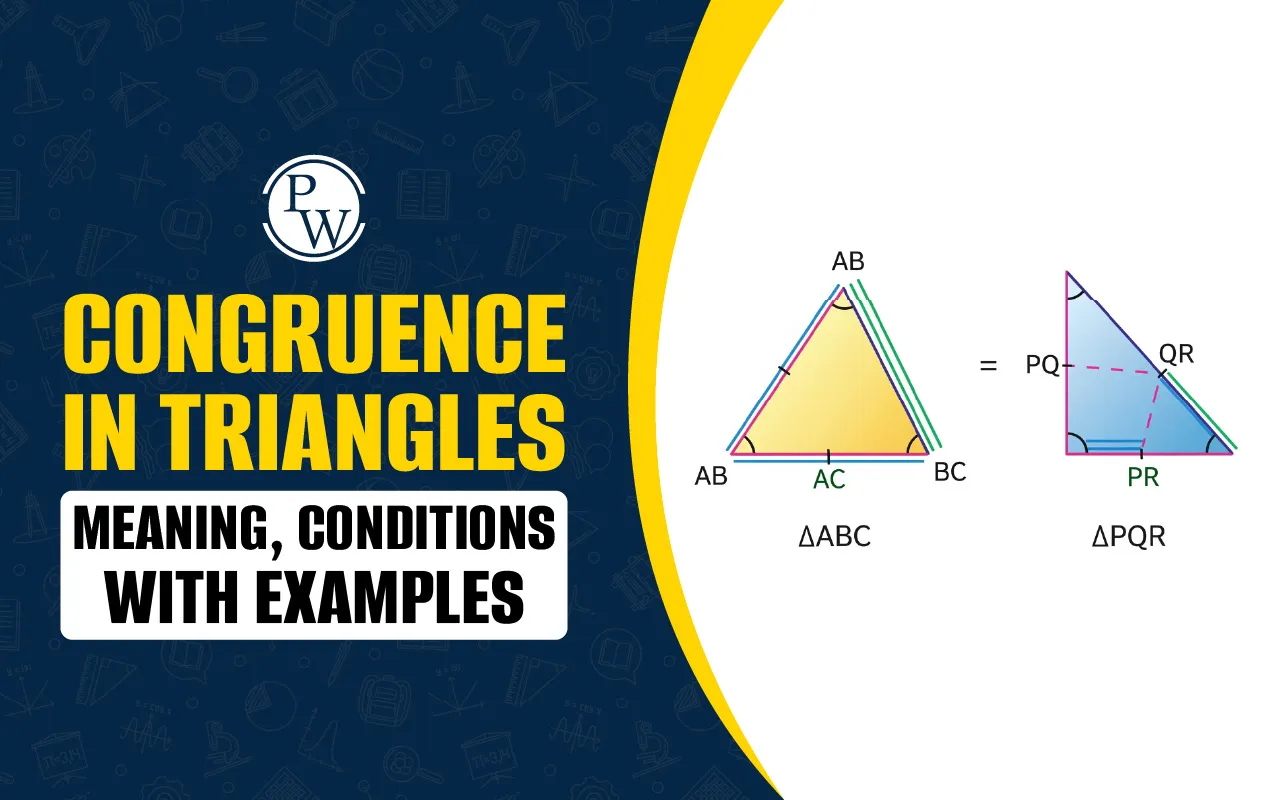
Congruence in triangles means two triangles are exactly the same in size and shape, even if they are flipped or rotated.
If two triangles are congruent, they overlap perfectly when placed on each other. This means:
-
Their corresponding sides are equal in length.
-
Their corresponding angles are equal in measure.
In geometry, the symbol “≅” is used to denote congruence. For example, if triangle ABC is congruent to triangle PQR, we write it as ΔABC ≅ ΔPQR
Conditions for Congruence of Triangles
The conditions for congruence of triangles are based on the information about the sides and angles of two triangles. Certain specific conditions must be satisfied to prove congruence in triangles. Let’s explore them one by one:
Side-Side-Side (SSS) Criterion
If all three sides of one triangle are equal to the three corresponding sides of another triangle, then the two triangles are congruent.
Example: If in ΔABC and ΔEFG, we have:
-
AB = EF
-
BC = FG
-
AC = EG
Then ΔABC ≅ ΔEFG
This condition ensures that the triangles have the same size and shape.
Side-Angle-Side (SAS) Criterion
If two sides of one triangle and the angle between them are equal to the corresponding sides and included angle of another triangle, the two triangles are congruent.
Example: If in ΔABC and ΔPQR,
-
AB = PQ
-
BC = QR
-
∠ABC = ∠PQR
Then ΔABC ≅ ΔPQR.
This rule works because the included angle fixes the position of the third side.
Also read: Straight angle
Angle-Side-Angle (ASA) Criterion
If two angles and the side attached to them in one triangle are equal to the corresponding angles and included side in another triangle, then the triangles are congruent.
Example: If in ΔABC and ΔPQR,
-
∠ACB = ∠PRQ
-
∠ABC = ∠PQR
-
BC = QR
Then ΔABC ≅ ΔPQR.
This rule works because the equal angles and sides fix the shape of the triangles.
Angle-Angle-Side (AAS) Criterion
If two angles and a side not included between them in one triangle are equal to the corresponding two angles and a side in another triangle, then the triangles are congruent.
Example: If in ΔABC and ΔPQR,
-
∠ABC = ∠PQR
-
∠ACB = ∠PRQ
-
AC = PR
Then ΔABC ≅ ΔPQR.
Also read: Parallelogram
Right Angle-Hypotenuse-Side (RHS) Criterion
This is a special case of congruence for right-angled triangles. If the hypotenuse and one of the sides of a right-angled triangle are equal to the hypotenuse and corresponding side of another right-angled triangle, then the triangles are congruent.
Example: If in ΔABC and ΔPQR,
-
∠ABC = ∠PQR = 90°
-
AC = PR (hypotenuse)
-
BC = RQ (one side)
Then ΔABC ≅ ΔPQR.
This condition is particularly useful in solving right-angled triangle related problems based on Pythagoras theorem.
Congruence in Triangles Properties
When two triangles are found to be congruent, we can establish their properties based on the CPCT (Corresponding Parts of Congruent Triangles) concept. This concept states the corresponding parts of congruent triangles are equal. This means if ΔABC ≅ ΔDEF, then:
-
AB = DE
-
BC = EF
-
AC = DF
-
∠BAC = ∠EDF
-
∠ACB = ∠EFD
-
∠ABC = ∠DEF
Also read: Construction in Maths
Congruent Triangle Examples
After understanding what is triangle congruence and its conditions, let us, let’s now look at some congruent triangle examples to strengthen the concept:
-
In ΔABC and ΔDEF, AB = DE = 6 cm, AC = DF = 5 cm, and ∠A = ∠D = 50°. Prove that the triangles are congruent.
Solution:
In ΔABC and ΔDEF:
AB = DE (6 cm = 6 cm)
AC = DF (5 cm = 5 cm)
∠A = ∠D (50° each)
Two sides and the included angle (between them) are equal.
Hence, by the SAS congruence rule, ΔABC ≅ ΔDEF.
-
In ΔPQR and ΔXYZ, ∠P = ∠X = 40°, ∠Q = ∠Y = 75°, and PQ = XY = 7 cm. Prove the triangles are congruent.
Solution:
In ΔPQR and ΔXYZ:
∠P = ∠X = 40°
∠Q = ∠Y = 75°
PQ = XY = 7 cm (side between the angles)
Two angles and the included side are equal.
Therefore, by the ASA congruence rule,
ΔPQR ≅ ΔXYZ.
3. In ΔLMN and ΔPQR, ∠L = ∠P = 60°, ∠M = ∠Q = 80°, and side LN = PR = 9 cm. Are the triangles congruent?
Solution:
In ΔLMN and ΔPQR:
∠L = ∠P = 60°
∠M = ∠Q = 80°
LN = PR = 9 cm (a non-included side)
Two angles and one non-included side are equal.
Therefore, by the AAS congruence rule,
ΔLMN ≅ ΔPQR.
4. Two right triangles, ΔABC and ΔDEF, have ∠B = ∠E = 90°. Also, AC = DF = 10 cm (hypotenuse), and AB = DE = 6 cm. Prove the triangles are congruent.
Solution:
In ΔABC and ΔDEF:
∠B = ∠E = 90°
Hypotenuse AC = DF = 10 cm
One side AB = DE = 6 cm
In right triangles, if the hypotenuse and one side are equal, the triangles are congruent.
Therefore, by the RHS congruence rule,
ΔABC ≅ ΔDEF.
Congruence in Triangles Interesting Facts
Here are some interesting facts about congruent triangles
-
Congruent Triangles are exact replicas of each other.
-
Congruent triangles may be in different orientations but perfectly superimposed by moving, rotating, or flipping.
-
The areas of congruent triangles are always the same.
-
The congruence in triangles concept effectively helps in identifying many important properties of triangles.
The concept of congruence in triangles is based on the idea that two triangles are identical in shape and size. Different conditions demonstrate the relationships between the sides and angles between two triangles that conform the congruence in triangles.
Also read: Vertex Formula
Make Your Child Quick & Confident in Maths with CuriousJr
Do you notice your child still using fingers, calculators, or rough work for even the simplest sums? This slows them down and lowers their confidence.
With CuriousJr’s Mental Maths Online Classes, children learn 50+ mental math tricks that make problem-solving quicker and smarter.
What your child gets:
-
Live interactive classes with engaging methods
-
Personal teacher guidance at every step
-
Homework and doubt-solving support
-
Daily progress tracking to see improvement
-
Games, shortcuts, and real-life examples to make Maths enjoyable.
Book a demo class today to know more about our classes.