Additive Identity Property: Definition, Formula, Examples
 Nikita Aggarwal27 Apr, 2026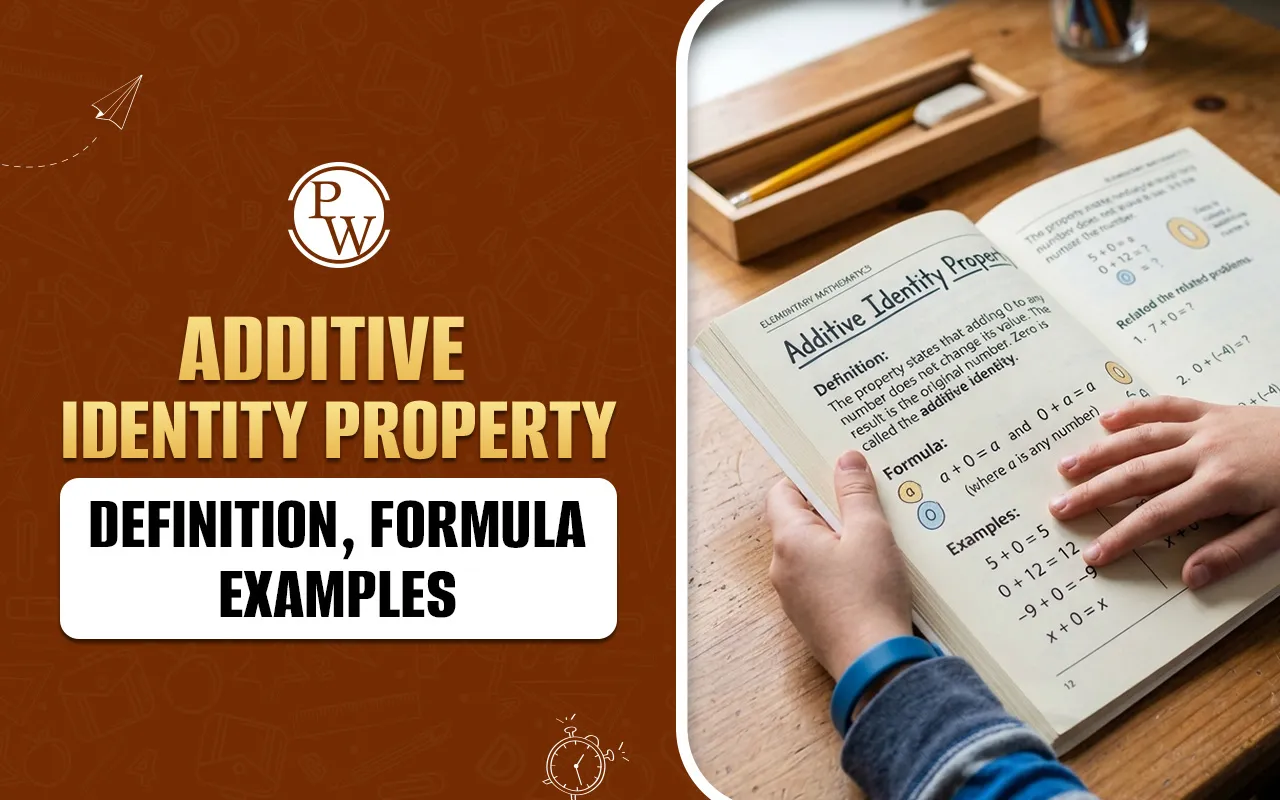
What is Additive Identity Property?
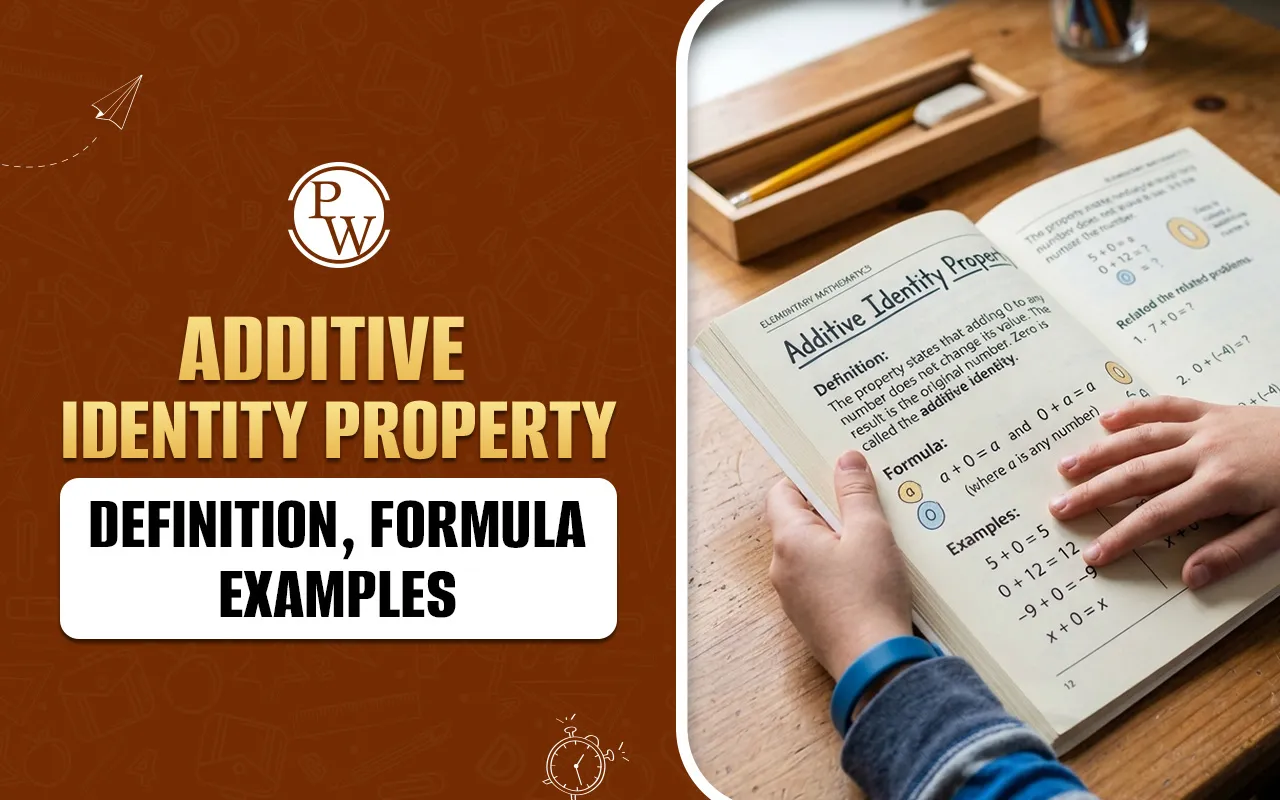
In math, "identity" means a value that doesn't change when you do something to it. The additive identity is a number that, when added to any real number, provides the same number as the sum.
That special number is 0 (zero).
Adding zero to a huge billion-dollar number or a tiny decimal will never change the initial number. This is why people call zero the "Additive Identity." This is the only number that has this property.
The zero property of addition is another name for the additive identity. This is because adding zero to any number does not change its value.
The formal additive identity property definition says that the sum of any real number and zero is that number. This property is true for many collections of numbers, such as:
-
Natural numbers: (1, 2, 3...)
-
Whole numbers: (0, 1, 2, 3...)
-
Integers: (−2, −1, 0, 1, 2, etc.)
-
Decimal and Rational numbers: (1/2, 0.5, -3.4...)
Many algebraic equations would be hard to simplify without this characteristic. It gives mathematicians a starting point from which they can change equations without changing their value.
Additive Identity Property Formula
To make things easier to remember, we use a simple formula. If we let "a" represent any real number, the property can be expressed as follows:
a + 0 = a
0 + a = a
In this equation:
-
a is any number (integer, fraction, or decimal).
-
0 is the additive identity.
-
The sum is equal to the original value of a.
This formula shows that the order of addition does not matter. Whether zero comes first or second, the result remains the original number.
Additive Identity Property in Subtraction
The additive identity is mostly about addition, but it also has a link to subtraction.
a − 0 = a ✔️ (The number stays the same)
0 − a ≠ a ❌ (The number changes)
For example:
10 − 0 = 10 ✔️
0 − 10 = -10 ❌
This shows that the identity property doesn't always work with subtraction, especially when the order changes. This is a common point where students get confused, so it is important to remember this distinction.
Why is Zero the Additive Identity Property?
You might wonder why other numbers don't work this way. If you add 1 to 5, you get 6. The "identity" of 5 has changed. If you subtract 1, you get 4. Again, the value is different. Only zero allows a number to remain exactly as it was.
In higher-level mathematics, this is a core part of "Identity Elements." Every operation (like multiplication or addition) has an element that leaves things unchanged. In addition, that element is always zero.
Additive Identity Property Examples
Let’s look at how this works in different scenarios. Seeing the examples in action helps solidify your understanding.
1. Working with Whole Numbers
If you have 15 apples and someone gives you 0 more, you still have 15 apples.
-
Example: 15 + 0 = 15
2. Working with Negative Integers
The property works exactly the same way with negative numbers. The sign does not change.
-
Example: (-42) + 0 = -42
3. Working with Fractions
Fractions can look intimidating, but the rule remains consistent.
-
Example: 3/4 + 0 = 3/4
4. Working with Decimals
Even with complex decimals, adding zero results in the original decimal.
-
Example: 12.85 + 0 = 12.85
5. Algebraic Expressions
In algebra, we often use variables. The property helps simplify expressions.
-
Example: (x + y) + 0 = x + y
Read More - Subtraction Property of Equality: Definition, Formula & Examples
Additive Identity Property vs. Other Properties
It is easy to confuse the additive identity with other rules, like the additive inverse. The table below clarifies the differences.
|
Property Name |
Definition |
Formula |
Example |
|
Additive Identity |
Adding 0 keeps the number the same. |
a + 0 = a |
8 + 0 = 8 |
|
Additive Inverse |
Adding a number's opposite results in 0. |
a + (-a) = 0 |
8 + (-8) = 0 |
|
Multiplicative Identity |
Multiplying by 1 keeps the number the same. |
a * 1 = a |
8 * 1 = 8 |
|
Commutative Property |
Order of addition does not change the sum. |
a + b = b + a |
2 + 3 = 3 + 2 |
Additive Identity Property in Different Number Systems
The beauty of the additive identity is its versatility. It isn't just for basic counting numbers.
Complex Numbers
In advanced maths, we deal with complex numbers (numbers with an imaginary part). Even here, the identity is 0 (specifically 0 + 0i).
-
(5 + 3i) + 0 = 5 + 3i
Rational and Irrational Numbers
Whether it is the square root of 2 or a simple fraction like 1/3, the rule is set in stone.
-
√2 + 0 = √2
-
0.333... + 0 = 0.333...
Read More - Closure Property – Definition, Formula, Addition, Multiplication, Division
Common Mistakes in Additive Identity
While the additive identity is simple, students often trip up on these specific points:
-
Confusing Identity with Inverse: Many students think the additive identity of 5 is -5. That is incorrect. -5 is the inverse because it brings the sum to zero. The identity is 0 because it keeps the 5 as a 5.
-
Confusing Addition with Multiplication: The additive identity is 0, but the multiplicative identity is 1. If you multiply a number by 0, it becomes 0, which changes the number’s identity.
-
Negative Signs: Some think that 0 might change the sign of a negative number. It doesn't. -7 + 0 is still -7, not +7.
Why is Additive Identity Important?
You might ask, "Why do we need a name for adding zero?" In mathematics, proving that a solution exists often requires using these basic properties. When solving an equation like x + 5 = 5, knowing the additive identity allows you to see immediately that x must be 0.
It also helps in computer programming and data science. Zero acts as a "neutral" element in algorithms, allowing programs to initialize sums without affecting the final outcome of the data being processed.
Additive Identity Property Short Summary
-
The additive identity property in maths says that adding zero to any number gives you that same number.
-
The number 0 is the only additive identity.
-
The additive identity formula is a + 0 = a.
-
This property works for all real numbers, like integers, fractions, and decimals.
-
It is different from the additive inverse, which is the number you add to get zero.
You will have a better understanding of algebra and more advanced arithmetic subjects if you learn this property well, you will understand algebra and more advanced arithmetic topics better. It is one of the "laws" of numbers that makes sure that every calculation you do is the same.
Additive Identity Practice Questions
Use these short questions to test your understanding:
-
What is the additive identity of -9?
-
Is it true or false that 0 + a = 0?
-
25 plus what equals 25?
Make Maths Easy and Fun with CuriousJr
CuriousJr helps children build a strong foundation in maths by removing fear and boosting confidence. Our Mental Maths online classes for students from Classes 1 to 8 are designed to improve speed, accuracy, and logical thinking through simple techniques and interactive learning.
With a dual-mentor approach, students attend engaging live classes and receive dedicated support to clear their doubts after every session. Animated lessons, fun activities, and exciting challenges make maths learning more enjoyable and interesting.
Parents are regularly updated with progress reports and review sessions, ensuring full visibility into their child’s learning journey.
Book a demo class today and see how CuriousJr makes maths simple, engaging, and confidence-building for your child.