Not Equal - Definition, Importance, Examples
 Nikita Aggarwal15 Apr, 2026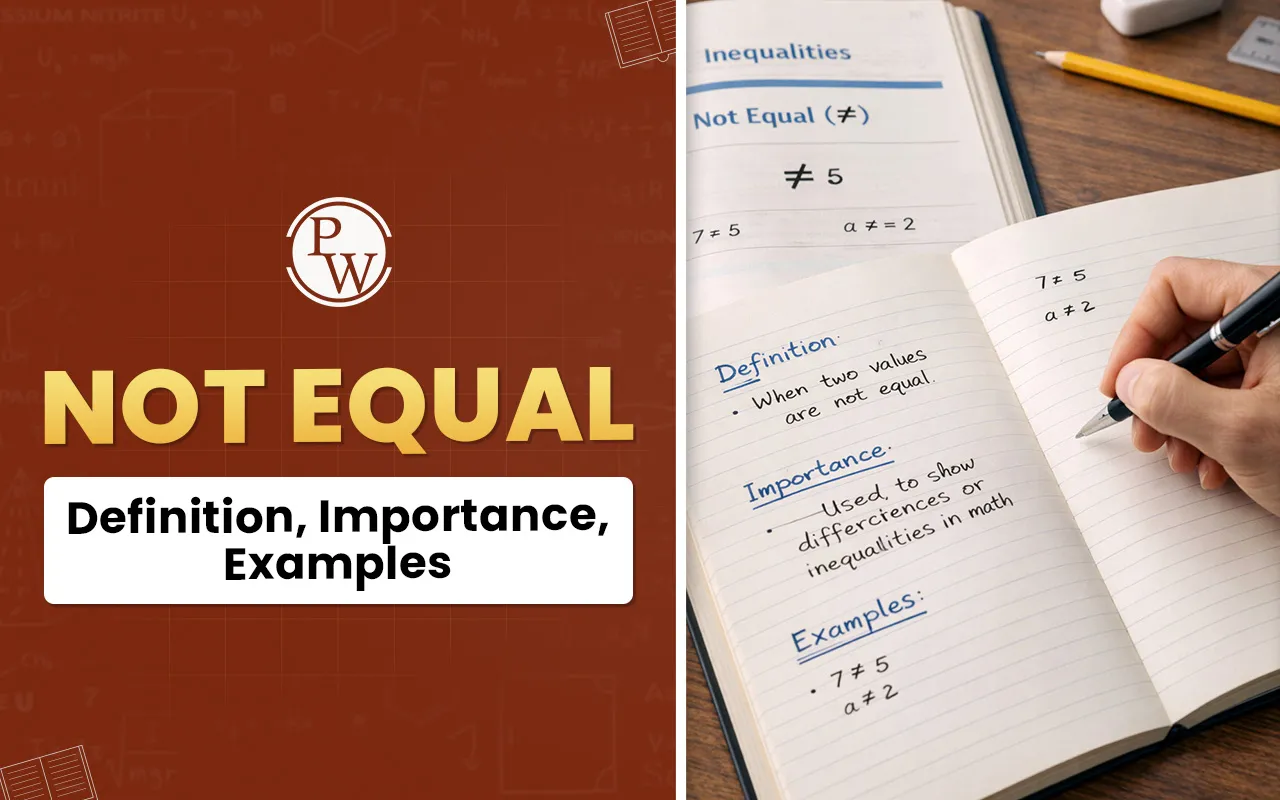
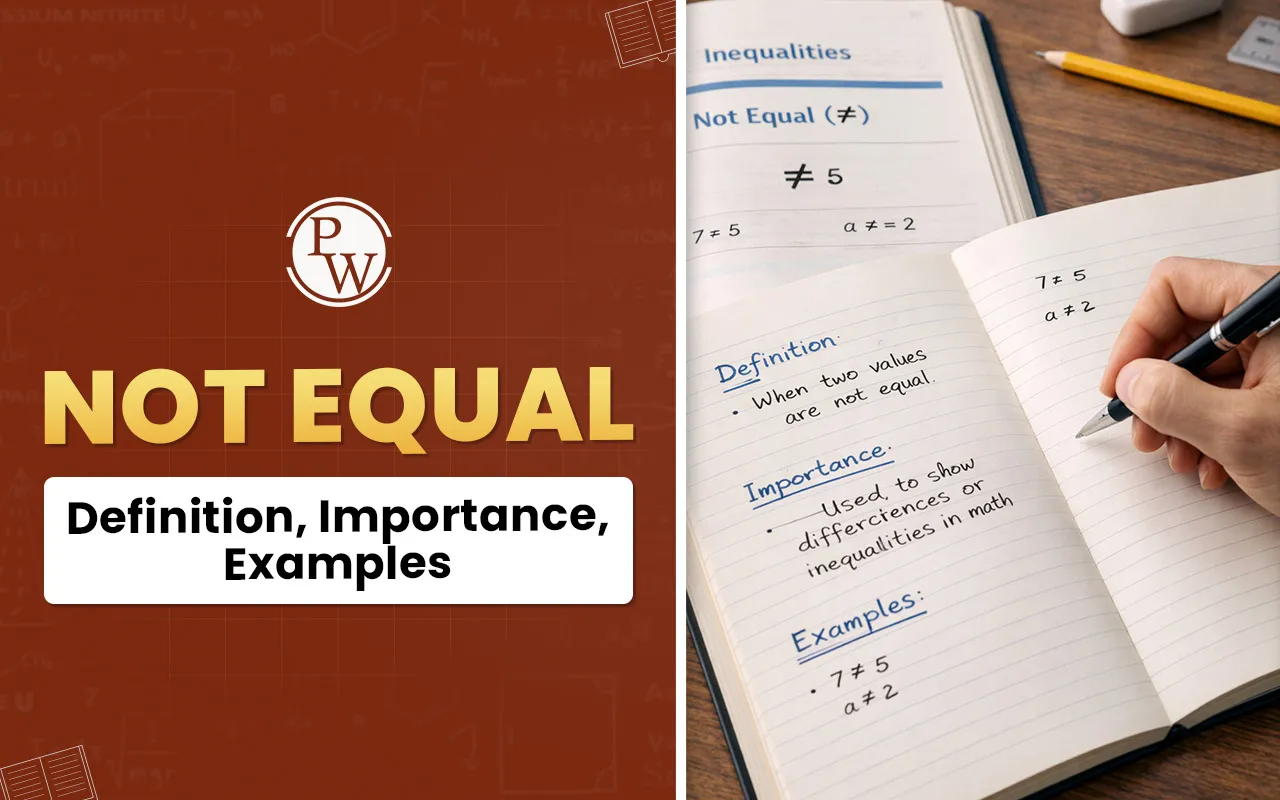
What is Not Equal?
To understand the not equal definition, we first have to look at its more famous sibling: the equals sign (=). The equals sign tells us that two quantities have the exact same value. When we place a forward slash through those two parallel lines (≠), we create the not equal sign.
This sign essentially says "no" to equality. Two numbers, such as 5 and 10, have different meanings. Therefore, we use the symbol 5 ≠ 10 to express a true statement. The term "not equal" refers to the fact that the two items under comparison differ in terms of size, value, or quantity.
Importance of Not Equal in Mathematics
You may be wondering why we need a certain symbol to indicate that something is different. The significance of inequality is found in its capacity to impose limitations and requirements..
-
Defining Domains: This symbol is used in higher maths to indicate what a number cannot be. For example, because division by zero is undefined, the denominator in a fraction is unequal to zero.
-
Logic and Reasoning: It helps in proving what is true by identifying what is false.
-
Data Comparison:In statistics, it is often more important to know that two data sets are different than to know that they are the same.
-
Programming: Computers rely on "if-then" logic. A program might run only if a user's input is unequal to a specific restricted value.
By using this symbol, mathematicians can set rules that keep calculations accurate and logical. It gives you a clear way to show that things that are not equal without having to say that one side is "greater than" or "less than" the other.
How to Represent Not Equal?
While the standard symbol is the crossed-out equals sign (≠), there are several ways to represent this concept depending on the medium you are using.
1. The Standard Mathematical Symbol
In your notebooks and textbooks, you will always see the symbol (≠). It is universally recognised in schools across the globe.
2. Not Equal in Computer Programming
Computers sometimes struggle with special symbols. Because of this, programmers use different keyboard characters to represent the not equal definition.
-
!= : Used in languages like C, C++, Java, and Python.
-
<> : Used in SQL and some older versions of BASIC.
-
!== : Used in JavaScript to check for both value and type.
3. Typing the Symbol on a Keyboard
Since the (≠) sign isn't on a standard keyboard, you can use shortcuts:
-
Windows: Hold Alt key and type 8800 on number pad.
-
Mac: Press Option + = (the equals sign).
-
Word Processors: You can often find it in the "Insert Symbol" menu.
Read More - Terminating Decimals
Practical Not Equal Examples
To truly grasp what is not equal, let’s look at some clear examples that compare numbers, fractions, and expressions.
Basic Number Comparisons
-
9 ≠ 4: Nine is worth more than four, so they are not the same..
-
-3 ≠ 3: The number is the same, but one is negative and the other is positive. Their spots on a number line are not the same..
-
0.5 ≠ 0.05: Decimal placement changes the value entirely.
Geometric and Measurement Examples
-
A Square ≠ A Triangle: These shapes have a different number of sides and angles on the inside.
-
1 Kilometre ≠ 1 Metre: While they both measure distance, their scale is vastly different.
-
60 Minutes ≠ 100 Seconds: These represent different durations of time.
Algebraic Expressions
Sometimes, expressions look different but might be equal, or they might look similar but are unequal.
-
2 + 2 ≠ 5: A classic example of an incorrect sum being identified by the symbol.
-
5 x 3 ≠ 5 + 3: Multiplying and adding the same numbers results in different outcomes (15 vs 8).
-
(4 + 1) ≠ (4 - 1): Changing the operator changes the result.
Read More - Substitution Method - Definition, Steps, Examples
Comparison Equal vs Not Equal
It is helpful to see these two concepts side-by-side to understand the not equal meaning in context.
|
Feature |
Equal (=) |
Not Equal (≠) |
|
Core Concept |
Balance and Identity |
Difference and Inequality |
|
Result |
Both sides are the same |
Both sides are different |
|
Example |
10 + 5 = 15 |
10 + 5 ≠ 20 |
|
Visual |
Two parallel lines |
Parallel lines with a slash |
Summary of Key Points
-
The symbol (≠) represents values that are different.
-
The not equal definition is the negation of equality.
-
It is used in maths, science, and computer coding (often as !=).
-
It is essential for defining limits and solving logical problems.