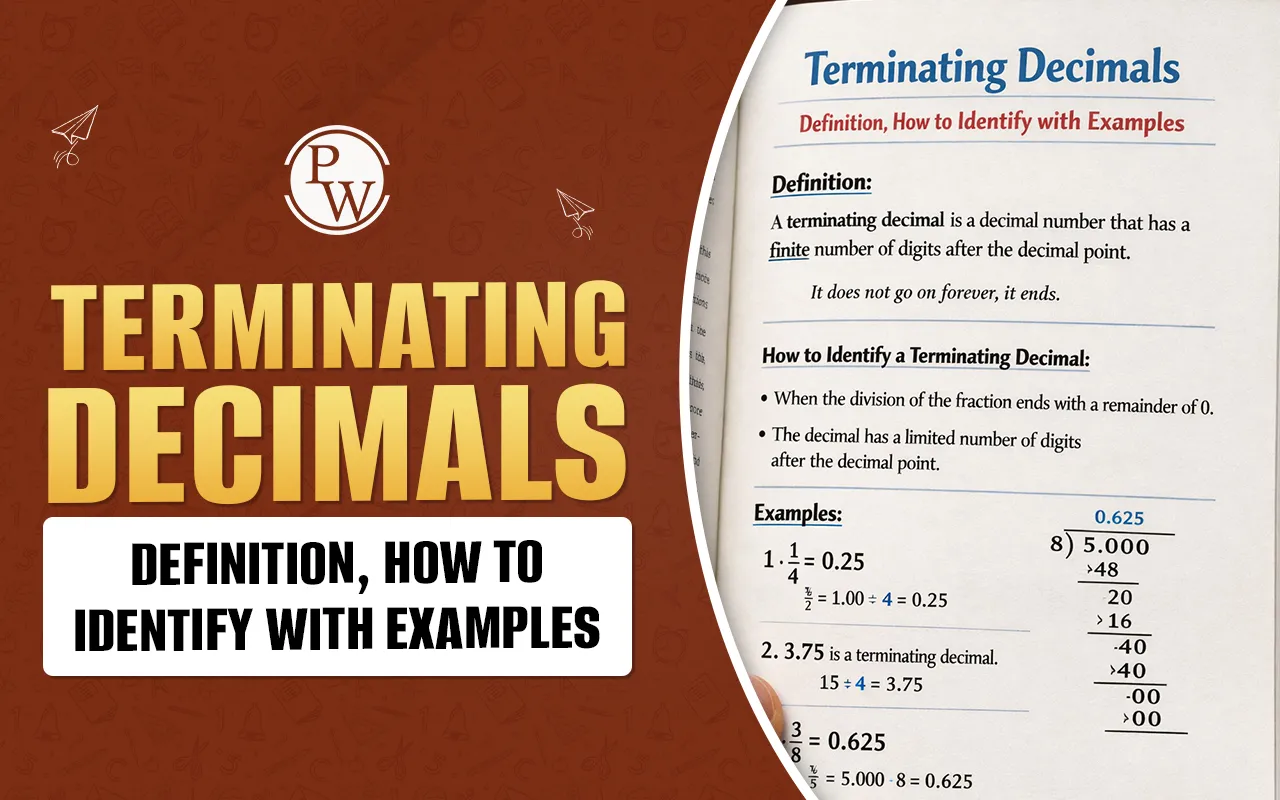
Terminating Decimals - Definition, How to Identify with Examples
 Nikita Aggarwal10 Apr, 2026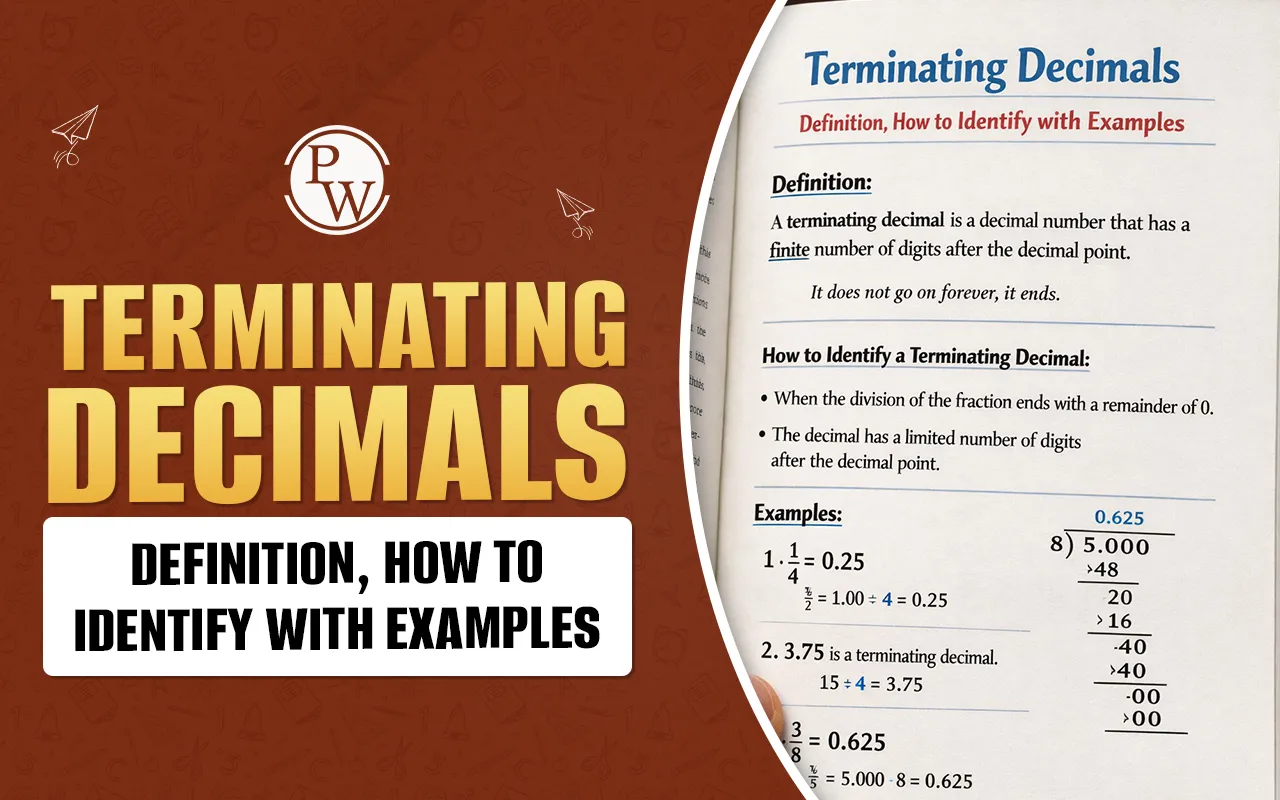
Definition of Terminating Decimal
A terminating decimal is a specific type of number that features a finite count of digits following the decimal point. In mathematics, decimals serve as a bridge to express whole numbers and fractions together, separated by a decimal point. For instance, in the number 10.4, "10" represents the whole value, while "4" represents the fractional part.
While decimals are generally categorised as terminating, non-terminating, and recurring, students primarily encounter terminating decimals when dealing with specific rational numbers. A number like 0.5 (from the fraction 5/10) is a perfect terminating decimal example because the digits stop immediately after the first place. Understanding this terminating decimal meaning is crucial for identifying which fractions will result in a clean, finite value versus those that repeat indefinitely.
How to Identify a Terminating Decimal?
You don't always need a calculator to determine if a fraction will result in a terminating or non-terminating decimal. There is a simple three-step rule to identify them:
-
Simplify the Fraction: Ensure the fraction is in its lowest terms (the numerator and denominator should have no common factors other than 1).
-
Prime factorisation: Look at the denominator and determine its prime factors.
-
The 2 and 5 Rule: If the prime factors of the denominator are only 2, only 5, or both 2 and 5, it is a terminating decimal. If any other prime factor (like 3, 7, or 11) appears, it is non-terminating.
Examples of the Identification Rule:
|
Fraction |
Simplest Form |
Denominator Factors |
Result |
|
3/20 |
3/20 |
2 \times 2 \times 5 |
Terminating |
|
7/25 |
7/25 |
5 \times 5 |
Terminating |
|
1/6 |
1/6 |
2 \times 3 |
Non-Terminating |
|
9/40 |
9/40 |
2 \times 2 \times 2 \times 5 |
Terminating |
Terminating Decimal Example
To better understand the terminating decimal meaning, let’s look at a few common examples found in school assignments.
-
0.125: This is a terminating decimal example. It ends after three decimal places. As a fraction, it is 1/8. The denominator 8 is 2 \times 2 \times 2, which fits our rule.
-
0.4: Simple and direct, this decimal ends after one digit. As a fraction, it is 4/10 or 2/5. Since the denominator is 5, it terminates.
-
0.85: The decimal stops after two digits. As a fraction, it is 17/20. The factors of 20 are 2 \times 2 \times 5, confirming it is terminating.
-
0.0625: This is the decimal form of the fraction 1/16. Since the denominator 16 is 2 \times 2 \times 2 \times 2 (only factors of 2), it results in a terminating decimal.
-
0.32: This value represents the fraction 8/25. Because the denominator 25 is 5 \times 5 (only factors of 5), it terminates after exactly two digits.
-
0.15: This common decimal represents the fraction 3/20. The prime factors of 20 are 2 \times 2 \times 5, which satisfies the rule for terminating decimals.
-
0.008: This is the decimal equivalent of 1/125. Since 125 is 5 \times 5 \times 5, the division stops after three decimal places.
-
0.55: This value comes from the fraction 11/20. Just like the previous examples, the presence of only 2 and 5 in the denominator's prime factorisation ensures that it is a terminating decimal in maths.
Read More - Decimal Worksheet for Students to Practice
How to Convert Fractions to Terminating Decimals?
The process of conversion is straightforward. You divide the numerator by the denominator using long division. Once the remainder hits zero, the decimal is complete.
For instance, to find the decimal for 3/8:
-
Divide 3 by 8.
-
3.0 divided by 8 is 0.3 with a remainder of 6.
-
60 divided by 8 is 7 with a remainder of 4.
-
40 divided by 8 is 5 with a remainder of 0.
-
Result: 0.375 (Terminating).
Read More - Decimal to Octal: Meaning, Conversion Steps
Key Tips For Terminating Decimal
Identifying and working with terminating decimals becomes much simpler when you keep these core mathematical principles in mind:
-
Finite Nature: By definition, every terminating decimal has a fixed or finite number of digits after the decimal point. It never repeats or continues forever.
-
Rational Connection: Any number that is a terminating decimal is always a rational number, as it can be written as a fraction where both the numerator and denominator are integers.
-
The Power of 2 and 5: A fraction will always result in a terminating decimal in maths if its denominator (in the simplest form) can be broken down into prime factors of only 2, only 5, or a combination of both (2^n \times 5^m).
-
Spotting Non-Terminating Numbers: If the denominator of a simplified fraction contains any prime factor other than 2 or 5 (such as 3, 7, or 11), the number will result in a non-terminating, recurring decimal rather than a terminating one.
Make Maths Easy and Enjoyable with CuriousJr
CuriousJr helps children build a strong foundation in maths by removing fear and boosting confidence. Our Mental Maths online classes for students from Classes 1 to 8 are designed to improve speed, accuracy, and logical thinking through simple techniques and interactive learning.
With our dual-mentor approach, students join engaging live sessions and receive personalised support to clear doubts after every class. Animated lessons, fun activities, and exciting challenges make maths easier to understand and more fun.
Parents stay updated with regular progress reports and review sessions, ensuring complete visibility into their child’s learning journey.
Book a demo class today and discover how CuriousJr makes maths simple, engaging, and confidence-building for your child.