NCERT Solutions for Class 8 Maths Chapter 11 Direct and Inverse Proportions
 Nikita Aggarwal10 Apr, 2026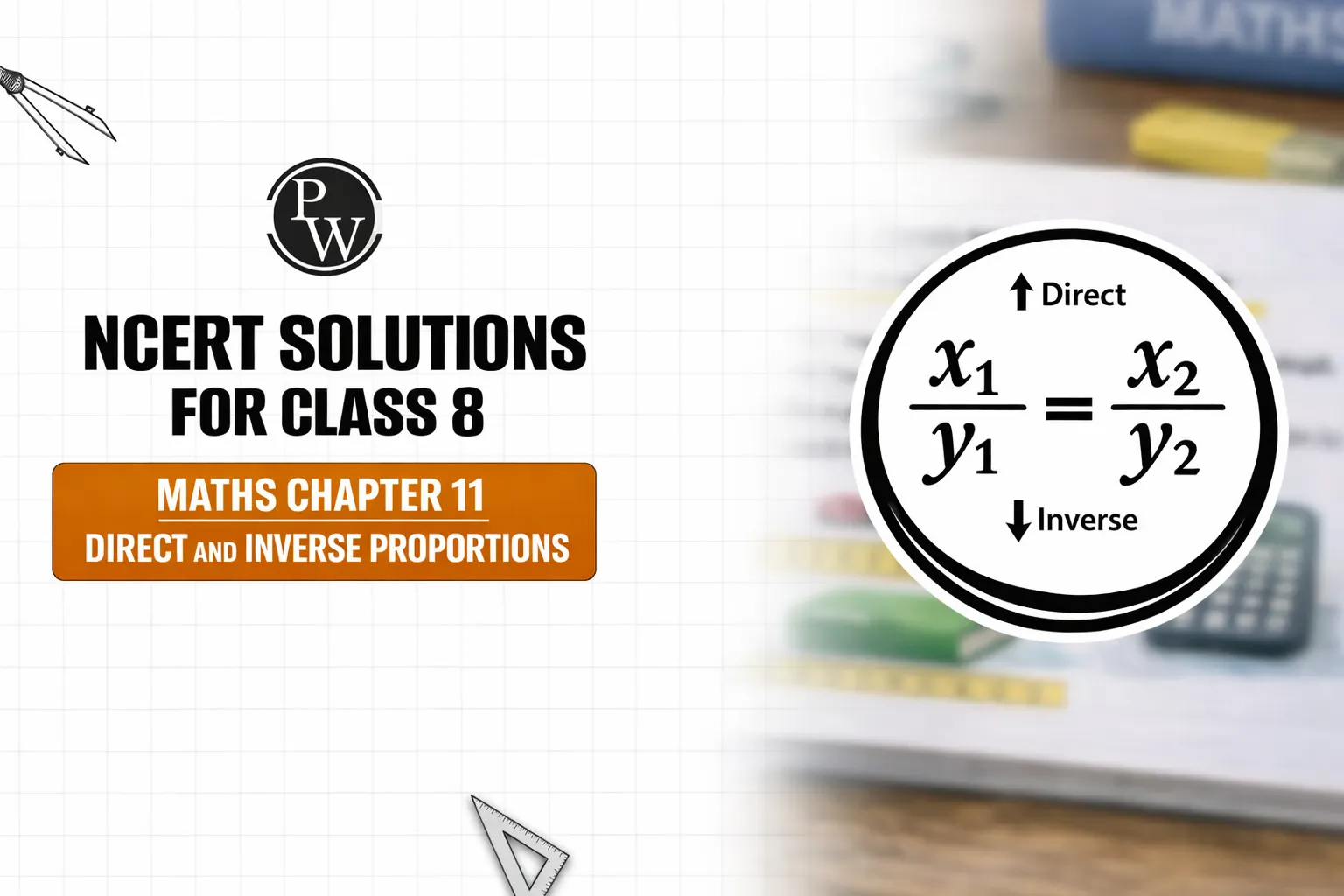
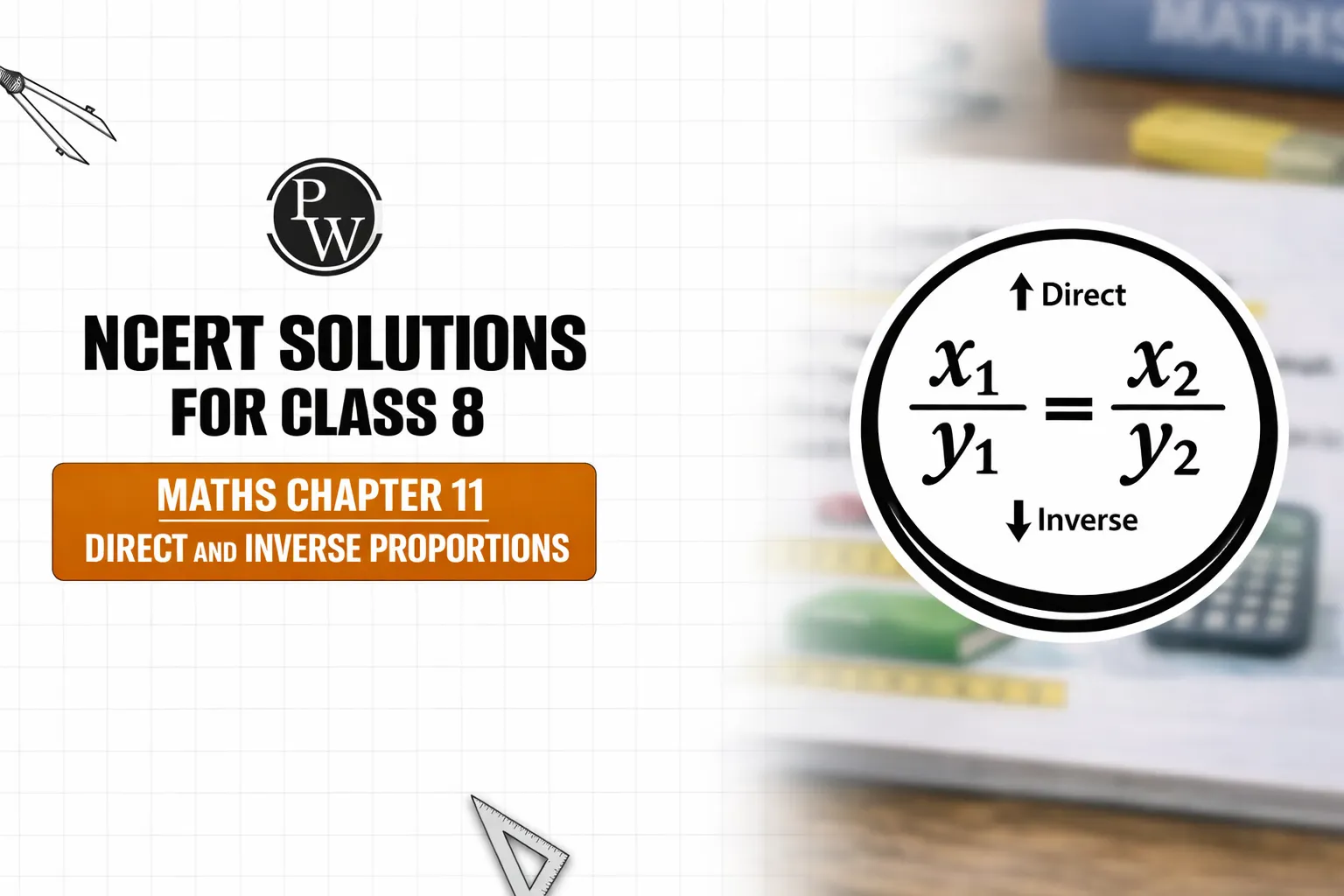
What are Direct and Inverse Proportions?
Direct Proportion
Two quantities are in direct proportion if one increases, the other increases at the same rate.
Formula: y ∝ x or y = k × x (k is constant)
Example: If 2 pens cost 20 units, 4 pens cost 40 units.
Inverse Proportion
Two quantities are in inverse proportion if one increases, the other decreases proportionally.
Formula: y ∝ 1/x or x × y = k (k is constant)
Example: If 4 workers complete a task in 8 days, 8 workers complete it in 4 day
Comparison Table for Chapter 11
Before starting your class 8 chapter 11 maths ncert solutions, use this table to pick the correct method:
|
Situation |
Type of Proportion |
Mathematical Rule |
|
Both values go up together |
Direct |
x1 / y1 = x2 / y2 |
|
One goes up, the other goes down |
Inverse |
x₁ × y₁ = x₂ × y₂ |
|
Price vs Quantity |
Direct |
Division Method |
|
Speed vs Time |
Inverse |
Multiplication Method |
Direct and Inverse Proportions Class 8 NCERT Solutions
Q1: A mixture of paint uses 1 part red pigment for every 8 parts base. Find the base for 4, 7, 12, and 20 parts of red pigment.
Solution: Red pigment and base are in direct proportion, so the ratio stays the same.
-
4 parts → 4 × 8 = 32 parts base
-
7 parts → 7 × 8 = 56 parts base
-
12 parts → 12 × 8 = 96 parts base
-
20 parts → 20 × 8 = 160 parts base
Q2: If 1 part red pigment needs 75 mL of base, how much pigment for 1800 mL of base?
Solution: Let red pigment = x. Using direct proportion:1 / 75 = x / 1800 → 75 × x = 1800 → x = 1800 ÷ 75 = 24
Answer: 24 parts of red pigment are needed.
Q3: A machine fills 840 bottles in 6 hours. How many in 5 hours?
Solution: Fewer hours → fewer bottles (direct proportion).
840 ÷ 6 = x ÷ 5 → x = (840 × 5) ÷ 6 = 700
Answer: The machine fills 700 bottles in 5 hours.
Q4: A bacteria photograph enlarged 50,000 times is 5 cm. What is the actual length? And if enlarged 20,000 times?
Solution:
-
Actual length = 5 ÷ 50,000 = 0.0001 cm
-
For 20,000 times: 5 ÷ 50,000 = x ÷ 20,000 → x = (5 × 20,000) ÷ 50,000 = 2 cm
Answer: Actual length = 0.0001 cm; enlarged length = 2 cm
Q5: Model ship mast = 9 cm; actual mast = 12 m. Ship length = 28 m. Model length?
Solution: Direct proportion: 9 / 12 = x / 28 → x = (9 × 28) ÷ 12 = 21
Answer: Model ship = 21 cm
Q6: 2 kg sugar contains 9,000,000 crystals. How many in 5 kg?
Solution: More sugar → more crystals. Using direct proportion: 2 / 9,000,000 = 5 / x → x = (5 × 9,000,000) ÷ 2 = 22,500,000
Answer: 2.25 × 10⁷ crystals
Read More - NCERT Solutions for Class 8 Maths Chapter 1 Rational Numbers
Q7: A box of sweets is shared among 24 children, 5 each. How many if 4 children leave?
Solution: Now 20 children. Fewer children → more sweets each (inverse proportion):
24 × 5 = 20 × x → 120 = 20 × x → x = 6
Answer: Each child gets 6 sweets
Q8: A farmer has enough food to feed 20 animals for 6 days. How long will it last if there are 10 more animals?
Solution: Now there are 20 + 10 = 30 animals. More animals will make the food run out faster.
We use the formula for inverse proportion:
20 × 6 = 30 × x
120 = 30 × x → x = 4
Answer: The food will last 4 days.
Q9: A factory uses 42 machines to make a certain number of articles in 63 days. How many machines are needed to make the same articles in 54 days?
Solution: Less time means more machines are needed. Let the number of machines be x.
42 × 63 = x × 54
2646 = 54 × x → x = 49
Answer: The factory needs 49 machines.
Q10: A loaded truck travels 14 km in 25 minutes. How far can it go in 5 hours at the same speed?
Solution: First, convert 5 hours into minutes: 5 × 60 = 300 minutes. Let the distance be x.
14 ÷ 25 = x ÷ 300
x = (14 × 300) ÷ 25 = 168
Answer: The truck will travel 168 km.
Q11. A canteen uses 6 kg of rice for 24 students. How much rice is needed for 40 students?
Solution: Since the number of students increases, the quantity of rice will also increase. So, this is a case of direct proportion.
6 / 24 = x / 40
x = (6 × 40) / 24
x = 10
Answer: The canteen will need 10 kg of rice.
Q12. A car travels 180 km in 3 hours at a steady speed. How far will it travel in 5 hours at the same speed?
Solution: Distance increases when time increases, so this is direct proportion.
180 / 3 = x / 5
x = (180 × 5) / 3
x = 300
Answer: The car will travel 300 km.
Read More - NCERT Solutions for Class 8 Civics Chapter 5 – Judiciary
Q13. If 8 notebooks cost ₹96, what will 15 notebooks cost at the same rate?
Solution: More notebooks will cost more money, so this is a direct proportion.
8 / 96 = 15 / x
x = (96 × 15) / 8
x = 180
Answer: 15 notebooks will cost ₹180.
Q14. A printing press produces 1,200 pamphlets in 8 minutes. How many pamphlets will it produce in 15 minutes at the same speed?
Solution: As time increases, the number of pamphlets printed also increases. So, this is direct proportion.
1200 / 8 = x / 15
x = (1200 × 15) / 8
x = 2250
Answer: The press will produce 2,250 pamphlets.
a
Tips To Solve Chapter 11 Class 8
To ensure you get the right class 8 chapter 11 maths question answer every time, follow these steps:
-
Draw a Table: Write your x and y values in a small 2×2 grid. This helps you keep the numbers organised and avoid mistakes.
-
Check the Relationship: Ask yourself, "If I double this number, what happens to the other?"
-
If it also doubles → direct proportion
-
If it halves → inverse proportion
-
Convert Units: Make sure both values use the same units. For example, 5 hours = 5 × 60 = 300 minutes before doing any calculations.
-
The "Reasonableness" Test: If you are solving an inverse problem (like speed) and your answer for "time taken" is higher than the original time despite a faster speed, you have used the wrong formula.
By applying these direct and inverse proportions class 8 NCERT solutions, you can turn wordy problems into simple arithmetic.
Make After-School Learning Fun and Effective with CuriousJr
CuriousJr School Online Classes help children stay engaged while building strong fundamentals through live interactive sessions, real-life examples, and enjoyable activities that make learning exciting.
With guidance from two dedicated mentors, every student receives personalized attention, ensuring better understanding and improved results. Our activity-based and visual teaching methods help children grasp concepts faster and more effectively. The curriculum is aligned with CBSE, ICSE, and State Boards, and includes regular quizzes, worksheets, and performance tracking to keep a close eye on progress.
CuriousJr provides complete learning support in Maths, Science, English, and Social Studies in a friendly and interactive environment. Book a demo class today and help your child learn with confidence.