NCERT Solutions for Class 7 English Chapter 5 – Golu Grows a Nose
 Shivam Singh15 Jan, 2026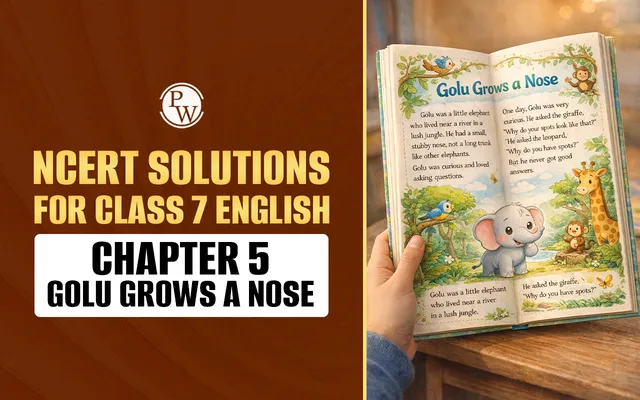
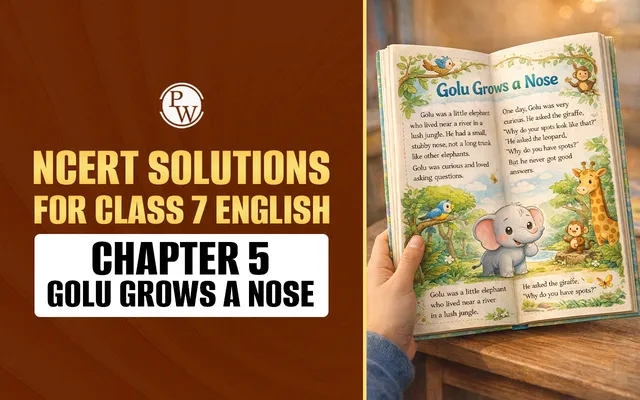
NCERT Solutions for Class 7 English Chapter 5
Golu Grows a Nose is Chapter 5 from the Class 7 English supplementary book An Alien Hand. The story is about a curious young elephant named Golu who always asks questions. He wants to know what the crocodile eats, so he goes to the Limpopo River to find the answer. This curiosity leads to an unexpected adventure that changes his life.
The chapter highlights important themes such as curiosity, learning through experience, and growth. Golu’s short nose is pulled by the crocodile, making it longer and stronger. Though the experience is painful at first, Golu soon realizes that his new long nose is very useful. It helps him pluck food, defend himself, and perform tasks more easily than before.
For Students searching for NCERT Class 7 English Chapter 5 question answer sets in clear and simple explanations. These Golu Grows a Nose NCERT solutions explain each question in easy language, helping students understand the story, characters, and moral lessons better.
Overall, Class 7 English Chapter An Alien Hand teaches students that curiosity leads to knowledge and that challenges often bring positive change. Practicing NCERT solutions helps improve comprehension and exam preparation.
NCERT Solutions for Class 7 English Chapter 5 Question Answers
Exercise (Page 34)
Answer the following Questions:
Question 1: Whom does Golu ask, “Why don’t you ever fly like other birds?”
Answer: Golu asks the ostrich why it doesn’t fly like other birds.
Question 2: Which uncle of Golu had red eyes?
Answer: Golu’s huge uncle hippopotamus had red eyes.
Question 3:
Golu’s relatives did not answer his questions because
(i) they were shy.
(ii) the questions were too difficult.
(iii) Golu was a naughty boy.
Answer:
(ii) The questions were too difficult.
Question 4: Who advised Golu to go to the Limpopo river?
Answer: The mynah bird advised Golu to go to the Limpopo river.
Question 5: Why did Golu go to the river?
Answer: Golu went to the Limpopo river to find out what the crocodile had for dinner.
Question 6:
The crocodile lay on the bank of the Limpopo river. Golu thought it was
(i) a living crocodile
(ii) a dead crocodile
(iii) a log of wood
Answer:
(iii) a log of wood.
Question 7: What did the crocodile do to show that it was a real crocodile?
Answer: The crocodile shed its false tears’ to show that it was a real one.
Question 8: “Come here, little one, and I’ll whisper the answer to you”. The crocodile said this because
(i) he couldn’t stand up.
(ii) he wanted to eat Golu.
(iii) Golu was deaf.
Answer:
(ii) he wanted to eat Golu
Question 9:
(i) Who helped Golu on the bank of the river?
Answer: The python helped Golu on the river bank. He saved Golu’s life from the crocodile.
Question 10: Name two things the elephant can do with his trunk, and two he cannot.
Answer: Two things the elephant can do with his trunk are:
(i) The elephant can keep away flies.
(ii) He can pull up things from below and take it to his mouth.
SHORT ANSWER TYPE QUESTIONS
Question 1: What do you know about Golu?
Answer: Golu was a baby elephant. He had a bulgy nose. He had no trunk. He was full of questions.
Question 2: Which bird directed Golu to go to the Limpopo river and why?
Answer: A mynah bird was sitting in the middle of a bush. Golu asked her what the crocodile ate at dinner. The mynah bird directed Golu to go to Limpopo river to find out the answer.
Question 3: What items of food did Golu take before leaving his home for Limpopo river?
Answer: He took a hundred sugarcanes, fifty dozen bananas and twenty five melons.
Question 4: How did Golu help the python?
Answer: Golu helped the python to coil around the branch of the tree again.
Question 5: What questions did Golu ask the python?
Answer: Golu met a python. He asked him three questions, (i) Have you ever seen a crocodile? (zz) What does a crocodile look like? (ra) What does a crocodile have for dinner?
Question 6: Why did the python help Golu?
Answer: Golu had helped the python to coil around the branch of a tree. The python felt grateful to him and quietly followed him. The python helped Golu when the crocodile caught him by the nose. He did not repay Golu for his goodness.
II. LONG ANSWER TYPE QUESTIONS
Question 1: Describe Golu’s meeting with the crocodile.
Answer: Golu reached the edge of Limpopo river. He saw a crocodile on it’s bank. The crocodile winked at Golu. Golu asked him if he was the crocodile. The crocodile raised his tail out of the mud. He was surprised why Golu asked him such a question. He shed crocodile tears. He asked Golu to come close. He would not answer the personal question. He would whisper the answer to his question. He would tell him what he had for dinner in a low tone. Golu put his head down close to the corcodile’s snout. The crocodile caught Golu by the nose. He declared that he would eat Golu that day, Golu screamed with fear and pain.
Question 2: What, according to the python, were the advantages of a long nose (trunk)?
Answer: A fly stung Golu on the shoulder. Golu hit the fly with his long nose (trunk). The fly lay dead Golu plucked a large bundle of grass, dusted it against his forelegs. He stuffed the grass into his mouth with the help of his long nose (trunk). The sun was very hot. Golu dug out some mud from the bank with the help of his long nose. He slopped the mud on his head. Golu could not do any of the above activities with a small nose. These were all the advantages of the long nose (trunk), according to the python.
Read More: English Grammar: A Complete Guide For Students
Master the Golu Grows a Nose Questions Answers Class 7 Exercises
Finding the right golu grows a nose questions answers class 7 requires looking closely at the interactions between Golu and the various animals he meets. Rudyard Kipling’s tale is not just a myth about how elephants got trunks; it is a lesson in inquiry. In the beginning, Golu had no trunk, only a bulgy nose as big as a boot. He asked his tall aunt, the ostrich, why she didn't fly like other birds. He questioned his tall uncle, the giraffe, about what made his skin so spotty. His curiosity knew no bounds, which often led him to ask "difficult" questions that the other animals couldn't answer.
When you study how golu grows a nose questions answers, you will notice that the turning point occurs when Golu meets the Myna bird. The bird suggests he go to the great, grassy Limpopo River to find out what the crocodile has for dinner. This journey is central to the chapter. We see Golu carrying sugarcanes, bananas, and melons for his trip. This level of detail is vital for students who want to score well. We often see that students who memorize the sequence of his journey find it much easier to tackle the golu grows a nose questions answers extra sections in their school exams.
Understanding Golu’s Curious Nature and the Myna’s Advice
Golu was full of questions. He didn't just stop at his aunts and uncles. He asked the hippopotamus why his eyes were always so red and the baboon why melons tasted like melons. The animals had no answers and called him a "naughty" baby elephant. This sets the stage for his encounter with the Myna bird.
The Myna bird gave Golu a specific direction. She told him to go to the banks of the Limpopo River. If you are looking for a golu grows a nose questions answers class 7, you should ensure it explains this interaction clearly. Golu didn't know what a crocodile looked like, nor did he know what they ate. This innocence is what leads him into a dangerous yet life-changing situation. He met a python first, who didn't answer his question but followed him quietly.
The Encounter at the Limpopo River
When Golu reached the edge of the river, he saw a "log of wood" which was actually the crocodile. The crocodile winked at him. Golu, being polite, asked if he had ever seen a crocodile. The creature crawled out of the mud and claimed he was the one Golu was looking for. To prove it, he shed "crocodile tears."
The crocodile asked Golu to come close so he could whisper his dinner menu. As Golu leaned in, the crocodile caught him by the nose. This is a vital part of the story. The crocodile declared that today, a baby elephant would be his dinner. This moment of tension is a favorite for examiners when they create golu grows a nose questions answers.
How Golu Got His Trunk
The struggle between Golu and the crocodile is intense. Golu sat back on his haunches and pulled. The crocodile pulled from the water. The python, who had been following Golu, arrived to help. He coiled himself around Golu’s stomach and told him to pull harder.
As they pulled, Golu’s nose began to stretch. It grew longer and longer. It hurt him a lot, but he didn't stop. Eventually, the crocodile let go. Golu sat there for two days, waiting for his nose to shrink and cool down. It cooled, but it never shrunk. It remained a five-foot-long trunk. This explains how the elephant got its most useful tool.
The Five Advantages of a Long Trunk
The python pointed out several benefits of the new nose to Golu. First, Golu could swat a fly away with it. Second, he could pluck a large bundle of grass and stuff it into his mouth. Third, he could scoop up mud from the bank and slap it on his head to stay cool. The trunk turned out to be a blessing in disguise, even though it came from a scary experience. At the end of the day, Golu thanked the python and went back home, no longer the "naughty" elephant with a bulgy nose.
Also Read:
| NCERT Solutions for Class 7 English Chapter 1 | NCERT Solutions for Class 7 English Chapter 2 |
Make After-School Learning Easy and Fun with CuriousJr
Searching for online tuition classes that simplify learning and keep your child engaged? CuriousJr School Online Tuition Classes help children grasp concepts faster through interactive lessons, real-life examples, and enjoyable activities that spark curiosity.
Why CuriousJr Is the Right Choice for Your Child:
-
Live, engaging classes that make every concept simple to understand
-
Two dedicated mentors providing personal guidance and support
-
Visual and activity-based learning for quicker and deeper understanding
-
Curriculum aligned with CBSE.
-
Regular quizzes, practice worksheets, and continuous progress tracking
CuriousJr supports learning in Science, Maths, English, and Social Studies through a fun and student-friendly approach. With constant guidance and encouragement, children gain confidence, stay motivated, and build strong learning habits.
Curious to see how CuriousJr can help your child learn better? Book a demo class today!