Factors of 199 – Prime Factorization, Factor Pairs & Steps
 Nikita Aggarwal6 May, 2026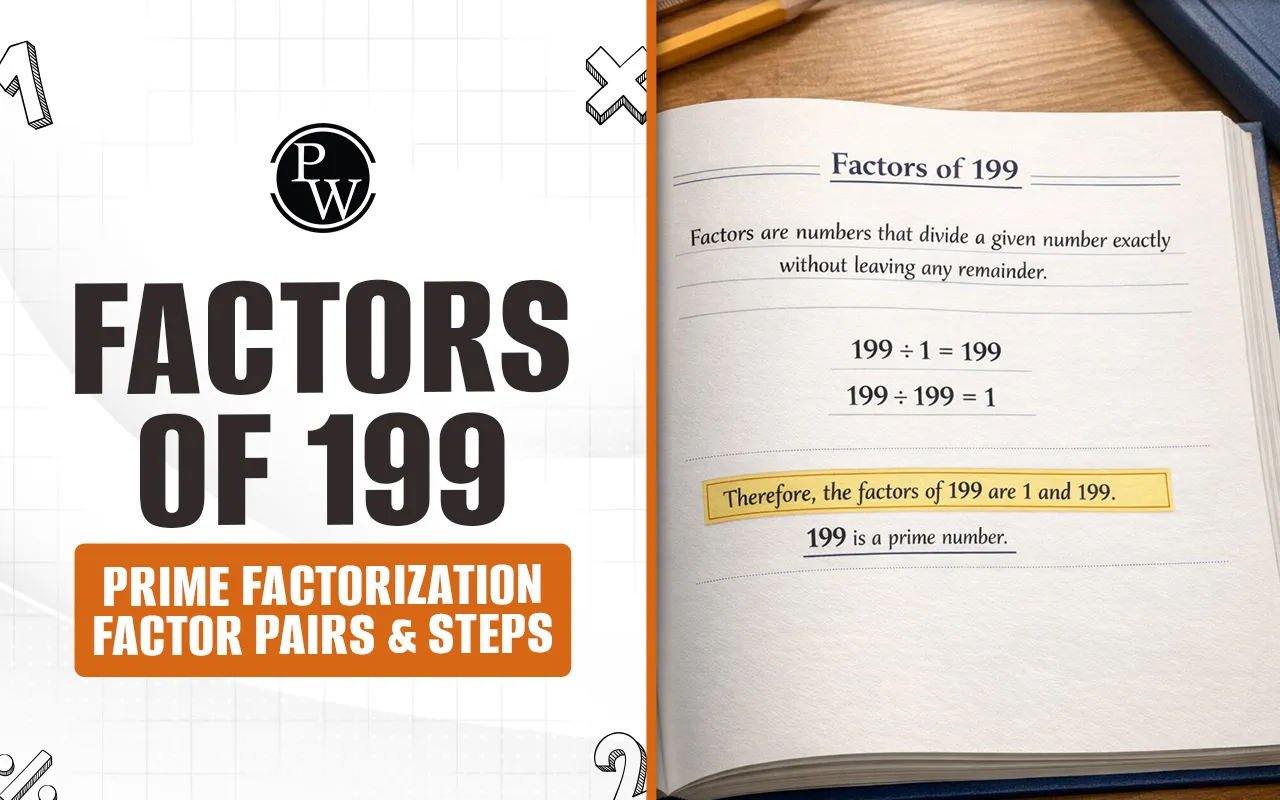
What Are the Factors of 199?
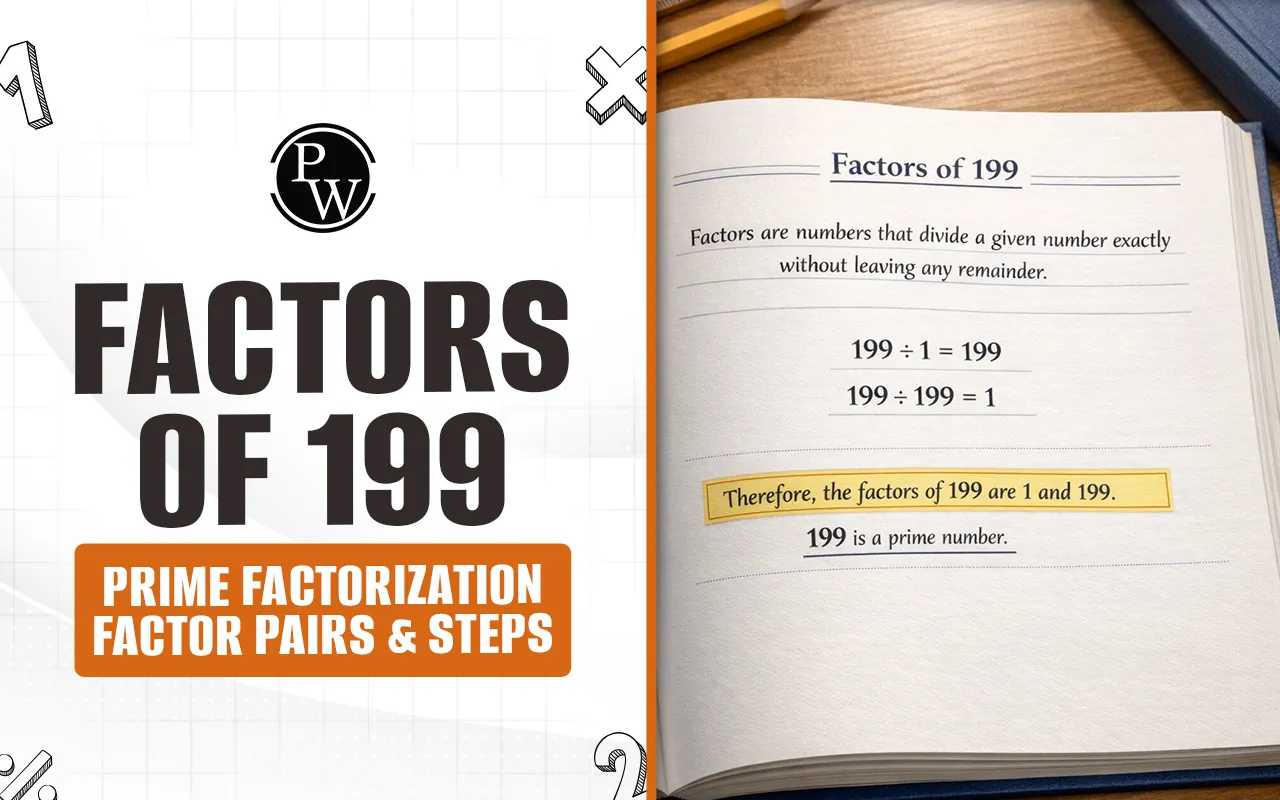
A factor is a number that can be divisible by another number without leaving anything behind. For example, when we try to find the factors of 199, we are trying to find numbers that can be multiplied together to give us 199. We are looking for numbers that can multiply together to equal 199.
We can see that 2 is not a factor because 199 is an odd number. If we try to divide 199 by small prime numbers like 3 (the digits 1, 9, and 9 add up to 19, which isn't divisible by 3) or 5, we will always get a decimal.
-
The only two numbers that can be divided evenly into 199 are 1 and 199.
-
So, the only factors are 1 and 199.
How to Find the Factors of 199
To find the factors of any number, we look for numbers that divide into the number without leaving a remainder. Below mentioned are the prime factorization of 199 steps -
1. The Square Root Rule
When you want to find the factors of a number, it is a beneficial idea to start by finding the square root of the number.
-
The square root of 199 is approximately 14.1.
-
This means we only need to check numbers up to 14. We check if any of these numbers divide into 199. If none of them do, then we know that no larger number will work, except for 199 itself.
Read More - Write 38 in Words | 38 Spelling with Examples
2. Testing Prime Divisibility
We are going to test the number 199 against the numbers 2, 3, 5, 7, 1, and 13 to see what happens.
-
Check 2: 199 is an odd number (it ends in 9). Therefore, 2 is not a factor.
-
Check 3: Add the digits: 1 + 9 + 9 = 19. Since 19 cannot be divided by 3, 199 is not divisible by 3.
-
Check 5: The number does not end with 0 or 5. Therefore, 5 is not a factor.
-
Check 7: 199 \div 7 = 28 with a remainder of 3. Not a factor.
-
Check 11: 199 \div 11 = 18 with a remainder of 1. Not a factor.
-
Check 13: 199 \div 13 = 15 with a remainder of 4. Not a factor.
3. Conclusion of the Search
The root limit is 14, and 199 has no divisors. 199 has only two factors: 1 and 199. Since it is a prime number, it cannot be divided evenly by any other number.
-
List of factors: 1,199.
What are the Factor Pairs of 199?
The numbers that go together are called factor pairs of 199. The factor pairs of the number 199 are two numbers that multiply to give the number 199.
Positive Factor Pairs
The only positive 199 factor pairs are the following:
-
(1, 199): 1 x 199 = 199.
Negative Factor Pairs
We also talk about numbers in algebra. When we multiply two numbers together, the answer is always a number. So the pairs of numbers that we multiply to get a positive result are:
-
(-1, -199): -1 x -199 = 199.
We usually focus on pairs in elementary school maths. Knowing negative pairs is helpful for algebra and quadratic equations.
Properties of 199
|
Property |
Details |
|
All Factors |
1,199 |
|
Prime Factorization |
199 |
|
Is 199 Prime? |
Yes |
|
Factor Pairs |
(1, 199), (-1, -199) |
|
Total Factors |
2 |
Read More - Binary Subtraction - Definition, Rules, Examples
Practice Questions on Factors of 199
To really get this topic, you should try to do these exercises. These exercises are made to be like the kinds of questions you might see in a maths competition or on a test.
Exercise 1: Identifying Factors
Question: From the following list of numbers, identify which are factors 199: {1, 3, 7, 9, 19, 199}.
-
Answer: 1 and 199. (As shown in our divisibility tests, the other numbers leave remainders).
Exercise 2: Sum and Average
Question: What is the average of the positive factor of 199?
-
Step 1: Find the sum of the factors (1 + 199 = 200).
-
Step 2: Divide the sum by the number of factors (200 ÷ 2 = 100).
-
Answer: 100.
Exercise 3: Prime Logic
Question: If 199 is a prime number, how many 199 factors exist in total?
-
Answer: 2 factors (1 and 199).
Exercise 4: Multiples vs Factors
Question: Is 398 a factor of 199 or a multiple of 199?
-
Answer: 398 is a multiple of 199 (199 x 2 = 398). A factor must be equal to or smaller than the number itself.
Exercise 5: Factor Pair Multiplication
Question: What is the result when you multiply the two numbers in the positive 199 pairs of factors?
-
Answer: 199. (1 x 199 = 199).
Make Maths Simple and Fun with CuriousJr
CuriousJr makes learning mathematics easy, engaging, and stress-free for children. We focus on building a strong foundation by reducing fear and boosting confidence through interactive and practical learning methods.
Our online Mental Maths classes for students from Classes 1 to 8 are designed to improve speed, accuracy, and logical thinking using simple techniques and engaging activities.
With a unique dual-mentor approach, students attend live interactive sessions and receive personalized support to clear doubts after every class. Animated lessons, fun challenges, and hands-on activities make maths enjoyable and effective.
Parents stay informed with regular progress updates and review sessions, ensuring complete transparency in their child’s learning journey.
Book a demo class today and experience how CuriousJr turns maths into a fun, confidence-building journey for your child.