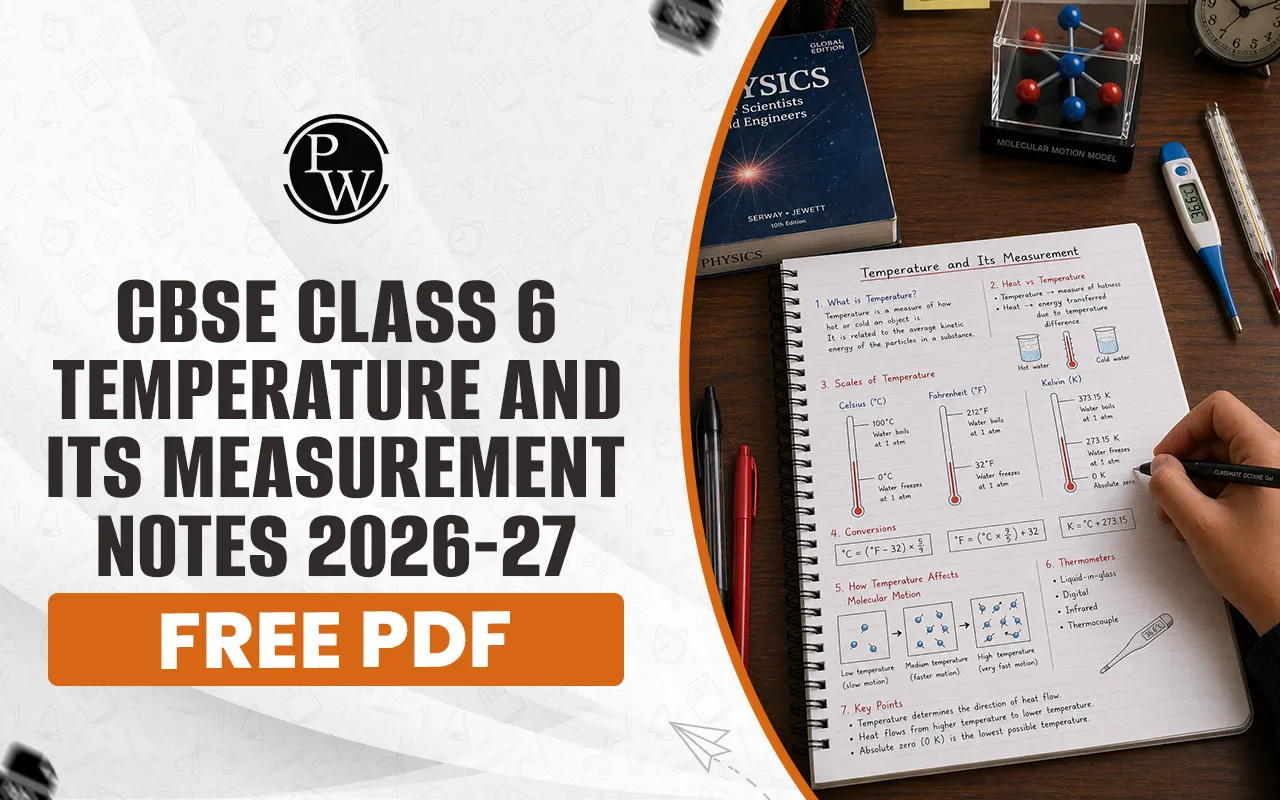
CBSE Class 6 Temperature and its Measurement Notes 2026-27 | Free PDF
 Nikita Aggarwal6 May, 2026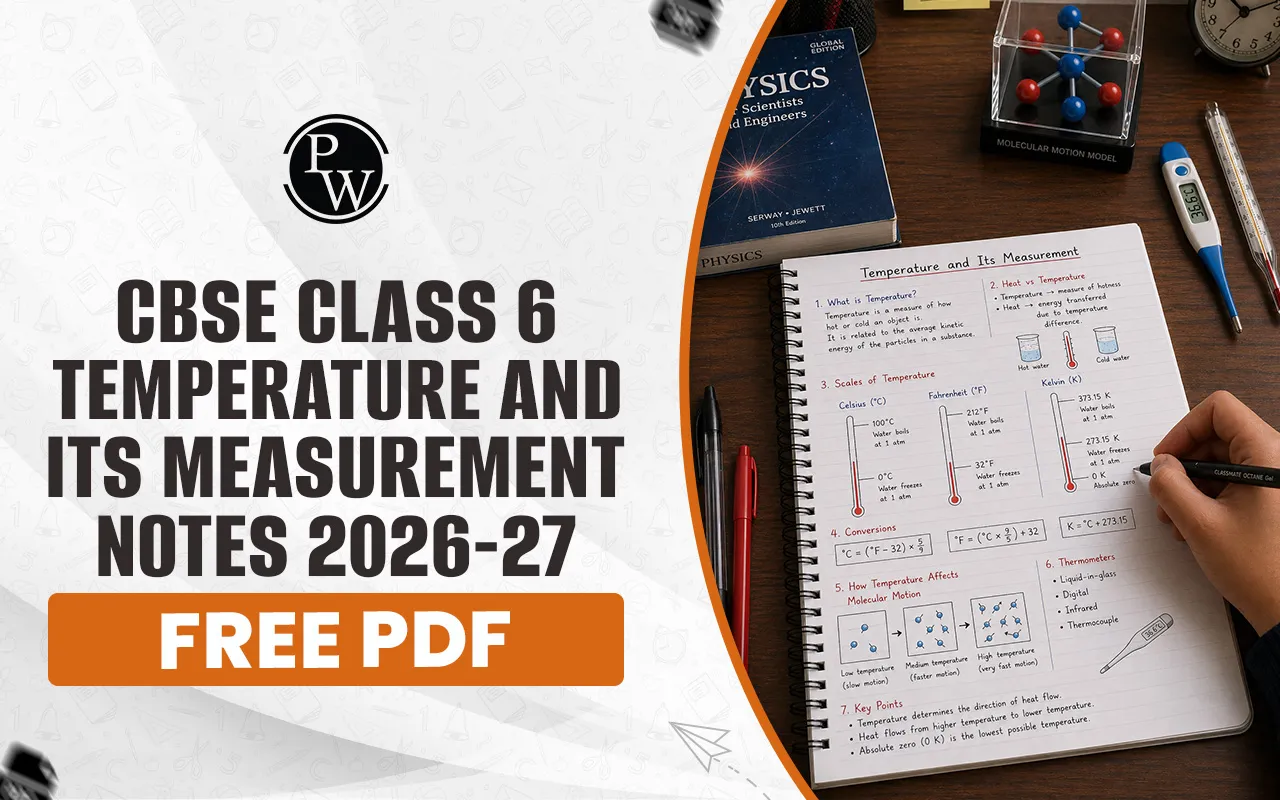
What is Class 6 Temperature and its Measurement?
The temperature of anything is a good way to tell how hot or cold it is. Our sense of touch can give us a general idea, but it's not always right. For instance, if you keep one hand in ice water and the other in warm water, then dip both into lukewarm water, your hands will give you conflicting signals because they are comparing the new water to their previous state!
To solve this, scientists use thermometers. Measurement involves using a specific scale (like Celsius) to assign a numerical value to the thermal state of a body. In your Class 6 syllabus, you will explore how molecules move faster as temperature rises and how various instruments help us record these changes accurately. This chapter forms the foundation for higher-level physics topics like thermodynamics.
Key Concepts Covered:
-
The Concept of Heat: Heat is a form of energy that flows from a hotter body to a colder body.
-
Defining Temperature: It is the effect of heat energy. It tells us the "intensity" of heat in an object.
-
Units of Measurement: The standard units you will encounter are degrees Celsius (°C), degree Fahrenheit (°F), and Kelvin (K).
-
Thermometers: These are devices used to measure temperature based on the expansion of liquids like mercury or alcohol.
Download Class 6 Temperature and Its Measurement Notes PDF
Having a physical or digital copy of your study material allows for "anytime" revision. You can download the PDF to keep on your tablet or print out for your study folder. These notes have labeled illustrations and step-by-step formulas for changing Celsius to Fahrenheit.
Benefits of Class 6 Temperature and its Measurement Notes for Students
Why should you trust our notes on temperature and its measurement?
-
Simplified Language: We don't use a lot of technical terms, so students can comprehend what we're saying.
-
Focused on CBSE Pattern: These notes are in line with the 2026–27 CBSE Pattern curriculum.
-
Visual Aids: We use tables and strong language to help you remember the most important information.
-
Quick Revision: You can go over these notes in 10 minutes instead of reading an entire chapter.
-
Self-Assessment Ready: The layout is designed to help you quiz yourself by covering the right-hand side of definitions as you study.
-
Confidence Builder: By mastering the small details like the 'kink' or 'meniscus,' you gain the confidence to handle experimental questions in your science viva.
-
Bridging the Gap: These notes link theoretical concepts to everyday activities, helping you realize why your soup is hot or why the fridge is cold.
-
Portability: With the PDF version, you can revise important thermal physics formulas while travelling or during short school breaks.
Key Features of Class 6 Science Temperature and its Measurement Notes
What makes these Class 6 temperature and its measurement notes for students different from a standard textbook? We have designed them specifically for the modern learner:
-
Snippet-Ready Definitions: Every major term, from "kink" to "absolute zero," is defined in a way that is easy to memorize and reproduce in exams.
-
Visual Hierarchy: We use bold text for key terms and bullet points for properties, allowing you to scan the page and find answers in seconds.
-
Exam-Oriented Diagrams: The notes include descriptions of where to label parts of a thermometer, which is a frequent 5-mark question in CBSE papers.
-
Safety & Precautions: A dedicated section on how to handle glass thermometers to ensure students learn safe laboratory practices.
-
Comparative Logic: Instead of long paragraphs, we use tables to show the differences between various scales and instruments.
Common Mistakes to Avoid in Class 6 Temperature and Its Measurement
Many students lose marks because of small, avoidable errors. Based on feedback, here are the most common pitfalls:
-
Forgetting Units: Never just write "37." Always write "37°C." In physics, a number without a unit doesn't mean anything.
-
Wrong Scale for the Job: Trying to measure boiling water with a clinical thermometer will break it.
-
Incorrect Reading Angle: Your eyes must be at the same level as the top of the mercury thread (meniscus). Reading from an angle leads to parallax error.
-
Holding the Bulb: Never hold the thermometer by the bulb while taking a reading, as your own body heat will change the result.
-
Washing with Hot Water: Never wash a clinical thermometer in very hot water to "clean" it; the extreme heat can cause the glass to crack or the mercury to expand beyond the tube's limit.
-
Improper Jerking: Avoid holding the thermometer loosely while jerking it down, as it can easily slip and shatter, creating a mercury hazard.
How CuriousJr Makes Online Learning Easy and Enjoyable
Every child thrives with the right balance of guidance, patience, and encouragement. CuriousJr transforms at-home online learning into a smooth, positive, and stress-free experience for both students and parents.
Parents trust CuriousJr’s online tuition classes because they keep children actively engaged, boost their confidence, and inspire a genuine love for learning. We foster a warm and supportive environment where students feel comfortable, motivated, and encouraged—never overwhelmed or confused.
Our classes are designed to strengthen core concepts while nurturing curiosity and creativity. Through interactive lessons, fun activities, and consistent practice, students stay involved and develop a deeper understanding of their subjects.
Our experienced and compassionate teachers offer personalized attention to every child, especially those who need extra support. This helps students learn at their own pace, overcome challenges, and build confidence. We also keep parents updated with regular feedback and progress reports, making it easier to monitor growth and guide improvement.
Book a demo class today and discover how CuriousJr makes online learning simple, engaging, and effective for your child.