Complement in Grammar - Definition, Uses, Examples
 Nikita Aggarwal6 May, 2026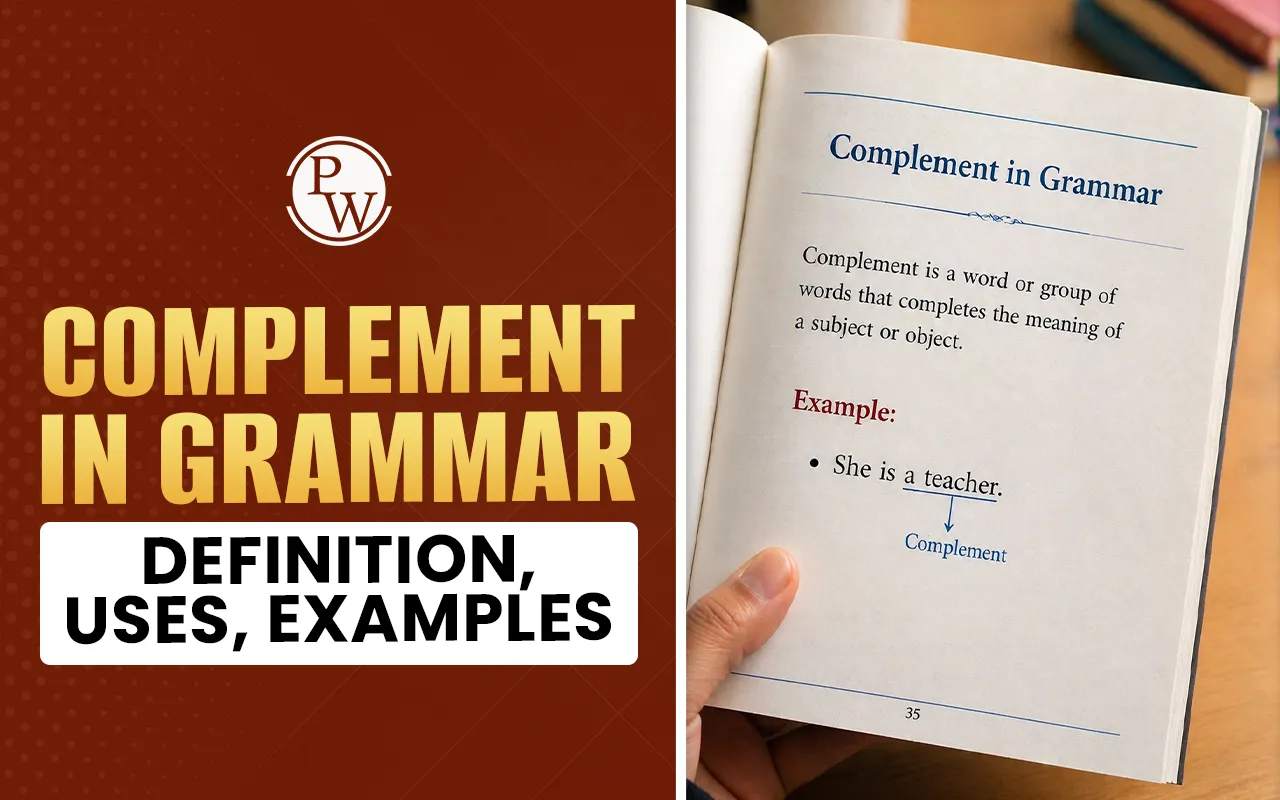
What is Complement in Grammar?
In simple terms, a complement is a word, clause, or phrase that "completes" the predicate of a sentence. While some parts of a sentence are optional—like adverbs that add extra detail—a complement is usually mandatory for the sentence to be grammatically sound. Without it, the verb cannot express a full thought.
The complement in grammar definition focuses on the relationship between the complement and other parts of the sentence, specifically the subject or the direct object. It often follows "linking verbs" (like to be, to seem, or to become) to rename or describe the subject.
How to Identify a Complement in Grammar?
To find a complement in a sentence, you should look at the verb first. If the verb is a linking verb, the information following it is almost certainly a complement. Unlike an object, which receives an action (e.g., "He kicked the ball"), a complement identifies or describes the entity already mentioned.
Consider these two examples:
-
Action: The chef tasted the soup. (Soup is the object).
-
Complement: The soup tasted delicious. (Delicious is the complement).
In the second example, "delicious" describes the soup itself. If you remove "delicious," the sentence "The soup tasted" feels unfinished. This necessity is the hallmark of a complement in grammar.
Types of Complements in Grammar
Grammarians generally categorise complements based on what part of the sentence they are completing. The two most common types found in English are subject complements and object complements.
Subject Complements
A subject complement follows a linking verb and provides more information about the subject. It can be a noun (predicate nominative) or an adjective (predicate adjective).
-
Noun as a complement: Sarah is a doctor. (Here, "doctor" renames Sarah).
-
Adjective as a complement: The sky became cloudy. (Here, "cloudy" describes the sky).
Common linking verbs that require a subject complement include:
-
Be (am, is, are, was, were)
-
Become
-
Seem
-
Appear
-
Feel
-
Smell
Object Complements
An object complement follows and modifies a direct object. These are often used with verbs like make, name, call, choose, or elect.
-
Example: The board named him chairman.
-
Breakdown: "Him" is the direct object. "Chairman" is the object complement because it explains what "him" became.
Read More - Proofreading - Meaning, Importance with FAQs
Uses of Complement in Grammar
Let’s look at the uses for complement in English language;
-
Complements help complete the meaning of a sentence so it does not feel unfinished.
-
They tell us what the subject is, such as in “Riya is a dancer.”
-
They describe what the subject is like, such as in “The room looks clean.”
-
They are often used after linking verbs like is, seem, become, feel, smell, and look.
-
They help students write clearer sentences instead of half-finished ones.
-
Object complements show a change, role, or result, such as in “They made him captain.”
-
They make everyday speaking, school writing, and sentence correction easier to understand.
Complement in Grammar Examples
To truly understand how this works, let us look at various complement in grammar examples across different sentence structures.
Subject Complement Examples:
-
That pizza smells fantastic.
-
My brother is a talented musician.
-
The water felt cold to the touch.
-
The participants were anxious before the results.
Object Complement Examples:
-
The jury found the defendant guilty.
-
We painted the kitchen yellow.
-
The movie made me sad.
-
They elected her president of the club.
More Complement in Grammar Examples
-
The baby seems sleepy.
-
Her answer was correct.
-
We found the test easy.
-
They called the puppy Bruno.
-
The garden looks beautiful after the rain.
-
My father became a teacher.
-
The news made everyone happy.
-
I consider this plan useful.
Subject Complements in Grammar vs. Adverbs
A common mistake for learners is using an adverb when a complement in grammar is required. Adverbs describe how an action is performed, while complements describe the state of the subject.
-
Incorrect: The flowers smell sweetly.
-
Correct: The flowers smell sweet.
Since "smell" is acting as a linking verb here, we need an adjective (sweet) to describe the flowers, not an adverb to describe the act of smelling.
Role of Adjective Complements in Grammar
Sometimes, an adjective itself needs a complement to complete its meaning. This is known as an adjective complement. It usually takes the form of a noun clause or a prepositional phrase.
-
Example: She is happy that you came.
-
Example: I am curious about the results.
Without the phrases in bold, we wouldn't know the reason for the happiness or the curiosity. This highlights how broad the complement in grammar uses actually are in everyday speech.
Read More - Root Words: Definition, Lists, and Examples
Verb Complements in Grammar
In some linguistic frameworks, direct and indirect objects are considered "verb complements" because they complete the meaning of a transitive verb. However, in standard school grammar, we usually distinguish between objects (which receive action) and complements (which describe or rename).
For the purpose of identifying a complement in grammar, focus on whether the word is functioning like an "equals sign" (=).
-
Subject = Complement (The man = a teacher).
-
Object = Complement (We called him = a hero).
Importance Of Complement in Grammar
Mastering the complement in grammar is essential for several reasons:
-
Sentence Completion: It ensures your sentences are not fragments.
-
Word Choice: It helps you decide between using an adjective or an adverb.
-
Complex Writing: It allows you to use sophisticated verbs like "consider," "appoint," and "deem" correctly.
-
Clarity: It prevents ambiguity in your writing, ensuring the reader knows exactly who is what or how something feels.
Complement in Grammar from Complementary Difference
It is worth noting a quick spelling tip. In grammar, we use "complement" (with an 'e'). This comes from the word "complete." A "compliment" (with an 'i') is a nice remark you make to someone. While they sound the same, their functions are entirely different. When discussing what is complement in grammar, always remember the 'e' for 'essential' or 'everything needs to be complete.'
Summary of Complement Functions
Here are the complement functions at a glance:
|
Type |
Function |
Example |
|
Subject Complement |
Renames or describes the subject after a linking verb. |
The tea is hot. |
|
Object Complement |
Renames or describes the direct object. |
I find him funny. |
|
Adjective Complement |
Completes the meaning of an adjective. |
I am glad to help. |
|
Noun Complement |
Completes the meaning of a noun. |
The idea that he might leave is scary. |
Tips for Students for Complement in Grammar
When you are trying to find the complement in a sentence, follow these steps:
-
Identify the verb. Is it an action (run, jump) or a state of being (is, seems)?
-
If it is a state of being, look at the word following it. Does it describe the subject? That is your subject complement.
-
If there is an object, check if there is a word after it that tells you what that object "is" or "has become." That is your object complement.
By practicing with these complement in grammar examples, you will start to see these patterns in every book you read and every essay you write.
Build Your Child’s Spoken English Confidence with CuriousJr
Is your child shy about speaking English or struggling to frame sentences? This can affect their confidence, classroom participation, and communication skills. CuriousJr’s online English classes are designed to make learning simple, engaging, and outcome-focused.
The program covers key areas such as grammar, pronunciation, vocabulary, and basic writing skills. Through interactive live sessions, children get regular speaking practice guided by experienced mentors. Engaging activities like games, storytelling, and writing exercises make the learning process fun and effective.
Parents receive regular progress updates, keeping them informed about their child’s improvement. With structured levels designed for different learning paces, CuriousJr helps children build a strong foundation in English step by step.
Book a demo class today and help your child speak English with confidence.