
CBSE Class 8 Science Exploring Forces Notes 2026-27 | Free PDF
 Nikita Aggarwal26 Sept, 2026
What is Class 8 Exploring Forces
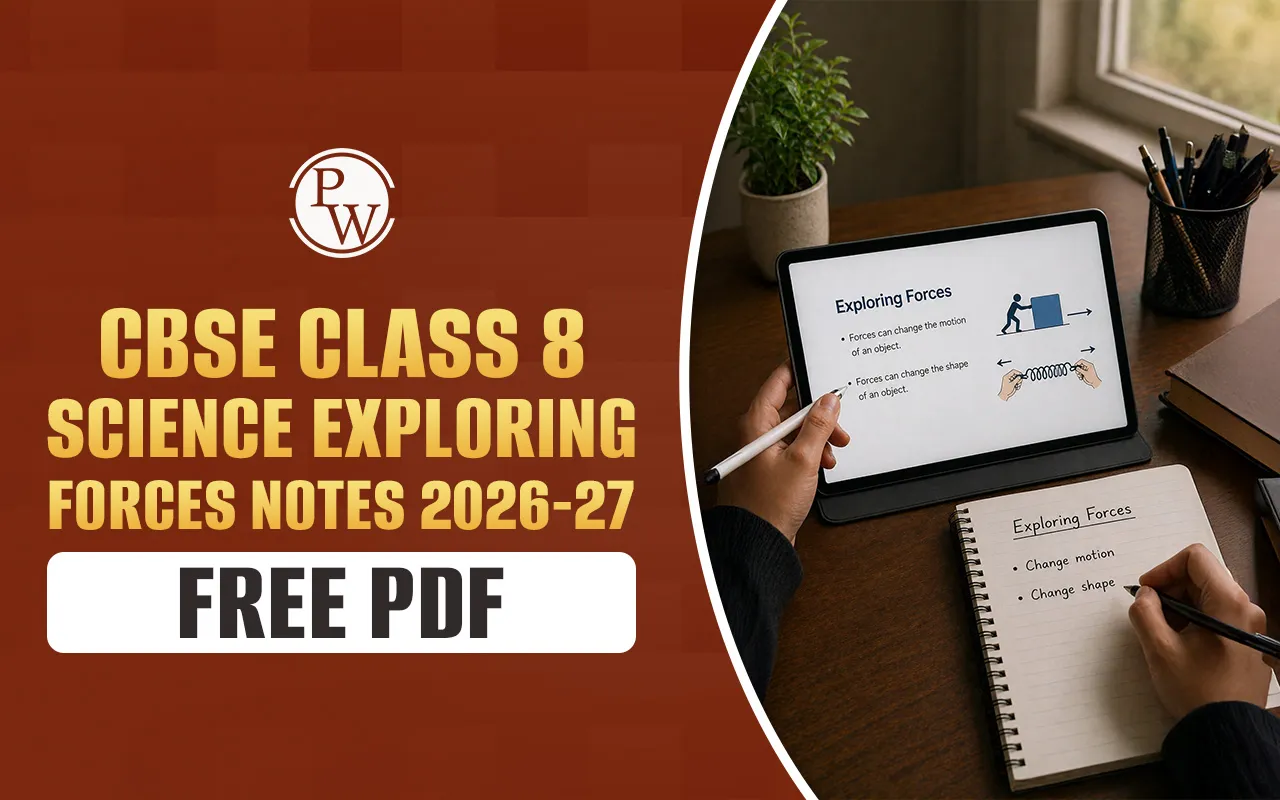
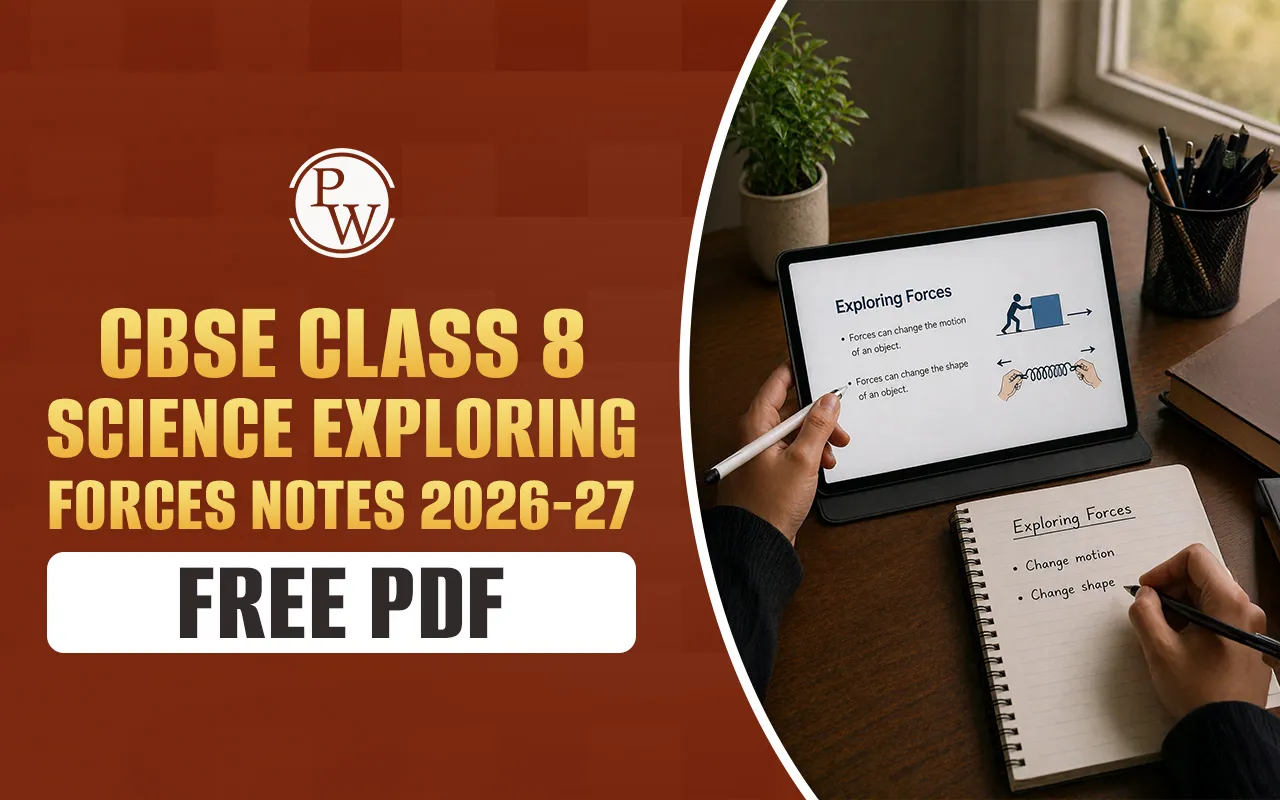
Exploring Forces is a Class 8 Science chapter that explains how forces act through interactions between objects. A force can be described as a push or a pull, and it can change the motion, direction, or shape of an object.
For example, pushing a door can make it move, while kicking a football can change its motion. Forces can act through direct contact or without direct contact.
The main concepts covered in Class 8 Exploring Forces include:
-
Force as a push or pull
-
Effects of force
-
Magnitude and direction of force
-
Contact forces
-
Non-contact forces
-
Multiple forces acting on an object
-
Balanced and unbalanced forces
-
Friction and other forces
Download Class 8 Exploring Forces Notes PDF
Students often find it helpful to have a physical or offline copy of their study material. Accessing the exploring forces notes PDF allows you to study during commutes or quick breaks without needing an active internet connection.
Our downloadable PDF includes:
-
Step-by-step derivation of force interactions.
-
Visual diagrams of contact and non-contact forces.
-
Solved examples of net force calculations.
-
A quick-revision summary table for last-minute prep.
Exploring Forces Class 8 Notes
Force as a Push or Pull
A force is a push or pull that can act on an object. Forces arise because of interactions between objects.
Examples include:
-
Pushing a table
-
Pulling a drawer
-
Kicking a football
-
Pulling a bucket with a rope
A force can change the state of motion of an object or change its direction or shape.
Effects of Force
A force can have different effects on an object. It can:
-
Make a stationary object move.
-
Stop or slow down a moving object.
-
Change the direction of motion.
-
Change the speed of an object.
-
Change the shape of an object.
The effect depends on how the force acts on the object.
Magnitude and Direction of Force
The magnitude of a force tells us how large the force is, while its direction tells us where the force acts.
When more than one force acts on an object, both the magnitude and direction of the forces need to be considered.
Contact Forces
A contact force acts when two objects are in physical contact.
Examples include:
-
Frictional force
-
Muscular force
For example, when you push a box with your hand, your hand and the box are in contact.
Non-Contact Forces
A non-contact force can act without direct physical contact between objects.
Examples include:
-
Gravitational force
-
Magnetic force
-
Electrostatic force
For example, a magnet can attract an iron object without touching it.
Multiple Forces Acting on an Object
Sometimes two or more forces act on the same object.
When forces act in the same direction, their effects can combine. When they act in opposite directions, their effects can oppose each other.
For example, if two people push a box in the same direction, the forces act together. If they push it in opposite directions, the forces oppose each other.
Class 8 Science Chapter 5 Exploring Forces Notes
For quick revision of Class 8 Science Chapter 5 Exploring Forces, remember these key points:
|
Concept |
Key Point |
|
Force |
A push or pull acting on an object |
|
Effect of force |
Can change motion, direction, speed, or shape |
|
Magnitude |
Indicates the size of a force |
|
Direction |
Indicates the direction in which a force acts |
|
Contact force |
Acts through physical contact |
|
Non-contact force |
Acts without direct physical contact |
|
Friction |
A contact force that opposes relative motion between surfaces |
|
Magnetic force |
A non-contact force associated with magnets |
|
Gravitational force |
Attraction between masses |
These points on CuriousJr can be used as Class 8 Exploring Forces short notes for quick chapter revision.
Exploring Forces Class 8 Notes PDF
Students looking for Exploring Forces Class 8 PDF notes can access the available notes using the link below.
The notes can be used for revising the important concepts of the chapter, including force, effects of force, contact and non-contact forces, and related examples.
Exploring Forces Class 8 Question-Based Revision
After reading the notes, practise questions based on the main concepts of the chapter.
1. What is force?
Force is a push or pull that acts on an object due to an interaction.
2. What are the effects of force?
A force can change the motion, speed, direction, or shape of an object.
3. What are contact forces?
Contact forces act when two objects are physically in contact. Frictional and muscular forces are examples.
4. What are non-contact forces?
Non-contact forces can act without direct physical contact. Gravitational, magnetic, and electrostatic forces are examples.
5. What is friction?
Friction is a contact force that opposes relative motion between surfaces that are in contact.
6. What is the difference between contact and non-contact forces?
Contact forces require physical contact between objects, whereas non-contact forces can act without direct physical contact.
Common Mistakes in Class 8 Exploring Forces
Students should check the following points while revising the chapter:
-
Ignoring direction: When comparing forces, consider both their magnitude and direction.
-
Confusing contact and non-contact forces: Friction and muscular force require contact, while gravitational and magnetic forces do not.
-
Treating force as only a cause of motion: A force can also change speed, direction, or shape.
-
Forgetting units: Force is measured in newtons (N).
-
Confusing mass and force: Mass measures the amount of matter in an object, while force describes an interaction that can affect an object's motion or shape.
Read More: CBSE Class 8 Science Electricity - Magnetic and Heating Effects Notes
Exploring Forces Class 8 Short Notes for Revision
For last-minute revision, remember:
-
Force is a push or pull.
-
Force results from an interaction between objects.
-
A force can change motion, direction, speed, or shape.
-
Contact forces require physical contact.
-
Non-contact forces act without direct physical contact.
-
Friction is a contact force.
-
Magnetic and gravitational forces are non-contact forces.
-
The magnitude and direction of forces are important when multiple forces act on an object.
-
Force is measured in newtons (N).
Read More: CBSE Class 8 Science Particular Nature of Matter Notes
How to Revise Exploring Forces Class 8 Notes
Use the notes in three steps:
Step 1: Learn the concepts
Start with force, its effects, magnitude, and direction.
Step 2: Classify the forces
Revise the difference between contact and non-contact forces and learn suitable examples.
Step 3: Practise questions
Test yourself with definitions, differences, examples, and questions about the effects of force.
This approach keeps the chapter focused on concepts rather than memorising isolated definitions.





CBSE Class 8 Science Exploring Forces Notes FAQs
What do Class 8 Exploring Forces notes cover?
What is force in Class 8 Science?
What are contact and non-contact forces?
Are Class 8 Exploring Forces notes available in PDF?

Get Free Counselling Today
and Clear up all your Doubts
 Live & recorded classes available at easeDashboard for progress trackingLakhs of practice questions