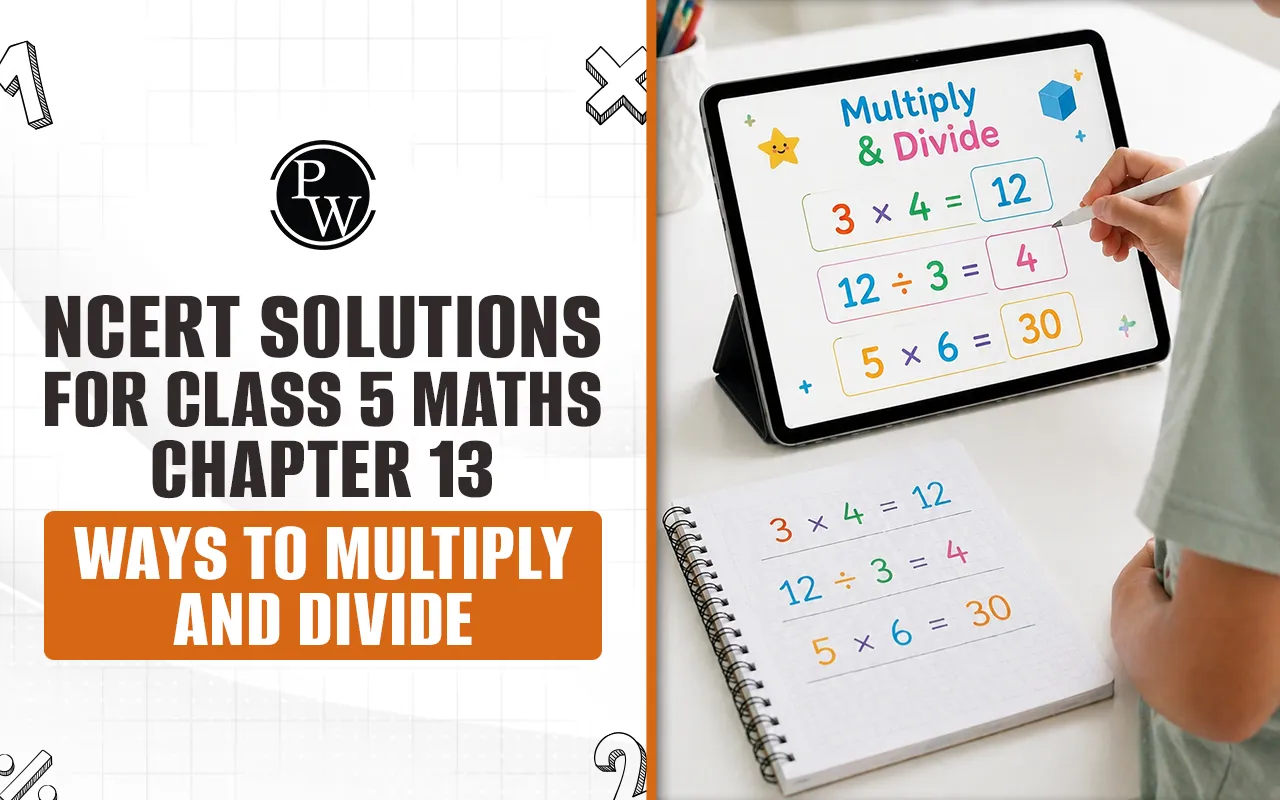
NCERT Solutions for Class 5 Maths Chapter 13 Ways to Multiply and Divide
 Nikita Aggarwal17 Sept, 2026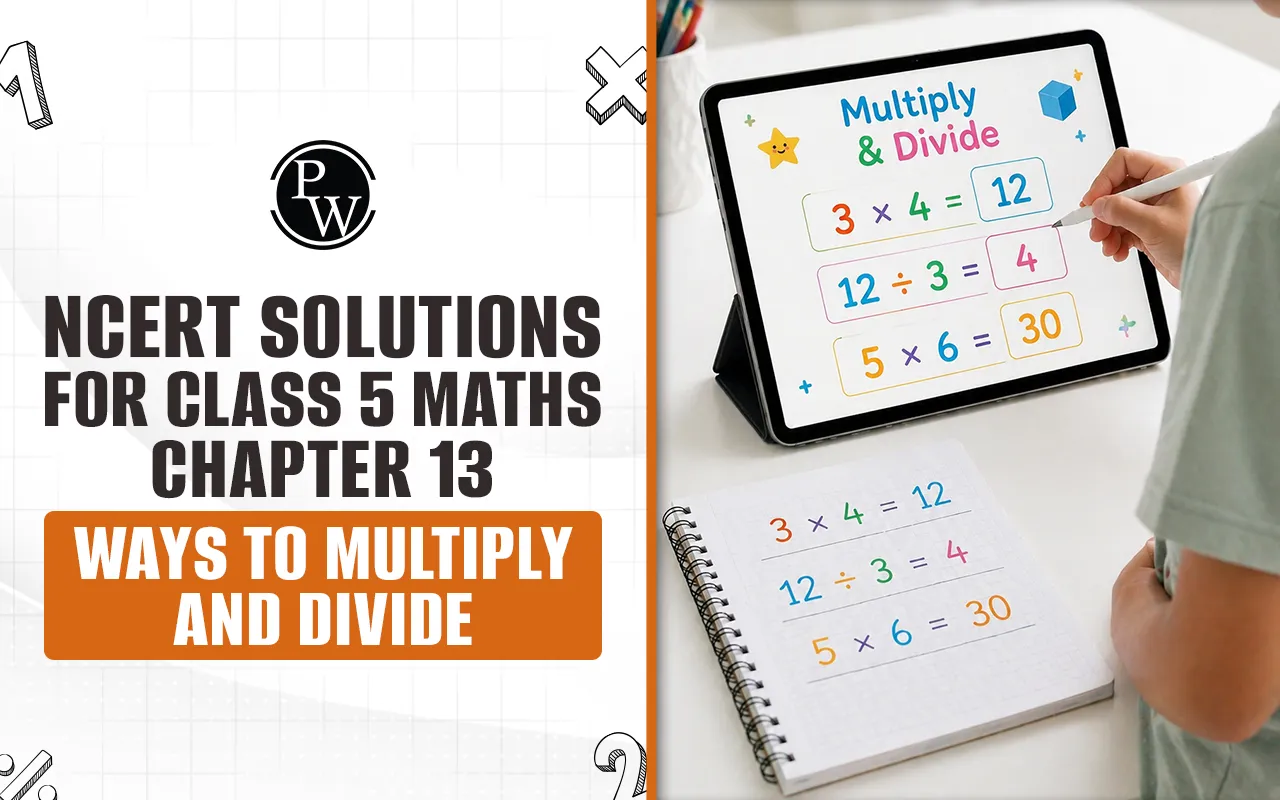
Class 5 Maths Chapter 13 Ways to Multiply and Divide Summary
In this chapter, the focus shifts from basic rote learning to understanding the logic of numbers. Students learn that there isn't just one way to solve a problem. You can break numbers apart, use distributive properties, or apply standard algorithms. The class 5 maths chapter 13 ways to multiply and divide ncert solutions cover various scenarios including:
-
Salary Calculations: Learning how to calculate daily, monthly, and yearly wages for different workers.
-
The Bela Method: A shortcut for multiplication that involves breaking down multipliers into tens and units.
-
Division Strategies: Using repeated subtraction and estimation to divide large numbers.
-
Real-world Applications: Solving problems related to water consumption, heartbeats, and land area.
Class 5 Maths Chapter 13 Ways to Multiply and Divide Question Answer
Below are the detailed solutions for the exercises found in Chapter 13. These are structured to help you follow the logic used in the NCERT textbook.
Maniratnam’s Salary Calculation
Maniratnam is a cashier. His job is to calculate the salaries of all the workers. He uses a specific grid method to multiply.
Question: If the minister’s salary is 195 Rupees per day, find his salary for the whole month of January.
Answer: January has 31 days. To find the total, we multiply 195 by 31.
Using the grid method:
-
Break 195 into 100, 90, and 5.
-
Break 31 into 30 and 1.
-
Multiply: (100 x 30) + (90 x 30) + (5 x 30) + (100 x 1) + (90 x 1) + (5 x 1).
-
Calculation: 3000 + 2700 + 150 + 100 + 90 + 5 = 6045.
The minister’s salary for January is 6,045 Rupees.
Shantaram the Special Cook
Shantaram is a cook who only comes on special days. Last year, he was called for only 28 days. For each day, he is paid 165 Rupees.
Question: Find out how much money he will get in all.
Answer: To get the total, we multiply 165 by 28.
-
Step 1: Multiply 165 by 8 (units place). 165 x 8 = 1320.
-
Step 2: Multiply 165 by 20 (tens place). 165 x 20 = 3300.
-
Step 3: Add the results. 1320 + 3300 = 4620.
Shantaram will receive 4,620 Rupees.
Question: If he is called for all 365 days of the year, how much salary will he get?
Answer: Multiply 165 by 365.
-
165 x 5 = 825
-
165 x 60 = 9900
-
165 x 300 = 49500
-
Total: 825 + 9900 + 49500 = 60225.
His annual salary would be 60,225 Rupees.
Years and Weeks Calculation
This section of class 5 chapter 13 ways to multiply and divide ncert solutions helps students convert time units into larger numbers.
Question: How many breaths do we take in one day if we breathe 15 times in one minute?
Answer: * Breaths in 1 minute = 15.
-
Minutes in 1 hour = 60.
-
Breaths in 1 hour = 15 x 60 = 900.
-
Hours in 1 day = 24.
-
Breaths in 1 day = 900 x 24.
-
Calculation: 900 x 24 = 21,600.
A person takes 21,600 breaths in a single day.
Question: If a baby elephant drinks 12 litres of milk every day, how much milk will it drink in two years?
Answer: * Daily milk = 12 litres.
-
Days in 1 year = 365.
-
Days in 2 years = 365 x 2 = 730 days.
-
Total milk = 730 x 12.
-
Calculation: 730 x 10 = 7300; 730 x 2 = 1460.
-
Sum: 7300 + 1460 = 8760.
The baby elephant drinks 8,760 litres in two years.
Read More - NCERT Solutions for Class 5 Maths Chapter 10 – Tenths and Hundredths
Division Problems Sharing and Distributing
Division is often seen as the reverse of multiplication. In class 5 maths chapter 13 ways to multiply and divide questions with answers, we look at how to split large amounts.
Question: 576 books are to be packed in boxes. If one box has 24 books, how many boxes are needed?
Answer: Total books = 576.
Books per box = 24.
We need to calculate 576 divided by 24.
-
24 x 10 = 240
-
24 x 20 = 480
-
Remaining: 576 - 480 = 96.
-
24 x 4 = 96.
-
Total boxes = 20 + 4 = 24.
24 boxes are needed to pack all the books.
Question: 836 people are watching a movie in a hall. If the hall has 44 rows, how many people can sit in 1 row?
Answer: Total people = 836.
Total rows = 44.
Calculate 836 / 44.
-
44 x 10 = 440.
-
Remaining: 836 - 440 = 396.
-
44 x 9 = 396.
-
Total: 10 + 9 = 19.
There are 19 people in each row.
Practice with Money and Wages
The class 5 chapter 13 ways to multiply and divide question answer sets often involve farmers and their daily struggles with wages.
Question: Sukhi works on a farm. He is paid 98 Rupees for one day. If he works for 52 days, how much will he earn?
Answer: Daily wage = 98 Rupees.
Number of days = 52.
Calculation: 98 x 52.
-
98 x 2 = 196.
-
98 x 50 = 4900.
-
Total: 196 + 4900 = 5096.
Sukhi earns 5,096 Rupees.
Water Usage Calculation
Question: A society needs 350 litres of water per person per day. If there are 300 people living there, how much water is needed in a day?
Answer: Water per person = 350 litres.
Total people = 300.
Total water = 350 x 300.
Calculation: 35 x 3 = 105. Add the three zeros.
Total water needed = 1,05,000 litres.
Read More - NCERT Solutions for Class 5 English Chapter 4 The Wise Parrot
Benefits of Using NCERT Solutions for Class 5 Maths
Using these class 5 maths chapter 13 ways to multiply and divide ncert solutions offers several advantages for young learners:
-
Conceptual Clarity: Instead of just giving the final number, the solutions show how to break down numbers into tens and hundreds, making mental math easier.
-
Step-by-Step Logic: Each problem follows a logical sequence. This helps students who might get lost in long multiplication or division.
-
Exam Readiness: These questions are frequently mirrored in school exams. Practicing them ensures that students are familiar with the format and difficulty level.
-
Practical Skills: The chapter uses real-life contexts like shopping, salaries, and farming. This helps students see the value of math in the real world.
-
Efficiency: Learning methods like the Bela method or the area model allows students to double-check their work using different techniques.
How CuriousJr Makes Online Learning Simple and Enjoyable
Every child learns best with the right mix of support, patience, and guidance. CuriousJr turns online tuition class at home into a positive and stress-free experience for both students and parents.
Parents trust CuriousJr’s online tuition classes because they help children stay engaged, build confidence, and develop a love for learning. We create a warm and supportive environment where students feel comfortable, valued, and encouraged—never pressured or confused.
Our classes focus on strengthening concept clarity while encouraging curiosity and creativity. Through interactive lessons, engaging activities, and consistent practice, children remain actively involved and genuinely interested in learning.
Our experienced and compassionate teachers give personal attention to every student, especially those who need extra help. This allows children to grasp difficult concepts at their own pace and steadily grow in confidence. Parents also receive regular updates and detailed feedback, making it easy to track progress and identify areas for improvement.
Book a demo class today and discover how CuriousJr makes online learning easy, engaging, and effective for your child.
|
Related Articles |