Acute Scalene Triangle - Definition, Properties, Formula, Examples
 Nikita Aggarwal6 May, 2026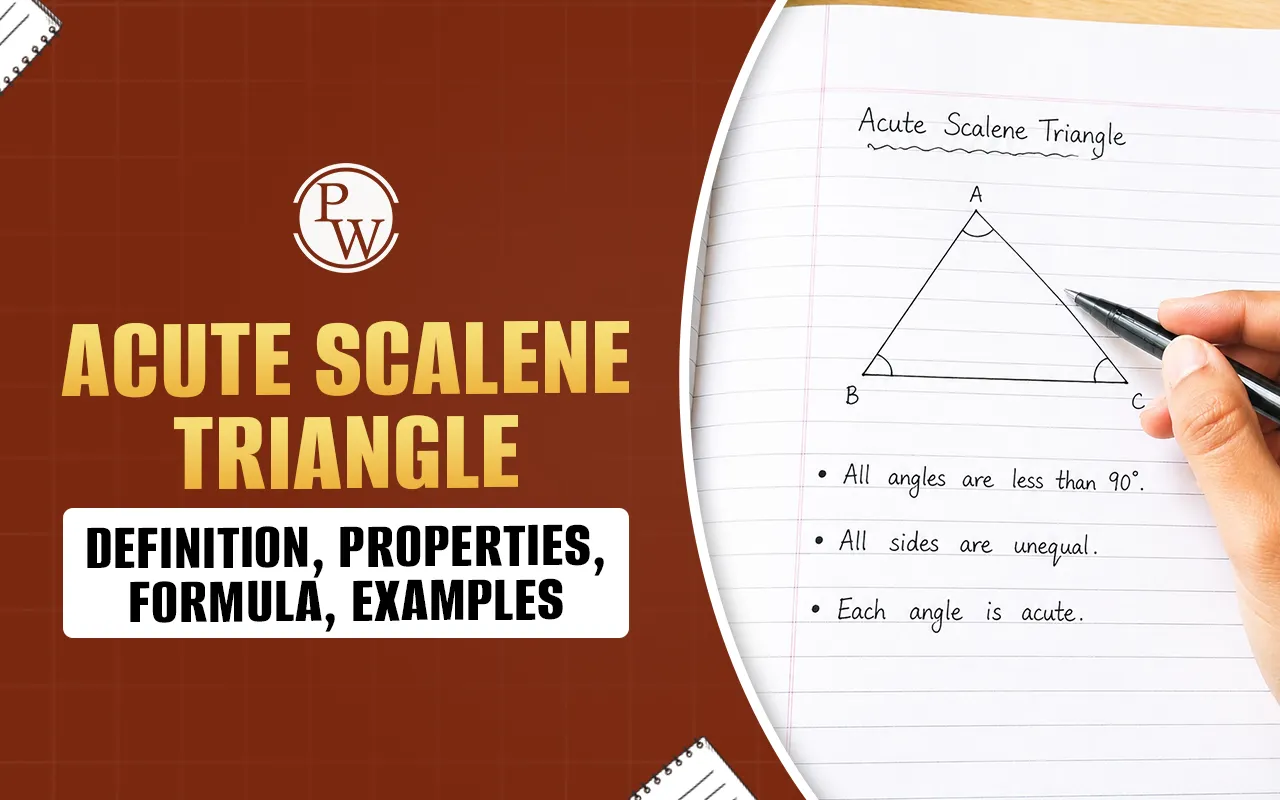
What is Acute Scalene Triangle?
To understand what is acute scalene triangle, we need to know two triangle types.
-
Acute triangle = a triangle where all three angles are less than 90°
-
Scalene triangle = a triangle where all three sides are different
So, an acute scalene triangle is a triangle that has:
-
Three different side lengths
-
Three different angles
-
Every angle smaller than 90°
This means it has no equal sides and no right angle.
For example, a triangle with angles 50°, 60°, and 70° is an acute scalene triangle in maths because:
-
All angles are below 90°
-
All angles are different, so all sides are different too
A triangle with angles 45°, 45°, and 90° is not an acute scalene triangle because it has one right angle and two equal angles.
Acute Scalene Triangle Definition
The formal acute scalene triangle definition is:
A triangle with three sides of different lengths where all three interior angles are less than 90 degrees.
Important points:
-
Side a ≠ side b
-
Side b ≠ side c
-
Side a ≠ side c
-
Each angle is between 0° and 90°
-
Sum of all angles = 180°
In simple words, it is a triangle that looks uneven because no sides match, but all corners are sharp and small.
Acute Scalene Triangle Properties
Knowing the acute scalene triangle properties helps students identify it quickly.
-
Three Unequal Sides
All sides have different lengths. -
Three Unequal Angles
All angles have different measures. -
All Angles are Acute
Every angle is less than 90°. -
Angle Sum Rule
The sum of the three angles is always 180°. -
Longest Side Rule
The largest angle faces the longest side. -
Shortest Side Rule
The smallest angle faces the shortest side. -
No Equal Sides
No two sides are the same. -
No Line of Symmetry
You cannot fold it into equal halves. -
Rotational Symmetry of Order 1
It looks the same only after a full turn of 360°. -
Triangle Inequality Rule
The sum of any two sides is greater than the third side.
Example:
If sides are 6 cm, 8 cm, and 9 cm:
-
6 + 8 > 9
-
6 + 9 > 8
-
8 + 9 > 6
So, it forms a triangle.
These are the most important acute scalene triangle properties used in maths.
Read More - Vertical Angles – Definition, Formula, Properties, Examples
Acute Scalene Triangle Formula
The acute scalene triangle formula is used to find perimeter and area.
Perimeter Formula
Perimeter means total length around the triangle.
Perimeter = a + b + c
Where:
-
a = first side
-
b = second side
-
c = third side
Example:
If sides are 5 cm, 7 cm, and 9 cm:
Perimeter = 5 + 7 + 9 = 21 cm
Area Formula (Base and Height)
If base and height are known:
Area = 1/2 × base × height
Example:
Base = 10 cm
Height = 6 cm
Area = 1/2 × 10 × 6 = 30 cm²
Heron’s Formula
Use this when all three sides are known.
Step 1: Find semi-perimeter
s = (a + b + c) / 2
Step 2: Use formula
Area = √[s(s-a)(s-b)(s-c)]
Example:
Sides = 6 cm, 7 cm, 8 cm
s = (6 + 7 + 8)/2 = 21/2 = 10.5
Then apply formula.
This is a very useful acute scalene triangle formula in exams.
Acute Scalene Triangle Examples
These acute scalene triangle examples will make the topic easy.
Example 1: Check the Triangle
Angles are 50°, 60°, and 70°.
Step 1: All are less than 90°
Step 2: All are different
Answer: Yes, it is an acute scalene triangle.
Example 2: Find Perimeter
Sides are 10 cm, 12 cm, and 14 cm.
Perimeter = 10 + 12 + 14 = 36 cm
All sides are different.
Now check if acute:
14² = 196
10² + 12² = 100 + 144 = 244
Since 196 < 244, it is acute.
Answer: It is an acute scalene triangle with perimeter 36 cm.
Example 3: Find Area
Base = 10 cm
Height = 6 cm
Area = 1/2 × 10 × 6 = 30 cm²
Example 4: Side Check
Sides are 5 cm, 6 cm, 7 cm.
All sides are different.
Check largest side:
7² = 49
5² + 6² = 25 + 36 = 61
Since 49 < 61, triangle is acute.
Answer: Yes, it is an acute scalene triangle.
These acute scalene triangle examples are common in school maths.
Read More - Straight Angle (180°) – Definition, Degree, Properties, Examples
Other Triangles Vs Acute Scalene Triangle
Understanding acute scalene triangle in maths becomes easier when compared with other triangles.
Acute Scalene vs Right Scalene
Both have different sides.
Difference:
-
Right scalene has one 90° angle
-
Acute scalene has all angles less than 90°
Acute Scalene vs Acute Isosceles
Both have all angles below 90°.
Difference:
-
Acute isosceles has two equal sides
-
Acute scalene has all different sides
Acute Scalene vs Obtuse Scalene
Both have unequal sides.
Difference:
-
Obtuse scalene has one angle more than 90°
-
Acute scalene has all angles less than 90°
How to Construct an Acute Scalene Triangle?
Follow these simple steps:
-
Draw a straight base line of 8 cm.
-
At one end, draw a 50° angle using a protractor.
-
At the other end, draw a 70° angle.
-
Extend both lines until they meet.
-
The third angle becomes:
180° - (50° + 70°) = 60°
Now the triangle has angles:
-
50°
-
70°
-
60°
All are less than 90° and all are different.
So this is an acute scalene triangle.
Acute Scalene Triangle Applications
The acute scalene triangle is not only used in books. It is seen in daily life too.
Architecture
Builders use triangle shapes in roofs and support frames.
Art and Design
Designers use uneven triangles to make creative patterns.
Navigation
Maps and land measuring often use triangle methods.
Engineering
Engineers use triangle shapes for strength and balance.
Construction
Bridges and frames may use triangle supports.
So, the acute scalene triangle in maths also has real uses.
Make Maths Simple and Fun with CuriousJr
CuriousJr helps children develop a strong base in mathematics by reducing fear and building confidence. Our online Mental Maths classes for students from Classes 1 to 8 focus on enhancing speed, accuracy, and logical thinking through easy techniques and interactive learning.
With a unique dual-mentor system, students attend engaging live sessions and get personalized doubt-solving support after each class. Animated lessons, fun activities, and exciting challenges make maths learning both effective and enjoyable.
Parents stay informed with regular progress updates and review sessions, ensuring complete clarity about their child’s learning progress.
Book a demo class today and discover how CuriousJr makes maths fun, engaging, and confidence-boosting for your child.