Exponents Shortcut Methods for Class 8
 Nivedita Dar26 May, 2026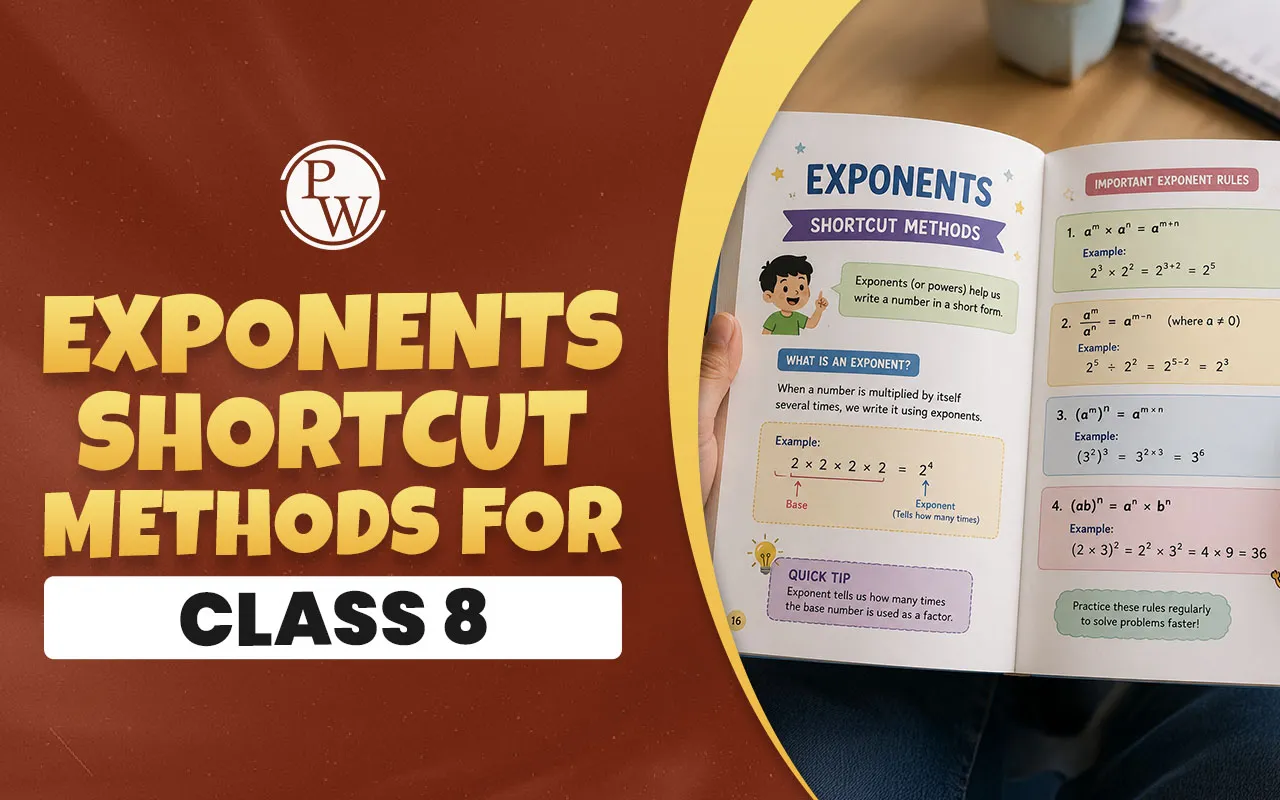
Students often experience fear when presented with many numbers raised to high exponents. It is a typical issue when children move on to Class 8, as calculations start to become abstract and time-consuming. Using some exponents tricks can make even the most complicated equations into simple arithmetic. Whether you need an exponents tip for a school exam or simply wish to strengthen your mental arithmetic skills, this article will help you get the job done!
Exponents Tricks Overview
The exponents just represent the number of times the base is multiplied. Although basically simple, the numbers get so big that doing it manually in a timed paper is almost impossible. This is where exponents tricks come into play. These tricks enable you to work with the powers themselves rather than with the huge numbers.
A shortcut is not just about jumping the steps; it's about working smarter. These rules are internalised, and a sense of numbers is developed, which is essential in mental maths in class 8. These strategies allow you to see the simple version of a problem and save several minutes of work on calculating what is in front of you.
Read More - Speed Maths Test for Class 8 (Try Now)
Exponents Tricks for Class 8
Going beyond long-form multiplication is essential for success in maths. These are the key exponent hacks that will help all Class 8 students be more efficient.
1. Same Base Trick (Product Law)
If two terms share a base, you can ignore it and work only with the powers.
-
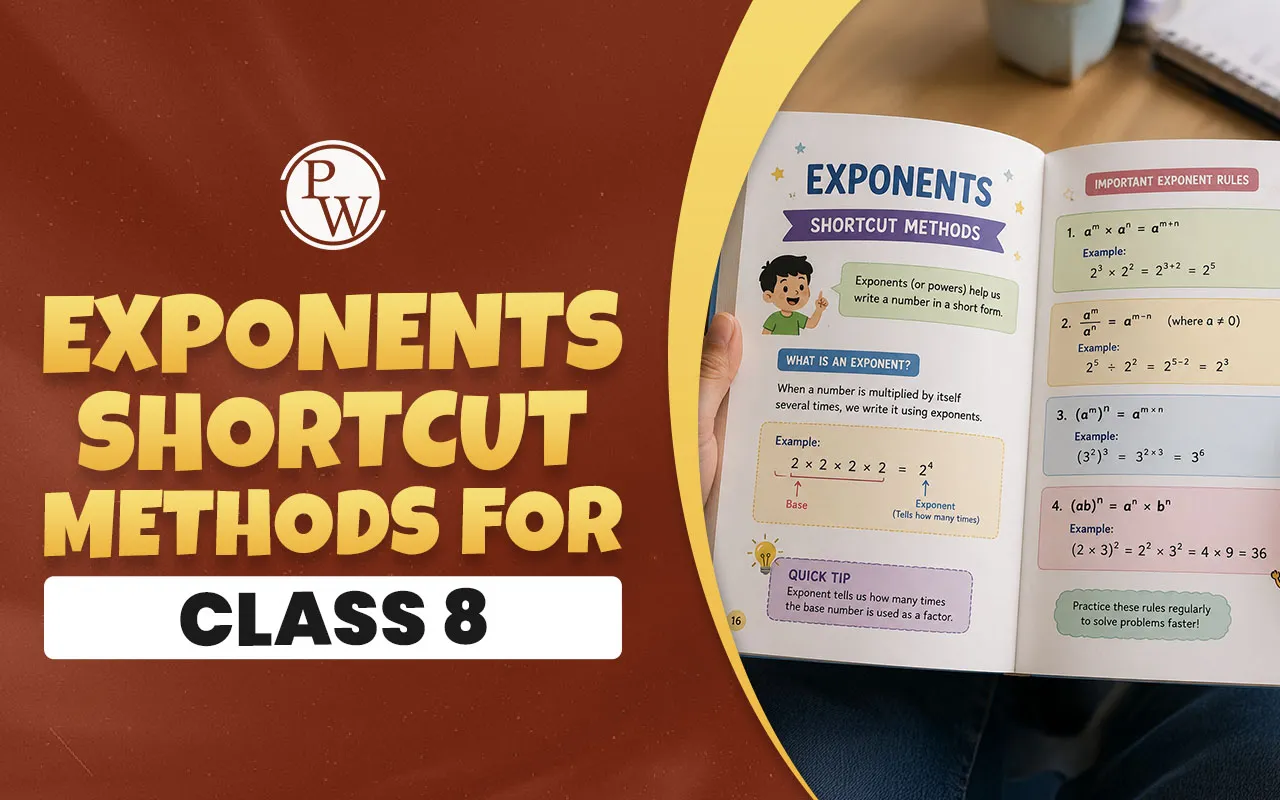
The Rule: a^m x a^n = a^(m+n)
-
How it works: When the bases are the same, just add the exponents.
-
Example: 2^3 x 2^4 = 2^7 = 128.
-
Mental Note: This is the easiest shortcut and is the basis for all shortcuts.
2. Power of a Power Shortcut
Occasionally a number to a power is enclosed in brackets, and another number to a power is in front of it. The answer is "scary", but it's simple.
-
The Rule: (a^m)^n = a^(mn)
-
How it works: Multiply the internal power by the external power.
-
Example: (3^2)^3 = 3^6 = 729.
-
Usage: When you encounter nested exponents, this is the trick to use to instantly flatten the expression.
3. Different Bases? Solve First
In mental arithmetic, a frequent mistake in class 8 is adding powers with different bases.
-
The Rule: The rule says that you cannot add the powers once the bases are different. All terms must be solved separately.
-
Example: 2^3 x 3^2 = 8 x 9 = 72.
-
Warning: Be careful not to attempt to add these together to get 5⁵ or 6⁵; these are common errors that exponent tricks assist you from making.
4. Zero-Power Magic
This technique may be the strongest trick to make long and complicated sequences of numbers look easy.
-
The Rule: a^0 = 1
-
Example: 7^0 = 1, 100^0 = 1, (xyz)^0 = 1.
-
Mental Note: When the base is raised to the power of zero, the answer is 1, regardless of the base's size.
5. Negative Power Trick
The negative exponents should not be interpreted as a negative answer: They are interpreted as a reciprocal or an inverse.
-
The Rule: a^-n = 1 / a^n
-
How it works: Keep moving the base to the denominator of a fraction, and ensure that the power is positive.
-
Example: 2^-3 = 1 / 8.
-
Context: This exponents shortcut is very useful in scientific notation and for minuscule decimal numbers.
Read More - 10-second Addition Tricks for Class 8
6. Multiply Inside Trick: (ab) ⁿ
If two numbers are being multiplied in bracket and raised to a power, the same power applies both.
-
The Rule: (ab)^n = a^n x b^n
-
Example: (2 x 3)^2 = 2^2 x 3^2 = 36.
-
Why use it: This rule is useful when the individual factors are small numbers, but their product inside the bracket is a huge number that would be too difficult to square or cube.
7. Divide Inside Trick: (a/b) ⁿ
Similar to multiplication, the power affects both the numerator and denominator of a fraction.
-
The Rule: (a/b)^n = a^n / b^n
-
Example: (2/3)^2 = 4/9.
-
Mental Maths Tip: Squaring in a single one-shot calculation is far easier and faster than trying to square the decimal directly or complex fraction type.
Practise Questions for Exponents Tricks
To sharpen your mental maths techniques, try solving these questions. Use the shortcuts mentioned above to find the answers without using a calculator.
Section A: Short Questions (1-2 Marks)
-
Simplify 10^5 x 10^3 using the product law.
-
Find the value of (250 x 34)^0.
-
Express 4⁻² as a positive exponent fraction.
-
Solve (2^2)^4.
-
If 5^x / 5^2 = 5^3, find the value of x.
Section B: Long Questions (3-5 Marks)
-
Simplify the expression (2^3 × 3^4 × 4) / (3^2 × 32) and express the answer in exponential form.
-
Find the value of m so that (-3)^(m+1) x (-3)^5 = (-3)^7.
-
Evaluate: { (1/3)^-1 - (1/4)^-1 }^-1.
-
If 25 x 5^n = 5^6, find the value of n.
-
Simplify [(1/2)^-2 + (1/3)^-2 + (1/4)^-2].
Exponents Tricks Benefits
Learning exponent tricks is more than just the right solution; it's a mind shift when dealing with numbers.
-
Speed and Efficiency: If a question in a timed exam can be answered in 5 seconds, with the help of a power, rather than in 50, you have an enormous advantage.
-
Reduced Errors: Most errors occur when manually multiplying large numbers. These techniques can save time in doing long-form calculations and thus reduce the chance for error.
-
Confidence Boost: When you see a complex-looking problem like (999)⁰ and can instantly say "1," it gives you a huge boost in confidence in your math skills.
-
Foundation for Algebra: Foundation for Algebra is literally a bridge to higher secondary maths. Learn a shortcut now, and it will greatly simplify subjects like algebraic expressions and scientific notation later in life.
-
Mental Sharpness: Regular practice of the mental maths class exercises helps in keeping your brain active and makes you proficient to think logically overall.
How Does CuriousJr Help with Class 8 Mental Maths?
The fundamental concept of CuriousJr is to make learning a logical exercise rather than rote memory. CuriousJr online Mental Maths classes provide structured environment where Class 8 students can practise mental maths techniques.
-
Gamified Learning: Students need not read dry textbooks; they can experience and learn a shortcut through puzzles or challenges that help make the concepts stick.
-
Visual Aids: CuriousJr explains through visuals why some exponent tricks are successful, and this improves retention.
-
Focus on Logic: The platform also works at training students to understand the 'why' with the 'how'. It is an ideal setup to train in the mental maths for class 8, as it makes abstract rules into very logical tools.
-
Progress Tracking: Students can see improvements in speed and accuracy over time when using various techniques to tackle a wider range of problems.
-
Bite-sized Content: The lessons are short, quick-fire and designed to bombard students in a non-intrusive way while keeping the content on something like exponents and powers very digestibly without overwhelming them.