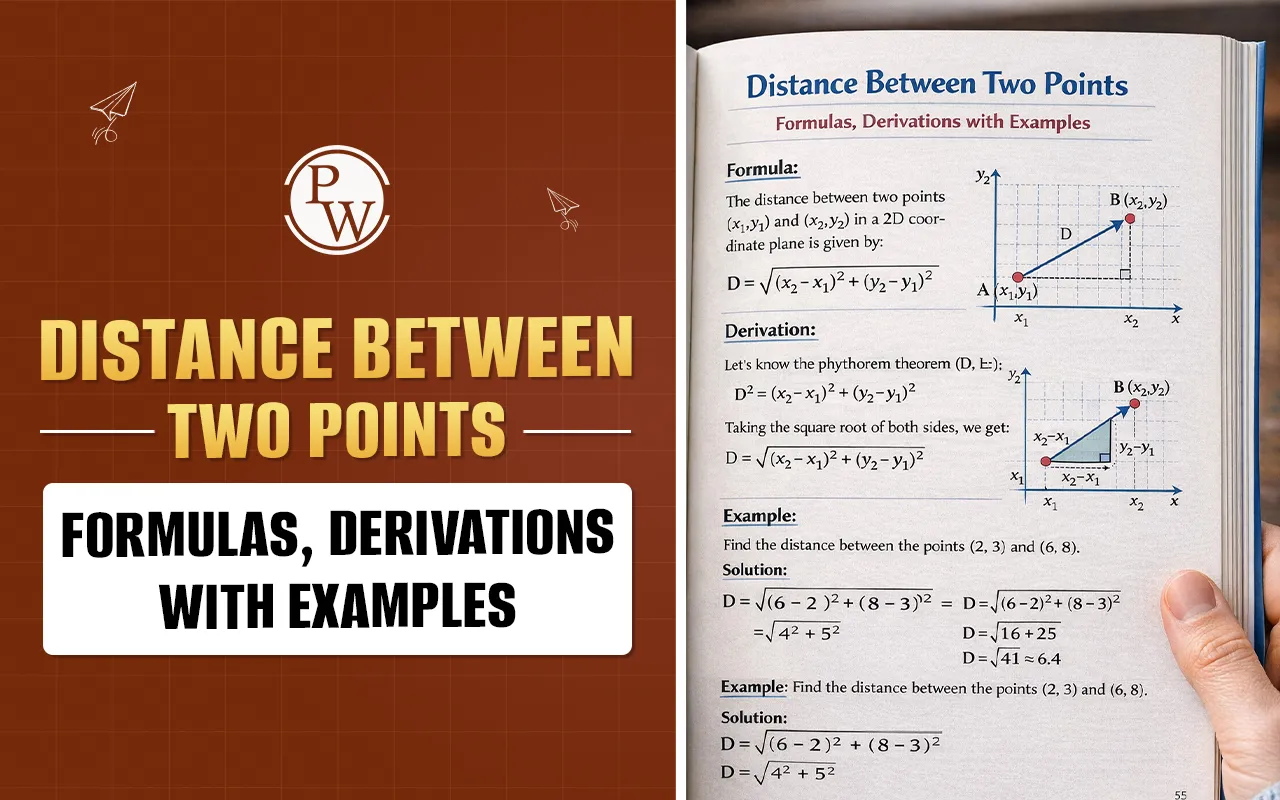
Distance Between Two Points - Formulas, Derivations with Examples
 Nikita Aggarwal9 Apr, 2026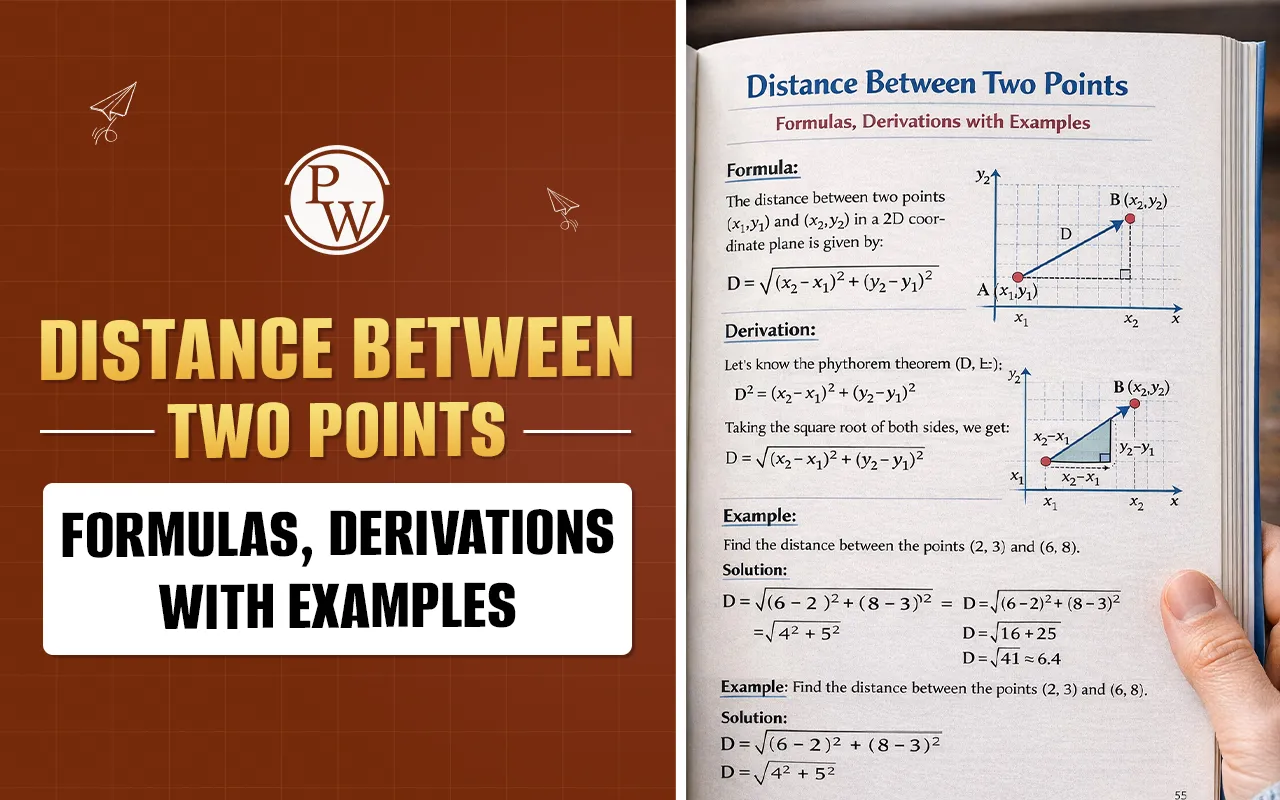
What is the Distance Between Two Points?
In geometry, the distance between two points refers to the length of the shortest path between them, which is always a straight line. This measurement is always non-negative, as distance cannot be less than zero.
Depending on where the points are located, we use different methods:
-
1D Space: Distance on a horizontal or vertical number line.
-
2D Space (XY Plane): Distance between points with (x, y) coordinates.
-
3D Space (XYZ Plane): Distance between points in a three-dimensional environment.
Distance Between Two Points Formula
To find the length between coordinates, we use specific distance between two points formulas based on the dimensions involved.
1. Distance on a Number Line (1D)
If you have two points A(x_1) and B(x_2) on a single line, the distance is simply the absolute difference between them:
Formula: d = |x_2 - x_1|
2. Distance in a 2D Plane
For points P(x_1, y_1) and Q(x_2, y_2), we use the standard distance formula:
Formula: d = \sqrt{(x_2 - x_1)^2 + (y_2 - y_1)^2}
3. Distance from the Origin
If you are measuring the distance from the point (0,0) to (x, y):
Formula: d = \sqrt{x^2 + y^2}
Below are some more examples for practice:
Example 1: Distance from the Origin
Find the distance between P(0, 0) and Q(6, 8).
Using d = \sqrt{x^2 + y^2}:
d = \sqrt{6^2 + 8^2} = \sqrt{36 + 64} = \sqrt{100} = \mathbf{10\ units}.
Example 2: Points on a Horizontal Line
Find the distance between A(-2, 4) and B(5, 4).
Since the y-coordinates are the same, use the absolute difference of x:
d = |5 - (-2)| = |5 + 2| = \mathbf{7\ units}.
Example 3: Working with Negative Coordinates
Find the distance between C(-3, -1) and D(-7, -4).
d = \sqrt{(-7 - (-3))^2 + (-4 - (-1))^2}
d = \sqrt{(-4)^2 + (-3)^2} = \sqrt{16 + 9} = \sqrt{25} = \mathbf{5\ units}.
Example 4: Calculating a Diagonal Path
Find the distance between X(1, 1) and Y(4, 5).
d = \sqrt{(4 - 1)^2 + (5 - 1)^2}
d = \sqrt{3^2 + 4^2} = \sqrt{9 + 16} = \sqrt{25} = \mathbf{5\ units}.
Example 5: Points on a Vertical Line
Find the distance between M(3, -2) and N(3, 10).
Since the x-coordinates are the same, use the absolute difference of y:
d = |10 - (-2)| = |10 + 2| = \mathbf{12\ units}.
Example 6: Using the 3D Formula
Find the distance between R(1, 2, 3) and S(3, 4, 4).
d = \sqrt{(3 - 1)^2 + (4 - 2)^2 + (4 - 3)^2}
d = \sqrt{2^2 + 2^2 + 1^2} = \sqrt{4 + 4 + 1} = \sqrt{9} = \mathbf{3\ units}.
Example 7: Distance with Decimal Coordinates
Find the distance between J(0.5, 2) and K(3.5, 6).
d = \sqrt{(3.5 - 0.5)^2 + (6 - 2)^2}
d = \sqrt{3^2 + 4^2} = \sqrt{9 + 16} = \sqrt{25} = \mathbf{5\ units}.
Read More - Half Angle Formula with Examples
Distance Between Two Points Derivations
Understanding the distance between two points derivations helps in retaining the formula for the long term. The 2D formula is actually a direct application of the Pythagoras Theorem.
Steps for Derivation:
-
Assume two points P(x_1, y_1) and Q(x_2, y_2) on a coordinate plane.
-
Draw a horizontal line from P and a vertical line from Q until they meet at a point R, forming a right-angled triangle PQR.
-
The horizontal side (PR) length is (x_2 - x_1).
-
The vertical side (QR) length is (y_2 - y_1).
-
According to Pythagoras Theorem: PQ² = PR² + QR²
-
Substituting the values: PQ^2 = (x_2 - x_1)^2 + (y_2 - y_1)^2.
-
Taking the square root gives us the final distance between two points formulas.
Distance Between Two Points Examples
Let’s apply the logic to some real-world mathematical problems to see how these distance between two points examples work in practice.
Example 1: Basic 2D Distance
Find the distance between A(2, 3) and B(5, 7).
-
(x_1, y_1) = (2, 3)
-
(x_2, y_2) = (5, 7)
-
d = \sqrt{(5 - 2)^2 + (7 - 3)^2}
-
d = \sqrt{(3)^2 + (4)^2}
-
d = \sqrt{9 + 16} = \sqrt{25}
-
Distance = 5 units
Example 2: Negative Coordinates
Find the distance between P(-1, -1) and Q(2, 3).
-
d = \sqrt{(2 - (-1))^2 + (3 - (-1))^2}
-
d = \sqrt{(3)^2 + (4)^2}
-
d = \sqrt{9 + 16} = 5
-
Distance = 5 units
Read More - Perpendicular Bisector: Definition, Properties, and Practical Examples
How to Find Distance Between Two Points Using Coordinates?
Calculating the distance between two points is a systematic process. Whether you are working in a 2D or 3D plane, following these structured steps ensures accuracy in your results:
-
Identify the Coordinates: Label your first point as A(x_1, y_1) and your second point as B(x_2, y_2).
-
Apply the Formula: Input these values into the standard distance between two points formula: d = \sqrt{(x_2 - x_1)^2 + (y_2 - y_1)^2}.
-
Simplify and Label: Solve the arithmetic within the square root and always express your final answer in "units".
Note: If you are working with a 3D plane, simply extend the calculation to include the z-axis usng the formula: d = \sqrt{(x_2 - x_1)^2 + (y_2 - y_1)^2 + (z_2 - z_1)^2}.
Tips to Remember For Distance Between Two Points
-
Order doesn't matter: Because we square the differences (x_2 - x_1), the result is the same even if you calculate (x_1 - x_2).
-
Positive Result: Distance is a scalar quantity and is always positive.
-
Simplifying Radicals: Constantly try to simplify the square root at the end (e.g., \sqrt{8} becomes 2\sqrt{2}).