Instant Square Calculation Tricks for Class 7
 Nivedita Dar26 May, 2026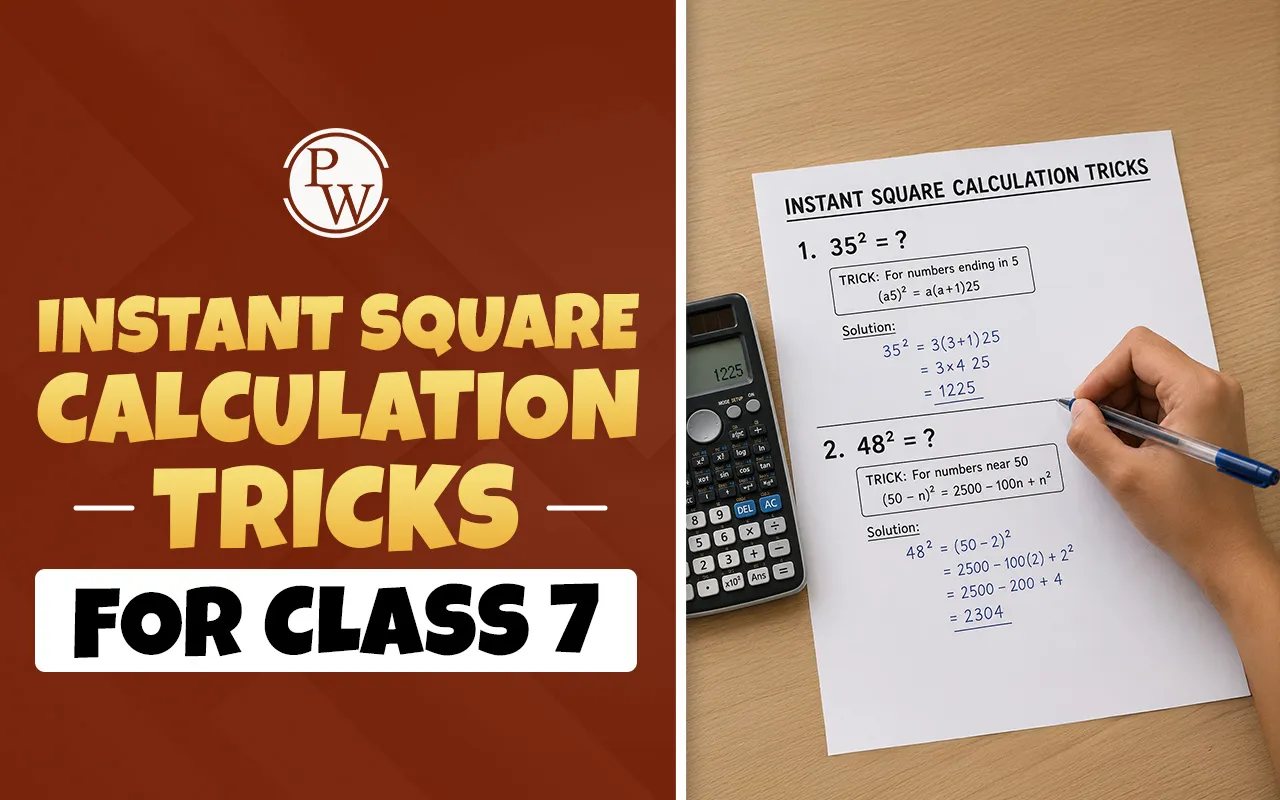
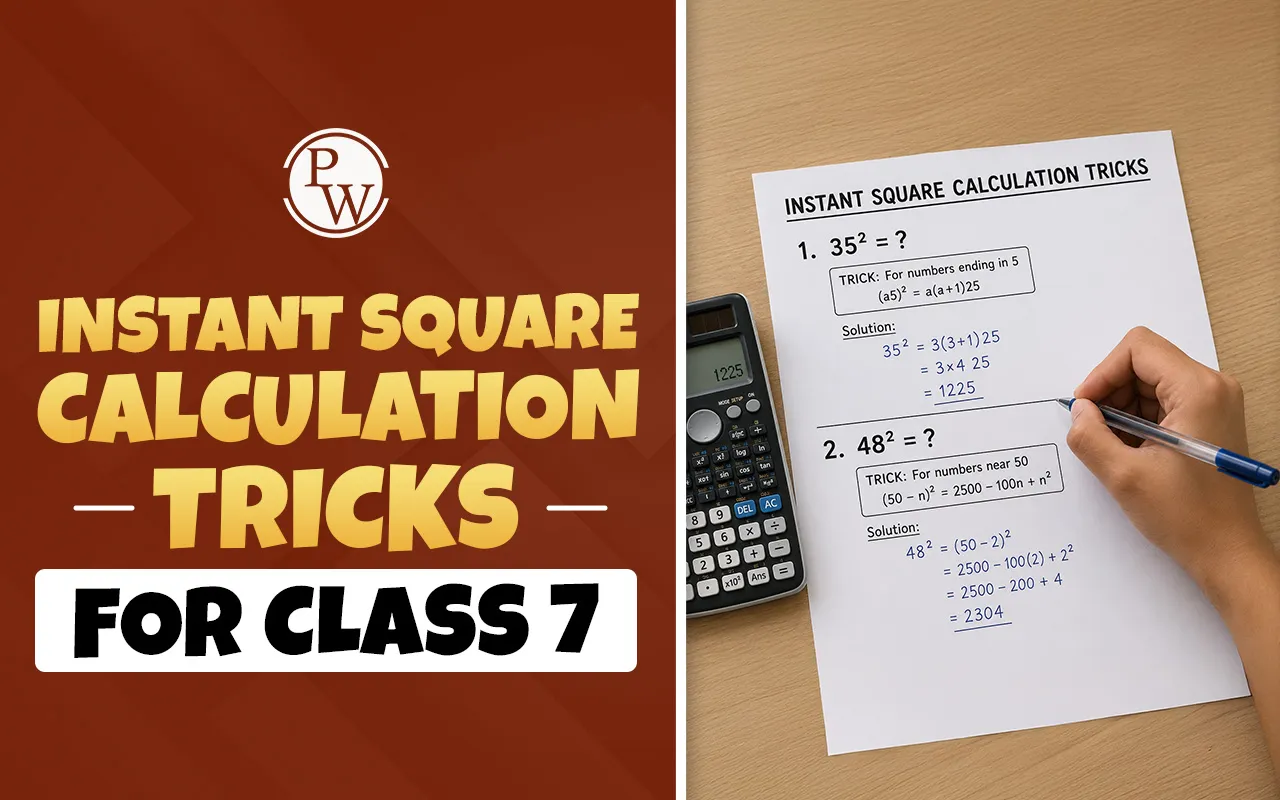
In your later years, maths often feels like a race against the clock, especially when you face huge multiplication problems on school tests. They repeatedly try and cross out errors in multiplication and squaring two-digit numbers, feeling hopeless. But with the help of Class 7 instant square calculation tricks, these terrifying examples can be made into easy mental tasks. This type of training steers you towards solving the real problem rather than wasting time doing repetitive, low-level manual arithmetic processes.
Class 7 Instant Square Calculation Tricks Overview
A square is simply a number multiplied by itself. The operation itself is trivial, but the classical method of multiplying digits begins to become slower and more error-prone as numbers get larger. So in 7th class you start using squares more often when it comes to geometry. This is why mental maths class 7 tips and tricks are the power-packed tools needed to ensure success in the class.
Essentially, these tricks are designed to make it easier for us to deal with multiplication by breaking numbers down into more efficient parts. You no longer see 98 as one number; you would consider it to be "100 — 2", which is a lot simpler. These speedy skills in arithmetic are not just knowing the answer fast but developing a deeper sense of how numbers combine.
Class 7 Instant Square Calculation Tricks
Then, if you need a maths pro, first, fill your mental toolkit with tools. Follow the links below to square tricks vedic maths by number pattern.
1. Square of Numbers Ending in 5
This method is perhaps the most well-known trick in the book. For numbers that end in 5, the answer forms a predictable pattern easily calculated in your head.
-
The Pattern: The last two digits of the answer are always 25.
-
The Calculation: Take the first digit (the part before the 5) and multiply it by the next consecutive integer.
-
The Formula: (a5)² = a(a + 1) followed by 25.
-
Example 1: Find the square of 25.
-
The first digit is 2. The next number is 3.
-
2 x 3 = 6.
-
Place 25 at the end: 625.
-
Example 2: Find the square of 45.
-
The first digit is 4. The next number is 5.
-
4 x 5 = 20.
-
Place 25 at the end: 2025.
2. Numbers Close to 10 (Base Method)
If you have a number like 12 or 13, which is slightly greater than ten, then instead of doing long-form multiplication with one digit, use a simple breaking method.
-
Method: Break the number into (10 + x).
-
Example: Find the square of 12.
-
12 squared = (10 + 2) squared.
-
The expression expands to 100 + 40 + 4.
-
Add them up: 144.
-
The step-by-step process used in this approach is to break down the calculation into simple chunks that will improve your mental square work.
3. Numbers Close to 100
The "Base 100" method works really well when numbers are close to 100. However, that is a textbook example of the maths shortcuts that save you a significant amount of time on time-consuming calculations .
-
Example: Find the square of 98.
-
Think of 98 as (100 - 2).
-
The mental calculation becomes: 10,000 - 400 + 4.
-
Result: 9604.
-
Using 100 as a reference means that students will not need to mentally multiply the larger digit, which often leads to mistakes on school tests.
4. The (a + b)² Identity Trick
This is a common algebraic trick that can be used to work out squares of numbers which are slightly larger than "round" hundreds, i.e., 20, 30 or even 50.
-
Standard Identity: (a + b)² = a² + 2ab + b²
-
Example: Find the square of 23.
-
Break 23 into (20 + 3).
-
a = 20, b = 3.
-
a² = 400.
-
2ab = 2 x 20 x 3 = 120.
-
b² = 9.
-
Total: 400 + 120 + 9 = 529.
5. The (a - b)² Identity Trick
The subtraction identity is more efficient for numbers slightly below a major base. This is one of the most important Class 7 instant square tricks for finding midrange numbers.
-
Standard Identity: (a - b)² = a² - 2ab + b²
-
Example: Find the square of 48.
-
Think of 48 as (50 - 2).
-
a = 50, b = 2.
-
a² = 2500.
-
2ab = 2 x 50 x 2 = 200.
-
b² = 4.
-
Total: 2500 - 200 + 4 = 2304.
6. Double Number Trick and Patterns
Others have a more rhythmic nature across the squares. Memorising these common forms will add to your overall speed.
-
11 squared = 121
-
12 squared = 144
-
Pattern Check: Pay close attention to growing pattern with numbers 11-19. By recognising these patterns, you can do arithmetic much faster without having to solve every problem from scratch.
Practice Questions for Class 7 Instant Square Calculation Tricks
Section A: Short Questions (Mental Calculations)
Try to solve these in under 5 seconds using the tricks mentioned above.
-
Get the square of 15 using "Ending in 5" rule
-
What is the square of 60? (Use the ending in 0 shortcut).
-
Calculate the square of 11 mentally.
-
Now square it using the (10 + x) method. 13
-
What is the square of 85?
Section B: Long Questions (Word Problems)
Apply your Class 7 instant square tricks for calculating to solve these real-world scenarios.
-
A square-shaped playground has a side length of 55 metres. Calculate the total area of the playground using the "Ending in 5" trick. (Area = side x side).
-
Rahul is tiling a floor that is 98 cm long and 98 cm wide. Instead of long multiplication, help Rahul find the area of the floor using the "Base 100" method.
-
A square photo frame has a side of 25 cm. If you need to find the area of the glass required to cover it, what would be the result? Show the steps using the (a5)² pattern.
-
The side of a square postage stamp is 12 mm. Find the area of the stamp by breaking 12 into (10 + 2) and applying the mental math shortcut.
Class 7 Instant Square Calculation Tricks Benefits
Learning these shortcuts does more than provide a fast solution. It alters the way you think about math in its entirety.
-
Improved Accuracy: Long multiplication has many steps where a small addition error can ruin the whole answer. These tricks involve fewer steps, meaning fewer places to go wrong.
-
Exam Speed: Competitive examinations and school tests have a limited time for each exam. Saving 30 seconds on calculating the square gives you more time for complex word problems.
-
Enhanced Calculation Confidence: When you are able to solve a problem using your brain when others try on paper, self-confidence increases tremendously for maths.
-
Mental Sharpness: Applying mental maths, class 7, keeps your mind more active and enhances the performance of memory and concentration.
How Does CuriousJr Help with Class 7 Mental Maths?
CuriousJr knows that maths learning shouldn't be a grind. Old ways of teaching in a classroom tend to be heavily based on memorisation, which can get dull pretty quickly. CuriousJr online mental maths classes : The Ultimate Interactive Platform to Learn Class 7 Mental Maths Skills
-
Interactive Visuals: Curious Jr games help students visualise how squares are created, so the logic sticks.
-
Step-by-Step Logic: In place of merely providing solutions, the site explains Class 7 instant square tricks for computation in easy-to-digest steps.
-
Bypassing Boredom: When mental square calculation has some games attached, students can practise for longer without losing energy.
-
Logic-First Mindset: Curious Jr instils a curiosity in students to understand the "why" behind vedic maths shortcuts, which is crucial for long-term retention.
-
Snippet-Friendly Learning: provides information in clear snippets, like how some of the top students take notes.