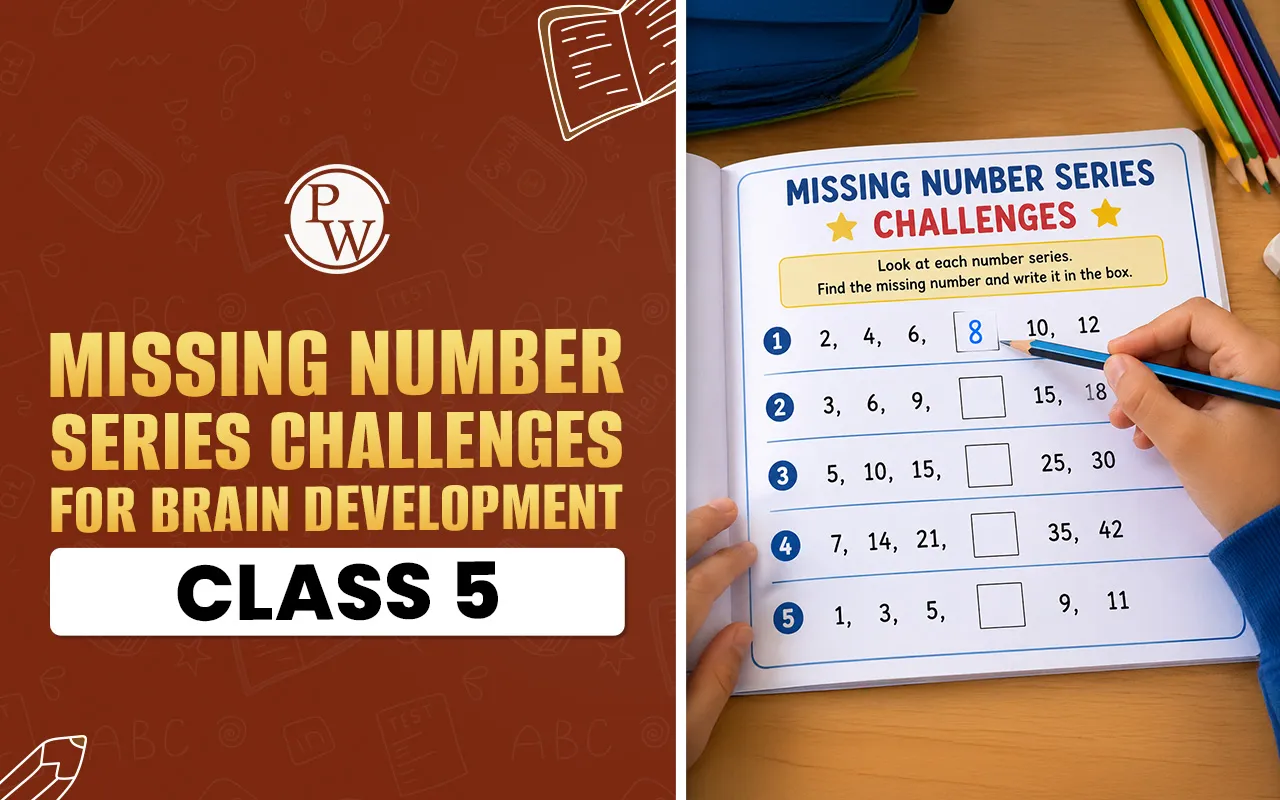
Missing Number Series Challenges for Brain Development (Class 5)
 Nikita Aggarwal26 May, 2026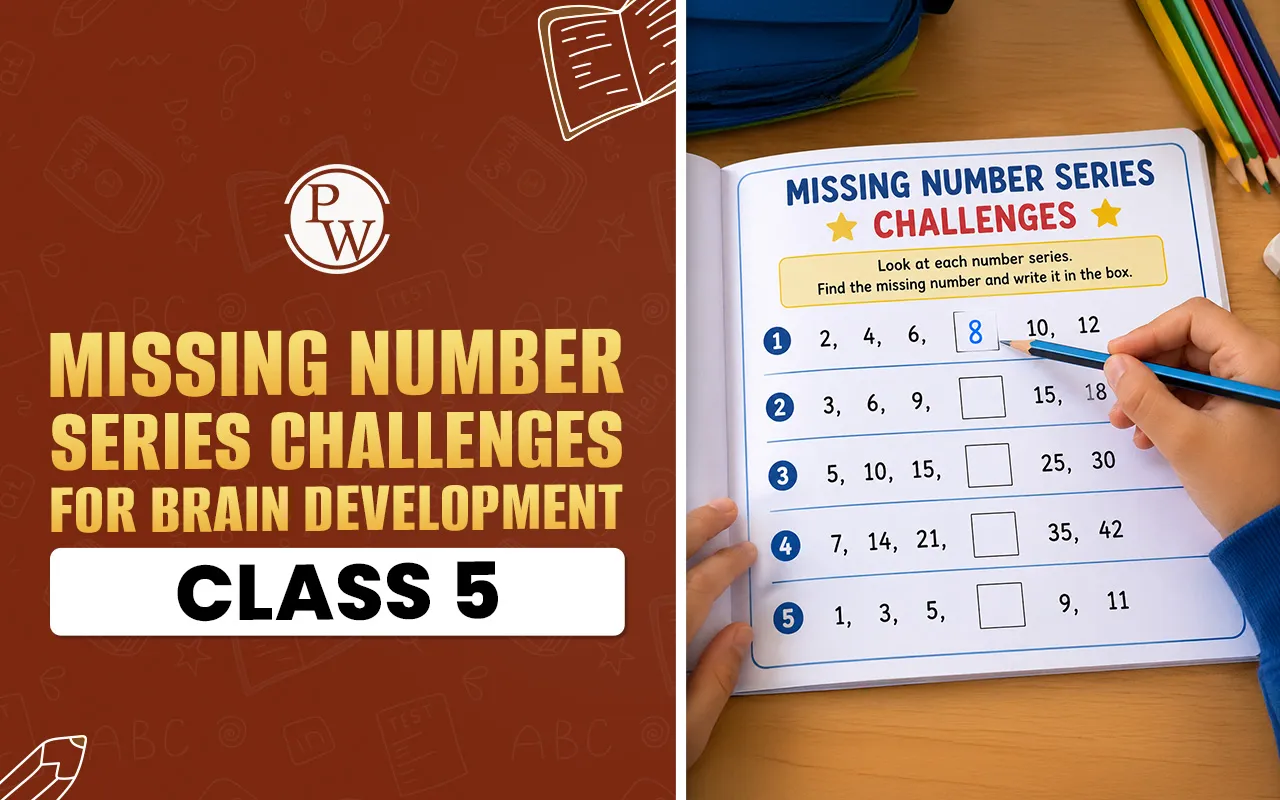
Importance of Missing Number Series Tricks for Class 5
Ten is a very receptive age for developing abstract thinking in the brain. Knowing a few tricks takes you from just adding and subtracting to solving real problems. These tricks help students to see the relation between numbers instead of seeing them as isolated figures.
When students run into these challenges, they are, in effect, doing class 5 brain training. It has them test hypotheses, such as whether a sequence is increasing by addition or multiplication. This trial-and-error approach helps students develop stronger mathematical and logical thinking skills.
How to Identify Patterns Using Missing Number Series Tricks
The first step in any number challenge is to determine the "rule" of the sequence. Most missing number puzzles follow a specific mathematical operation that stays consistent throughout the string.
Students should find the rule using the first three numbers in the series. If the numbers are increasing slowly , the rule is probably '+ ' . If they increase fast, it is generally by multiplication. On the other hand , downward numbers indicate subtraction or division .
Common Types of Number Patterns
One of the best tricks for quick solving is to get the category of the pattern. Students will be exposed to the major forms of:
-
Arithmetic Sequences: The difference between any two successive numbers is constant (e.g. 2, 5, 8, 11).
-
Geometric Sequences: Each number is multiplied by a constant to get the next ( eg 3 , 6 , 12 , 24 ) .
-
Square and Cube Series: Numbers follow the sequence of perfect squares or cubes (e.g., 4, 9, 16, 25).
-
Alternating Series: Two different rules are applied to alternating positions in the list.
Missing Number Series Tricks for Arithmetic Patterns
Addition and subtraction form the basis of most number series practice in primary school. The easiest way to solve these is the "Difference Method." By calculating the gap between the first two numbers and the second and third, the pattern usually reveals itself.
|
Sequence |
Difference |
Pattern Rule |
|
10, 15, 20, ? |
+5 |
Add 5 to the previous number |
|
50, 42, 34, ? |
-8 |
Subtract 8 from the previous number |
|
1, 3, 6, 10, ? |
+2, +3, +4 |
Add an increasing integer |
Using the table above, students can see how the gap dictates the next move. This visual breakdown is one of the many tricks that simplify mental maths class 5 tasks.
Read More - Place Value Tricks for Faster Large Number Calculations (Class 5)
Using Missing Number Series Tricks for Multiplication and Division
When the gaps between numbers get significantly larger, addition is no longer the culprit. Multiplication patterns require students to have a strong grip on their times tables. For example, in the series 5, 10, 20, 40, the numbers double each time.
One of the clever tricks for division is to work the pattern backwards. If a decreasing series like 100, 50, 25 feels difficult, trying to multiply starting from the smallest number can often make the logic clearer. This flexibility in thinking is a key part of critical thinking skills.
Advanced Tricks for Two-Step Patterns
Sometimes a single operation is not enough. Some puzzles are two step, like multiply by two and then add one. These are very common in Logical Reasoning and Competitive Exams.
To solve these, students should write the differences of the numbers. If the first set of differences doesn’t reveal any pattern, they should look for the “difference of the differences.” This second layer often shows a fixed number, helping them master these tricks for more difficult challenges.
Examples of Missing Number Series Tricks
Let's look at a few examples to apply the logic we have discussed. These examples are designed to build confidence in applying these tricks across different difficulty levels.
-
Series: 2, 4, 8, 16, ?
-
Logic: Each number is multiplied by 2.
-
Answer: 32.
-
Series: 100, 90, 81, 73, ?
-
Logic: Subtract 10, then 9, then 8, then 7.
-
Answer: 66.
-
Series: 1, 4, 9, 16, ?
-
Logic: These are square numbers (1x1, 2x2, 3x3, 4x4).
-
Answer: 25.
By working through these examples, students reinforce their class 5 brain training and become more comfortable with varied logic reasoning maths.
Read More - Decimal Rounding Tricks for Faster Calculation Speed (Class 5)
Common Mistakes While Solving Missing Number Series
Students often fail because they think that the first pattern they see applies to the whole string. One of the best tricks is to check the rule on at least three transitions before answering.
Another common mistake is to forget to check for primes or squares. If a difference looks random, often it can be solved by looking if the numbers themselves are prime. Paying attention to such details helps students strengthen their critical thinking skills.
Learn Missing Number Series Tricks for Class 5 with CuriousJr
Building a strong foundation in logic requires more than just textbook reading; it requires interactive and engaging platforms. This is where CuriousJr helps Class 5 students excel. By providing a gamified environment for mental maths and logical puzzles, CuriousJr ensures that learning these tricks becomes an exciting adventure. The platform focuses on practical application, allowing students to test their critical thinking skills through real-time challenges that adapt to their learning pace.
Learning CuriousJr online mental maths class gives many useful benefits that help students improve faster and enjoy maths more. Some of the key benefits parents should know about when enrolling their child in the mental maths for class 5 online course are:
1. Faster Problem Solving: Students can solve mental maths questions for class 5 quickly without using fingers, rough paper, or calculators.
2. Stronger Memory and Focus: Regular practice and simple explanations help students remember steps and focus better in class.
3. Better Exam Performance: Quick calculation skills help students save time in exams and reduce silly mistakes.
4. More Confidence in Maths: When students regularly solve questions on mental maths for class 5 with answers and get their doubts cleared on time, they feel more confident while solving even tough questions.
5. Enjoyable Learning Experience: Fun and easy methods make learning mental maths for class 5 interesting. As a result, students start enjoying the subject instead of feeling scared.