Decimal Rounding Tricks for Faster Calculation Speed (Class 5)
 Nikita Aggarwal26 May, 2026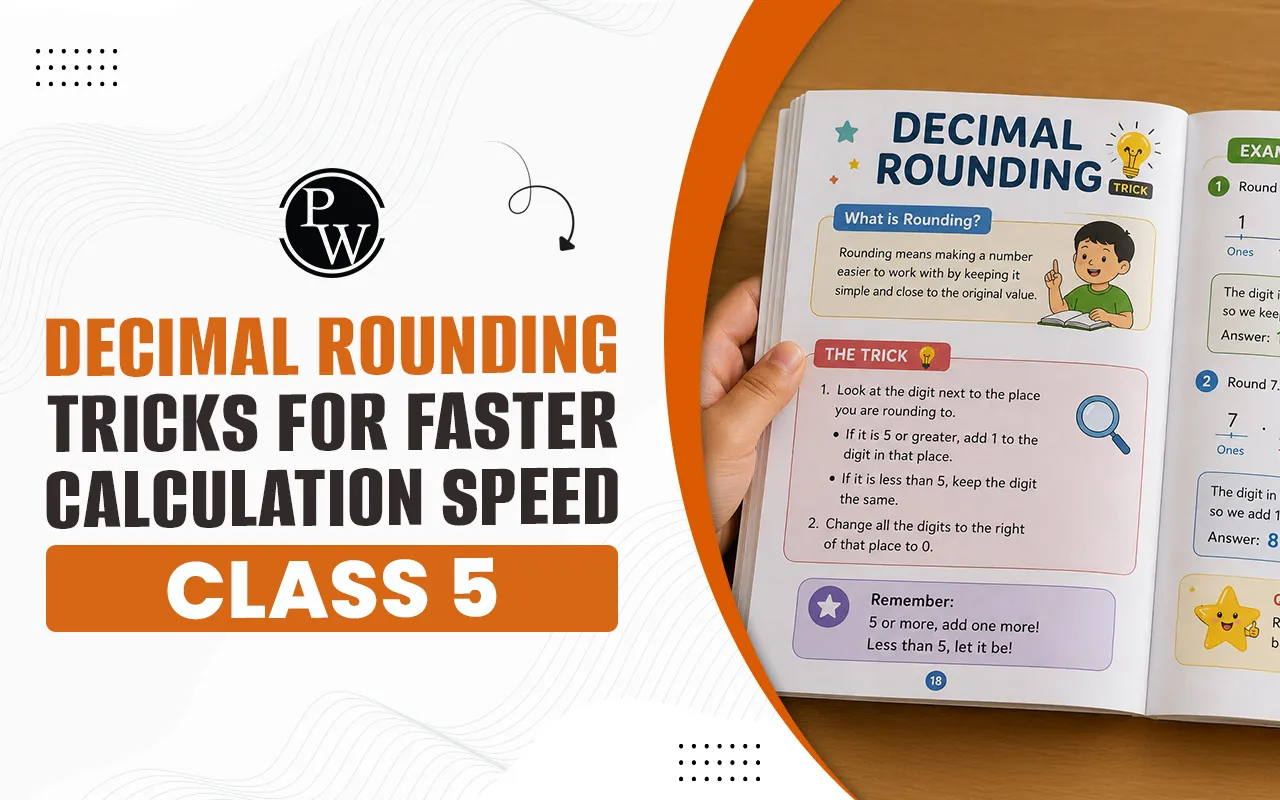
Importance of Decimal Rounding Tricks
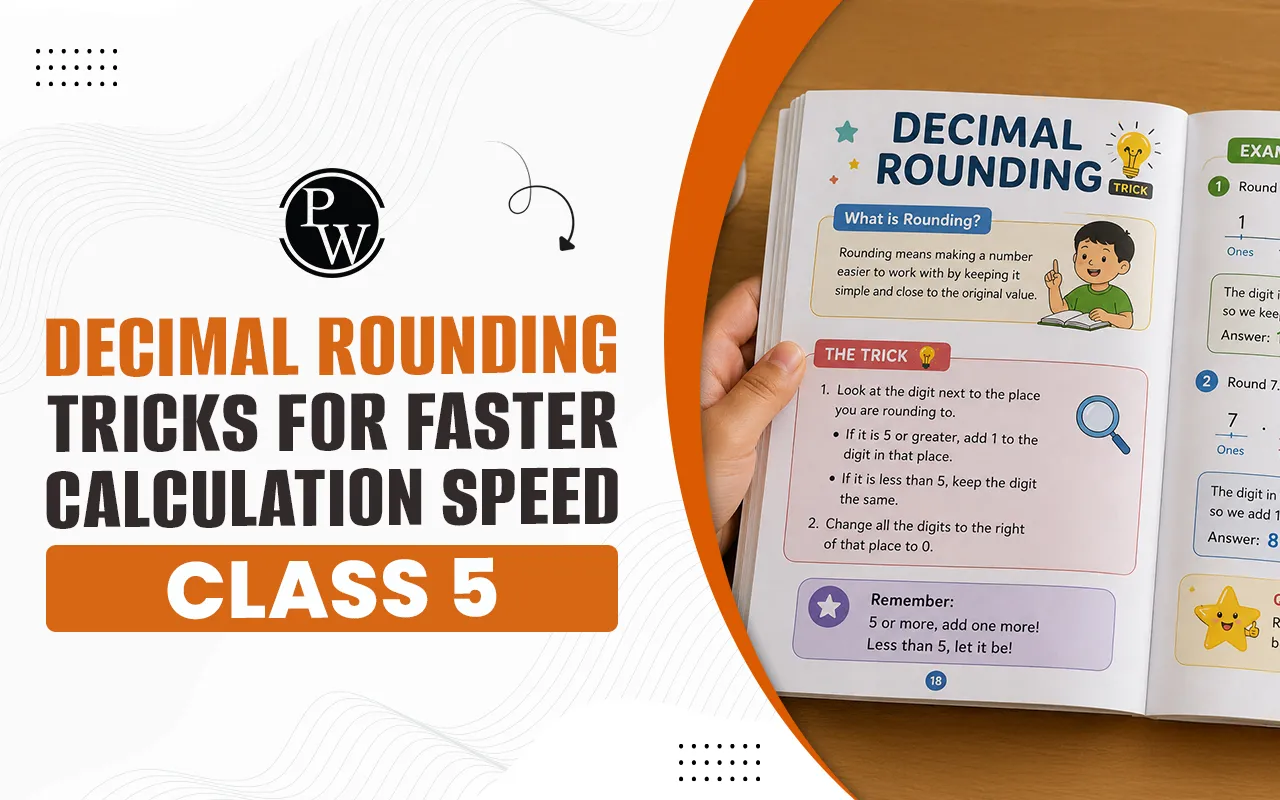
Learning to round decimals is not just about following a set of school rules; it is a vital skill for fast calculation methods. When you round a number, you are essentially creating a simpler version of it that is still close enough to the original to give a useful answer.
In daily life, there is rarely any need for all the digits after the decimal point. For example, if you are buying a snack that costs 2.99, your brain automatically rounds it up to 3. This shortcut is the basis of estimation maths tricks. These methods reduce the cognitive load on your brain, so you can focus on the core logic of a problem instead of getting stuck on tiny digits.
Decimal Rounding Rules for Class 5
Before you can use any shortcuts, you have to understand the basic rounding rules. These rules are the “law” of rounding, making sure that we all end up with the same simplified number.
The most important digit to look at is the one immediately to the right of the place value you are rounding to. This is often called the "deciding digit." If this digit is 5 or more, you round up. If it is 4 or less, you keep the digit the same and drop everything that follows.
The following table explains how to handle the deciding digit in different scenarios:
|
Deciding Digit Value |
Action to Take |
Resulting Change |
|
0, 1, 2, 3, or 4 |
Round Down |
The target digit stays exactly the same. |
|
5, 6, 7, 8, or 9 |
Round Up |
Add 1 to the target digit. |
Decimal Rounding Tricks for Whole Numbers
When you are dealing with class 5 decimals, the most common task is rounding to the nearest whole number. This is particularly helpful when you need a quick estimate for a sum. A great trick is the "Number Line Visualisation." Imagine the whole numbers on a line and see which one your decimal is physically closer to.
If you have the number 7.6, look at the 6. Since it is greater than 5, the 7 becomes an 8. If you have 7.4, the 4 tells you to stay at 7. This trick works because you are finding the "nearest neighbour." It prevents you from making the common mistake of always rounding up, which would make your final answer too high.
How to Apply Decimal Rounding Tricks to Tenths
Rounding to the nearest tenth means you want only one digit after the decimal point. This is a step up in difficulty but follows the same logic. You must look at the hundredths place (the second digit after the point) to decide what to do with the tenths place.
To make this faster, use the "Finger Cover" method. Cover all digits to the right of the hundredths place with your finger. Focus only on that second digit. If it is high, "bump up" the first decimal digit. If it is low, keep it. This keeps your eyes from getting distracted by a long string of numbers.
Here are some examples of rounding to the nearest tenth:
-
4.58 becomes 4.6 (8 is high, so 5 goes up).
-
12.31 becomes 12.3 (1 is low, so 3 stays).
-
0.85 becomes 0.9 (5 is the "tipping point," so round up).
Read More - Percentage Tricks Using Mental Maths for Class 5
Decimal Rounding Tricks to Improve Mental Maths Speed
Improving the speed involves practicing these shortcuts until they become automatic. Instead of writing everything down, try to round the numbers in your head as soon as you see them. This is especially useful for addition.
For example, if you need to add 5.1 and 3.9, round them to 5 and 4. Your estimate is 9. The real answer is also 9! While it won't always be that exact, it gives you a "ballpark" figure so you know if your final calculated answer is sensible. If your estimate is 10 and your final answer is 100, you know a decimal point has been misplaced.
Using Decimal Rounding Tricks for Multiplication
Multiplication with decimals can be slow and prone to errors. To speed this up, round both numbers to the nearest whole number before you start. This gives you a target to aim for.
Suppose you have to multiply 4.8 by 2.1.
-
Round 4.8 to 5.
-
Round 2.1 to 2.
-
Multiply 5 by 2 to get 10.
Now you know your final answer should be around 10. When you do the actual calculation (4.8 x 2.1 = 10.08), you can be confident in your result. This trick is a lifesaver during timed tests where you don't have time to re-check every single multiplication step.
Read More - Speed Maths Test for Class 5
Decimal Rounding Practice Questions for Class 5 Maths
To get better at mental maths class 5 level problems, you need consistent practice. Try to solve the following rounding challenges in your head within three seconds each.
The goal here is not perfect precision but rapid identification of the nearest simplified value. Try these:
-
Round 9.44 to the nearest whole number.
-
Round 15.67 to the nearest tenth.
-
Round 0.22 to the nearest whole number.
-
Round 101.5 to the nearest whole number.
Working through these quickly helps your brain recognise patterns. You will soon stop "calculating" and start "seeing" the rounded value, which is the hallmark of a maths expert.
Avoiding Common Mistakes with Decimal Rounding Tricks
One common error students make is "double rounding." This happens when you round a number to the tenth, and then use that new number to round to the whole number. This can lead to incorrect answers. Always go back to the original number provided in the question.
Another mistake is forgetting the "5 rule." Remember, 5 is the midpoint, but in standard maths rules, we always round up. Think of it as a ball sitting on top of a hill; at 5, it has enough energy to roll forward to the next number. Keeping these simple visual cues in mind will ensure you never get confused during a high-pressure exam.
How CuriousJr Helps Develop Class 5 Maths Skills with Decimal Rounding Tricks
Mastering these shortcuts is a gateway to more advanced topics like percentages and ratios. When you feel comfortable with decimals, you stop fearing maths and start enjoying the logic behind the numbers. CuriousJr kids online Mental Maths Class provides a fantastic environment where these concepts are broken down into interactive steps that make learning feel like a game. By exploring the modules on CuriousJr, you can apply your rounding skills to real-world coding and logic puzzles, turning abstract school lessons into practical tools for your future.