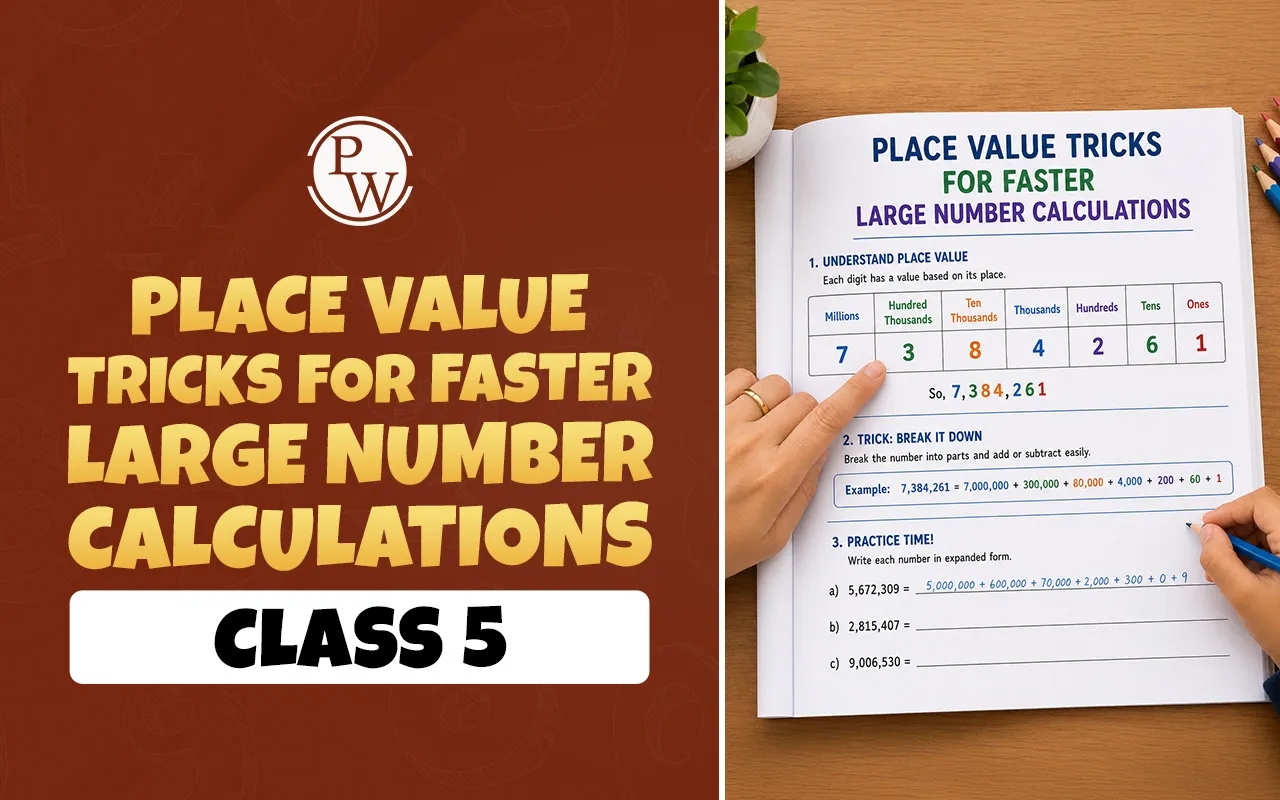
Place Value Tricks for Faster Large Number Calculations (Class 5)
 Nikita Aggarwal26 May, 2026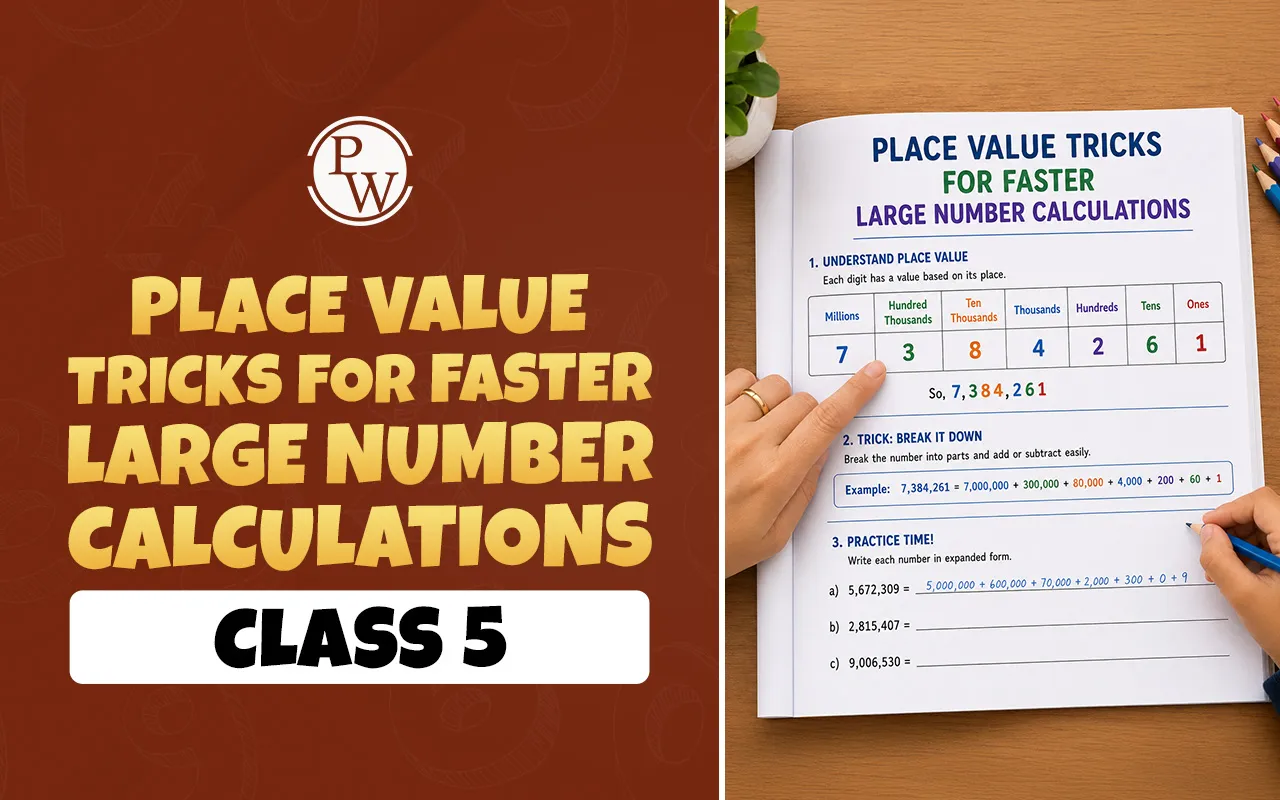
Importance of Place Value Tricks
The secret to mental maths is understanding how digits move in a grid. If you see a number like 5,40,000 , then you should not see six different digits, but a specific “home” for each value. To compute sums fast, it is important to know these shortcuts.
Most students try to memorise numbers, but the smartest way is to visualize the "periods." This method allows for mental maths class 5 students can use to solve addition or subtraction of large numbers in seconds.
Tricks to Understand Decimal Numbers
One of the most effective tricks involves shifting digits when multiplying or dividing by 10, 100, or 1000. Instead of doing long multiplication, you simply move the "value" of the number to the left or right.
-
Multiplying by 10: Move every digit one place to the left and add a zero.
-
Dividing by 10: Move every digit one place to the right.
-
Multi-step shifts: For 100, move two places; for 1000, move three.
How to Apply Place Value Tricks in the Indian System
The Indian Numbering System contains a special pattern of commas that helps you in number system tricks. The first comma is after three digits, every other comma is after every two digits. It is a visual cue , a shortcut built right in to know right away what the value of a digit is .
Before looking at the breakdown, remember that each "period" (Thousands, Lakhs, Crores) acts as a separate group. This makes reading much smoother.
|
Period |
Ten Crores |
Crores |
Ten Lakhs |
Lakhs |
Ten Thousands |
Thousands |
Hundreds |
Tens |
Ones |
|
Value |
10,00,00,000 |
1,00,00,000 |
10,00,000 |
1,00,000 |
10,000 |
1,000 |
100 |
10 |
1 |
Using this table, you can see that "Lakhs" always have five zeros following the primary digit. Remembering the "zero count" for each period is one of the best tricks for speed.
Common Place Value Tricks for International Numbering
If you are dealing with millions and billions, the pattern changes to groups of three. This consistency actually makes it easier to perform place value understanding exercises. In the International system, every comma represents a specific word: the first is "thousand," the second is "million."
To learn this, try the "Three-Digit Chunk" method. Look at 456,789. Instead of reading it all at once, read "456" then say "Thousand," then read "789." This simple division reduces the mental load significantly.
Read More - Decimal Rounding Tricks for Faster Calculation Speed (Class 5)
Difference Between Indian and International Number Systems
Converting Indian and International Values is a very common problem in class 5 maths basics. Use the “Ten-to-One” rule to keep them straight. e.g. 1 million = 10 lakhs. Knowing these equivalent points, you will be able to switch between systems without drawing a chart every time.
Solving Addition with Place Value Tricks
Conventional carry-over addition is slow. A quicker trick is “Left-to-Right Addition.” If you concentrate on the largest digit you can get a rough estimate of the answer very quickly. When you add 5,000 + 3,000 , you look at the " thousands " place first .
This method is a core part of the mental maths syllabus. This avoids the common error of matching the wrong columns together, a frequent occurrence when students work from right to left and lose track of the columns.
Expanded Form Tricks for Large Numbers
When numbers look too big, break them down. This is the "Expand and Conquer" trick.
To add 456 + 231:
-
Add the hundreds: 400 + 200 = 600.
-
Add the tens: 50 + 30 = 80.
-
Add the ones: 6 + 1 = 7.
-
Total: 687.
Read More - Division by 5, 10, 25 Vedic Maths Tricks for Class 5
Place Value Tricks for Subtraction Sums
Subtractions like 1,000 - 467 are often hard because of the "borrowing" involved. A great trick here is the "All from 9, Last from 10" rule. This is a Vedic maths secret that fits perfectly into Class 5 learning.
To subtract 467 from 1000:
-
Subtract 4 from 9 = 5.
-
Subtract 6 from 9 = 3.
-
Subtract 7 from 10 = 3.
-
Result: 533.
This method eliminates the need for messy crossing out and borrowing, making it one of the most useful fast calculation skills for timed tests.
Place Value Tricks for Large Number Multiplication
When multiplying large numbers that end in zeros, ignore the zeros at first. This is a classic trick. If you need to solve 600 times 70, just multiply 6 and 7 to get 42. Then, count the total zeros (two from 600 and one from 70) and attach them to the end.
The result is 42,000. This avoids long-form multiplication and keeps your workspace clean. This logic applies to any number of zeros, making it a powerful tool for large number reading and calculation.
Daily Practice with Place Value Tricks
To get faster, you need to practice identifying values without writing them down. Try "Digit Hunting" games where you look at a car number plate or a receipt and immediately name the place value of a specific digit. This builds the "mental muscle" needed for advanced topics later.
Consistent practice with these number system tricks ensures that by the time you reach higher classes, you aren't slowed down by simple arithmetic errors.
|
Number |
Digit to Check |
Place Value |
Total Value |
|
8,45,210 |
4 |
Ten Thousands |
40,000 |
|
12,33,987 |
2 |
Lakhs |
2,00,000 |
|
50,06,122 |
6 |
Thousands |
6,000 |
As you become more comfortable with these tables, you will notice that your calculation skills improve across all subjects, not just maths. Whether you are calculating distances in geography or dates in history, these skills stay with you.
Learning to navigate the world of large digits is the first step toward becoming a maths expert. If you find these methods helpful, you might enjoy exploring more interactive ways to practice. Platforms like CuriousJr offer gamified experiences where you can apply these tricks to solve puzzles and build your own logic-based games, turning abstract numbers into real-world fun.
How to Learn Place Value with CuriousJr
The journey of learning mental maths class 5 concepts is much more exciting when you can see the results in action. Applying these tricks helps you code better and think more logically. Using the CuriousJr platform allows you to take these maths basics and use them to create your own digital projects, proving that numbers are the language of the future.
CuriousJr online Mental maths for class 5 is carefully curated to help students solve maths questions quickly and easily. These key offerings make learning mental maths simple and enjoyable.
-
Live and Interactive Classes: Maths is taught in fun and simple ways to keep students interested and active.
-
Personal Teacher Support: Every student gets proper guidance from a dedicated teacher who helps them at every step.
-
Daily WhatsApp Help: Students and parents get everyday support for questions and homework through WhatsApp.
-
Homework and Doubt Clearing: Students get help with homework and can easily clear their doubts whenever needed.
-
Daily Progress Tracking: Parents can see their child’s daily performance to understand how they are improving.
-
Flexible Learning: As these are online classes, students can learn comfortably from home at a suitable time.