Logical Deductions Mental Maths Tricks for Class 8
 Nikita Aggarwal28 May, 2026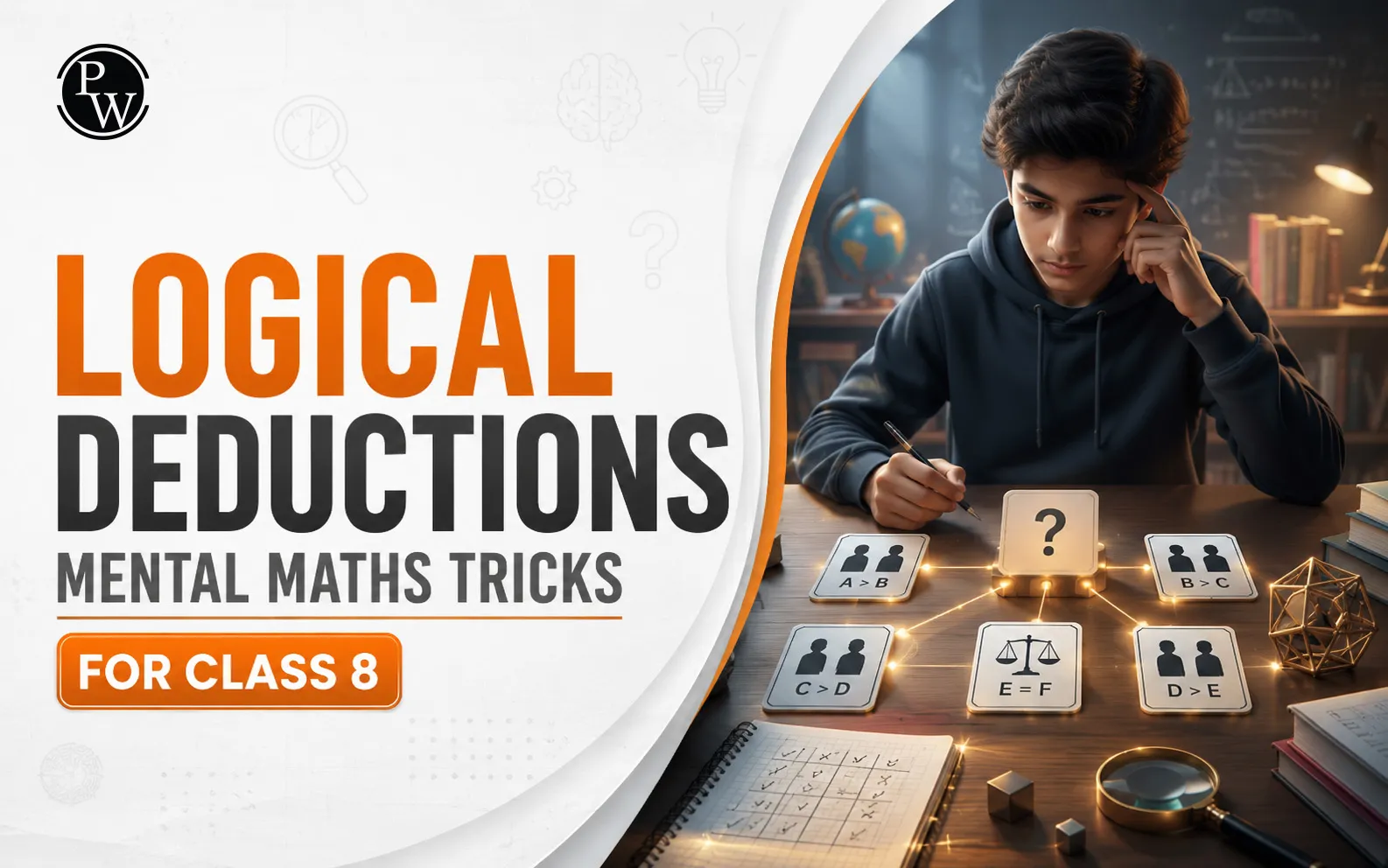
Importance of Logical Deductions Mental Maths Tricks
At this stage, by developing the skill of sharp critical thinking, you are laying the foundation for the future competitive exams. When you practise structured reasoning methods, you are training your brain to process information in a systematic way rather than blindly guessing answers.
Mental ability reasoning tricks alter the perspective of solving word problems and identifying data patterns. Instead of reading a paragraph over and over, you learn to pull out the key facts on the first reading.
Here’s what you will get from regularly practising these methods:
-
Higher Accuracy: You eliminate wrong answers systematically using clear rules.
-
Faster Processing: You solve multi-step problems in seconds without needing rough paper.
-
Better Focus: Breaking down data keeps your mind calm and organized during exams.
The syllabuses are more than just simple arithmetic and test your analytical skills. Logical deductions for class 8 help you bridge the gap between simple maths and advanced problem-solving. This practice teaches you to calmly handle complex data structures and not feel overwhelmed when facing unfamiliar questions under exam conditions.
Logical Deductions Mental Maths Tricks for Statement and Conclusion Problems
These problems present a short statement followed by potential conclusions. Your task is to decide which conclusion directly follows the given data without making assumptions outside the text.
When solving statement and conclusion problems, consider the given statement to be 100% true even if it contradicts facts of the real world. Never bring in outside knowledge to justify an answer.
To evaluate conclusions effectively, use the following checklist:
-
Direct Link: The conclusion must directly relate to the keywords in the statement.
-
No Extrapolation: Avoid guessing what happens next; look only at what is already written.
-
Watch for Qualifiers: Words like "all," "never," "always," or "none" usually make a conclusion too rigid to be true unless explicitly stated.
Let us look at a practical example to see how this works in a live testing scenario.
Statement: All students in the room are top-rankers. Rahul is in the room.
To find the correct path forward, analyse the connection between the items using a clean, logical flow:
-
Identify the main group: "People in the room."
-
Identify the sub-group property: "They are all top-rankers."
-
Place the individual: "Rahul is inside this specific room."
-
Deduce the result: "Therefore, Rahul must be a top-ranker."
Read More - Exponents Shortcut Methods for Class 8
Logical Deductions Mental Maths Tricks for Deduction Reasoning Questions
Syllogisms and Venn diagrams form the core of school-level logic assessments. Turning sentences into visual shapes makes abstract relationships clear and easy to understand.
Using Venn Diagrams for Visualising Sets
Visualising data sets prevents logical slips. When working on deduction reasoning questions grade 8 level, draw simple, overlapping circles mentally or on paper to track how different groups interact.
The table below outlines the three primary relationships you will encounter in these exercises:
|
Relationship Type |
Visual Setup |
Core Logical Rule |
|
Universal Affirmative (All A are B) |
Circle A sits entirely inside Circle B. |
If something belongs to A, it must belong to B. |
|
Particular Affirmative (Some A are B) |
Circle A and Circle B overlap slightly. |
At least one item shares characteristics of both groups. |
|
Universal Negative (No A are B) |
Circle A and Circle B are completely separate. |
No item from group A can ever enter group B. |
Elimination Strategies for Multiple-Choice Questions
If a conclusion says "Some B are A," look at your overlapping circles to verify the link. If the circles do not touch, eliminate that option immediately. Eliminating wrong choices is often faster than searching for the correct one from scratch.
Read More - Mensuration Tricks Using Mental Maths for Class 8
Logical Deductions Mental Maths Tricks for Analytical Reasoning Exercises
Analytical reasoning puzzles require you to arrange data based on specific constraints, such as seating plans, linear queues, or scheduling grids.
-
Seating Arrangements and Linear Queues
When working through analytical reasoning exercises for students, always fix definite positions first. If a clue states "Amit sits exactly in the middle of a five-person bench," place Amit in position three immediately.
Use these tips to organize spatial data without getting confused:
-
Establish Direction: Always decide which way your subjects are facing (e.g., North or South) to keep left and right clear.
-
Mark Negatives: Write down who cannot sit next to whom at the edge of your worksheet.
-
Build Multiple Paths: If a clue has two possibilities, sketch both quickly and cross out the one that breaks a rule later.
-
Decoding Complex Grid Puzzles
Grid puzzles match people with specific traits, like favorite subjects or sports. Draw a small matrix grid with names on the side and traits on top. Put a tick mark for confirmed matches and a cross for definite exclusions until the grid is complete.
Logical Deductions Mental Maths Tricks for Coding and Decoding
Coding questions ask you to decipher a rule that transforms a word into a secret sequence of letters or numbers. Discovering the underlying pattern allows you to apply it to new words effortlessly.
Working with Letter Shifts
Letters shift forward or backwards in the alphabet based on a fixed numerical sequence. Writing down alphabet rank numbers helps you spot these intervals instantly.
The list below details the most common shift patterns used in school assessments:
-
Constant Shifts: Every letter moves forward by a fixed number of spaces (e.g., $+2, +2, +2$).
-
Progressive Shifts: The movement increases sequentially with each letter (e.g., $+1, +2, +3$).
-
Alternating Shifts: The pattern toggles between forward and backward movements (e.g., $+1, -1, +1$).
Opposites and Mirror Coding
Another popular pattern pairs letters from opposite ends of the alphabet. For example, A becomes Z, B becomes Y, and C becomes X. Memorizing these pairs saves you from counting letters manually during time-sensitive exams.
Logical Deductions Mental Maths Tricks for Daily Practice
Building fast mental processing requires consistent, daily habits. Practicing short, focused drills trains your brain to recognize patterns without second-guessing yourself.
The Five-Minute Morning Drill
Dedicate five minutes every morning to solving two logic puzzles. This morning routine wakes up your brain and sharpens your focus before you start your standard schoolwork.
Tracking Progress with Error Logs
Keep a small notebook for questions you answer incorrectly. Write down where your logic failed so you can review your mistakes before exams and avoid repeating them.
To maximize your study efficiency, try organizing your weekly practice topics using this simple schedule:
|
Day of the Week |
Targeted Focus Area |
|
Monday & Tuesday |
Venn diagrams and group definitions |
|
Wednesday & Thursday |
Linear queues and grid arrangements |
|
Friday |
Letter coding patterns and numerical shifts |
How to Learn Logical Deductions Mental Maths Tricks with CuriousJr?
You need structured guidance and interactive learning tools to develop good habits of critical thinking. Check out the dedicated learning material where you can learn logical deductions mental maths tricks, with fun exercises designed for your school syllabus.
Interactive platforms show you exactly where a logical path went wrong, providing immediate feedback. This focused approach takes abstract reasoning concepts and turns them into practical skills you can use in your day-to-day school assignments and competitive exams.
Learning advanced problem-solving techniques becomes fun and accessible when you find structured learning platforms. CuriousJr Mental Maths courses have step-by-step challenges to practise analytical reasoning, pattern recognition and coding puzzles at your own pace.