Message Writing - Definition, Format, Examples
 Nikita Aggarwal6 May, 2026
What is Message Writing?
A message is a short, informal piece of writing that you send to someone who isn't available at the time to tell them something important. It is often based on a phone call or something someone saw in person.When you write a message, you want to make sure that the important information, like who, what, when, and why, is clear and to the point. The tone stays casual but direct because it is usually written for someone the writer knows. Message writing differs from formal letters in that it typically lacks long introductions and focuses more on speed and clarity.
What is the Message Writing Format?
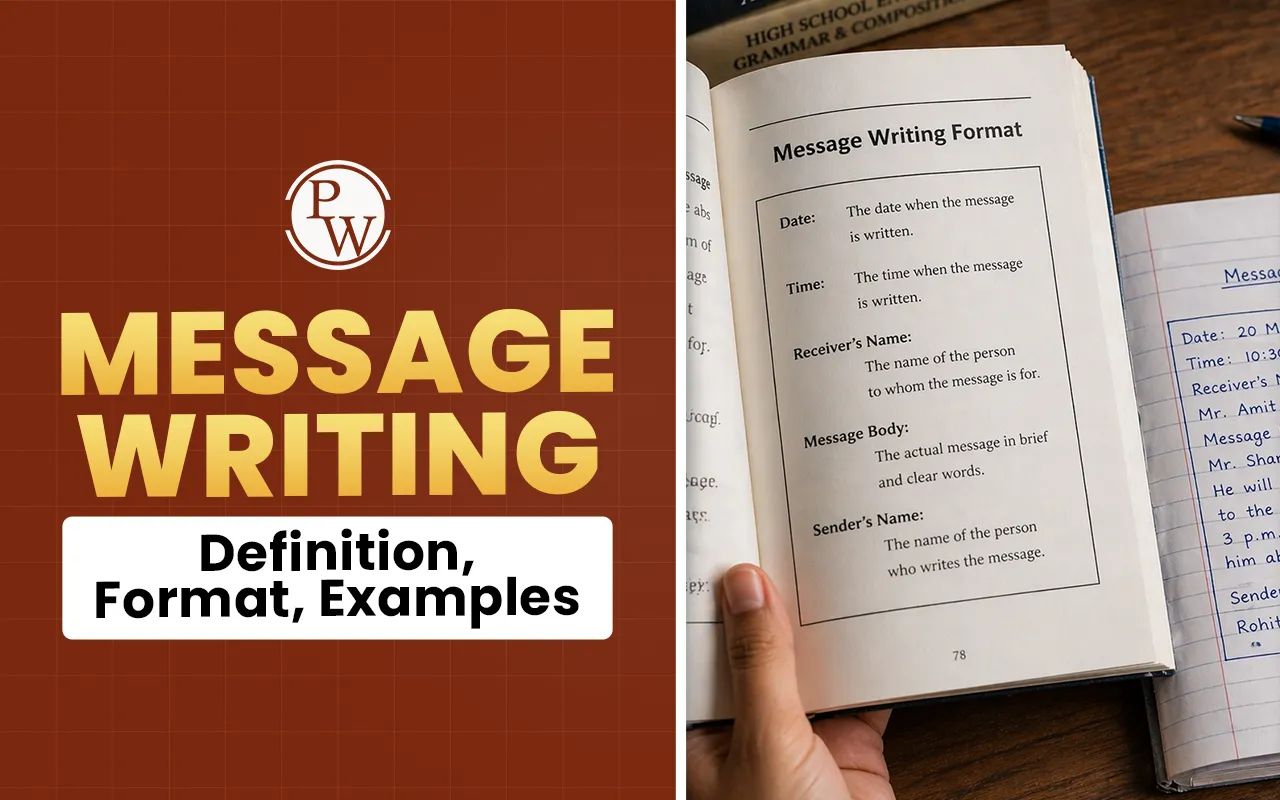
To ensure your message is professional and straightforward to read, you must follow a specific layout. It is usually preferred to write the message inside a box. Here is the step-by-step message writing format:
-
The Header: Write the word ‘MESSAGE’ in bold, capital letters at the very top centre of the box.
-
Date: Mention the date on the left-hand side (e.g., 21st April 2026).
-
Time: Place the time on the right-hand side, exactly opposite the date. This helps the receiver know how old the information is.
-
Salutation: A brief greeting to the person the message is for (e.g., 'Dear Mother' or 'Rahul').
-
Body of the Message: This section is the main part where you explain the information. Stick to the word limit (usually 50 words).
-
Sender’s Name: End the message by writing your name on the bottom left.
Message Writing Examples
Looking at examples of message writing is the best way to understand how to apply the format. Let’s look at a common scenario.
Scenario 1: A Phone Call from a Friend
The Prompt: You are Rohit. Your sister’s friend, Sneha, called while your sister was out. Sneha wants your sister to bring her science project to school tomorrow. You have to leave for your cricket practice.
|
MESSAGE 21st April 2026 | 4:30 PM Dear Sis, Your friend Sneha called while you were at the market. She requested that you bring her science project to school tomorrow without fail. I am leaving for my cricket practice now. Rohit |
Scenario 2: Office Communication
The Prompt: You are the receptionist. Mr Khanna called for the manager, who is in a meeting. Mr Khanna wants the manager to call him back regarding the new contract.
|
MESSAGE 21st August 2026 | 11:00 AM Dear Sir, Mr Khanna from Zenith Corp called while you were in the meeting. He asked you to call him back immediately regarding the details of the new contract. Receptionist |
Read More - Paragraph Writing - Structure and Types
Message Writing Practice Sheet
Practising message writing questions is the most effective way to understand how to condense information. Below are two solved examples following the official format.
Question 1: The Urgent Phone Call
The Conversation:
-
Caller (Mr Roy): Hello, can I speak to Mr Sharma?
-
Recipient (Aryan): Hello, I’m his son, Aryan. He is at the gym right now.
-
Mr Roy: Please tell him that the flight to Mumbai is rescheduled. It will now depart at 8:00 PM tonight instead of 4:00 PM. He needs to reach the airport by 6:00 PM.
-
Aryan: I’ll let him know.
Answer:
|
MESSAGE Date: 21st April 2026 | 10:30 AM Dear Dad, Mr Roy called while you were at the gym. He informed me that your flight to Mumbai has been rescheduled. It will now depart at 8:00 PM tonight. You are requested to reach the airport by 6:00 PM. Aryan |
Question 2: The School Project Reminder
You are Riya. Your brother Rahul’s friend, Kabir, came over while Rahul was in his swimming class.
Kabir wanted to remind Rahul to bring the biology practical file to school tomorrow, as the teacher will be checking it during the first period. You are leaving for your music class.
Answer:
|
MESSAGE Date: 21st April 2026 | 4:45 PM Rahul, Kabir came by while you were swimming. He reminded you to carry your biology practical file to school tomorrow. The teacher will check it during the first period. I am heading to my music class now. Riya |
Why Do We Use Message Writing?
In an era of instant messaging and digital calls, you might wonder about the relevance of handwritten notes. However, the logic behind this skill is more important than ever. Here is why we use message writing in English:
-
Clarity and Brevity: It trains the mind to filter out "noise" and focus only on essential facts. This is a vital professional skill.
-
Physical Reminders: A written message left on a desk or fridge acts as a constant visual cue, ensuring the task isn't forgotten once a phone screen is turned off.
-
Accuracy of Information: When you write down a message, you reduce the risk of forgetting details like a phone number, a new time, or a changed venue.
-
Time Management: It allows the sender to communicate and move on to their tasks without waiting for the receiver to become available.
-
Professionalism: In many offices, "while you were out" slips or memos are standard practice for maintaining a record of communication.
Read More - How to Write Descriptive Writing? - Format with Examples
Rules for Message Writing
Writing a message might seem simple, but there are specific rules you should follow to avoid losing marks or confusing the reader.
-
Use a Box: Always draw a rectangular box around your message. It gives the writing a neat, contained look.
-
Word Limit: Keep it short. Most writing questions expect you to stay within 50 words. Over-explaining leads to mistakes.
-
Indirect Speech: If you are reporting a conversation you had with someone else, use reported/indirect speech.
-
No Extra Details: Avoid adding your opinions or unnecessary "fluff". Stick to the facts provided in the prompt.
Clarity: Use simple language so the receiver can understand the core point at a glance.