
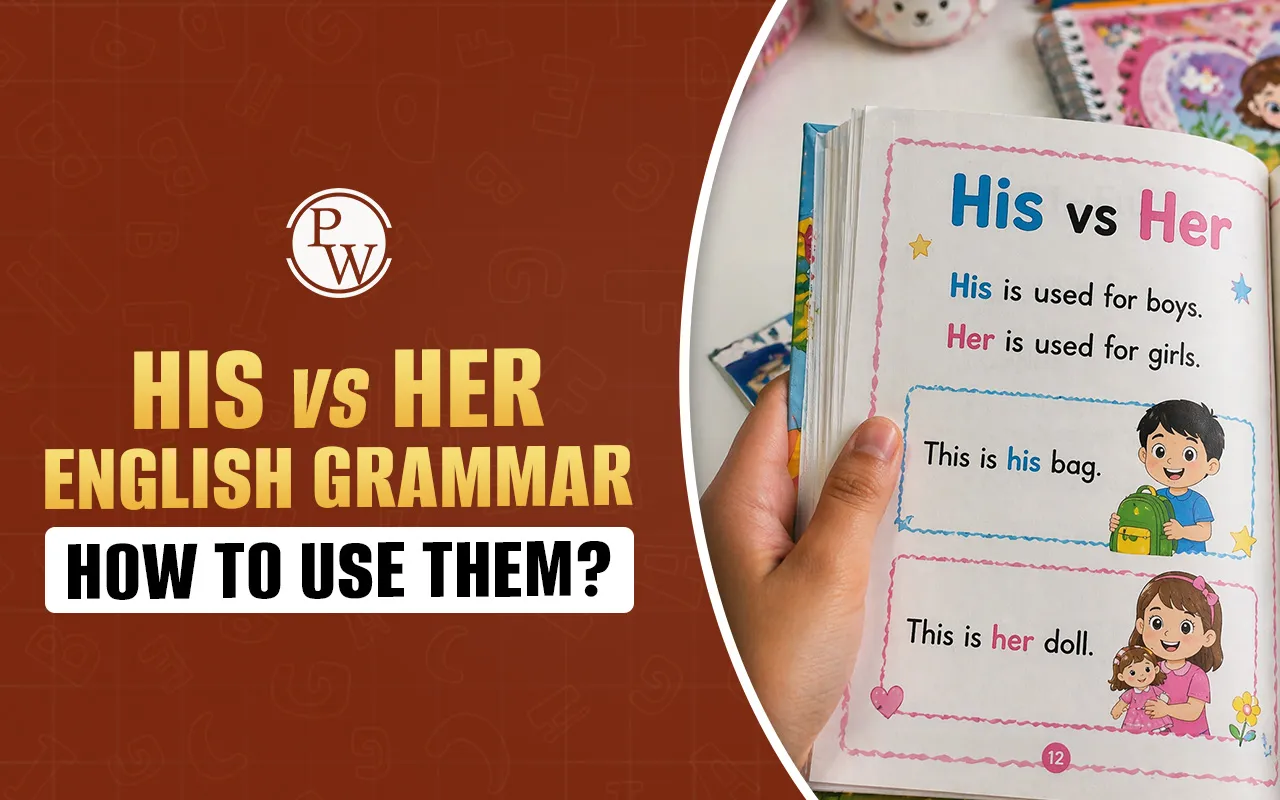
His vs Her in English Grammar – How to Use Them?
 Nikita Aggarwal6 May, 2026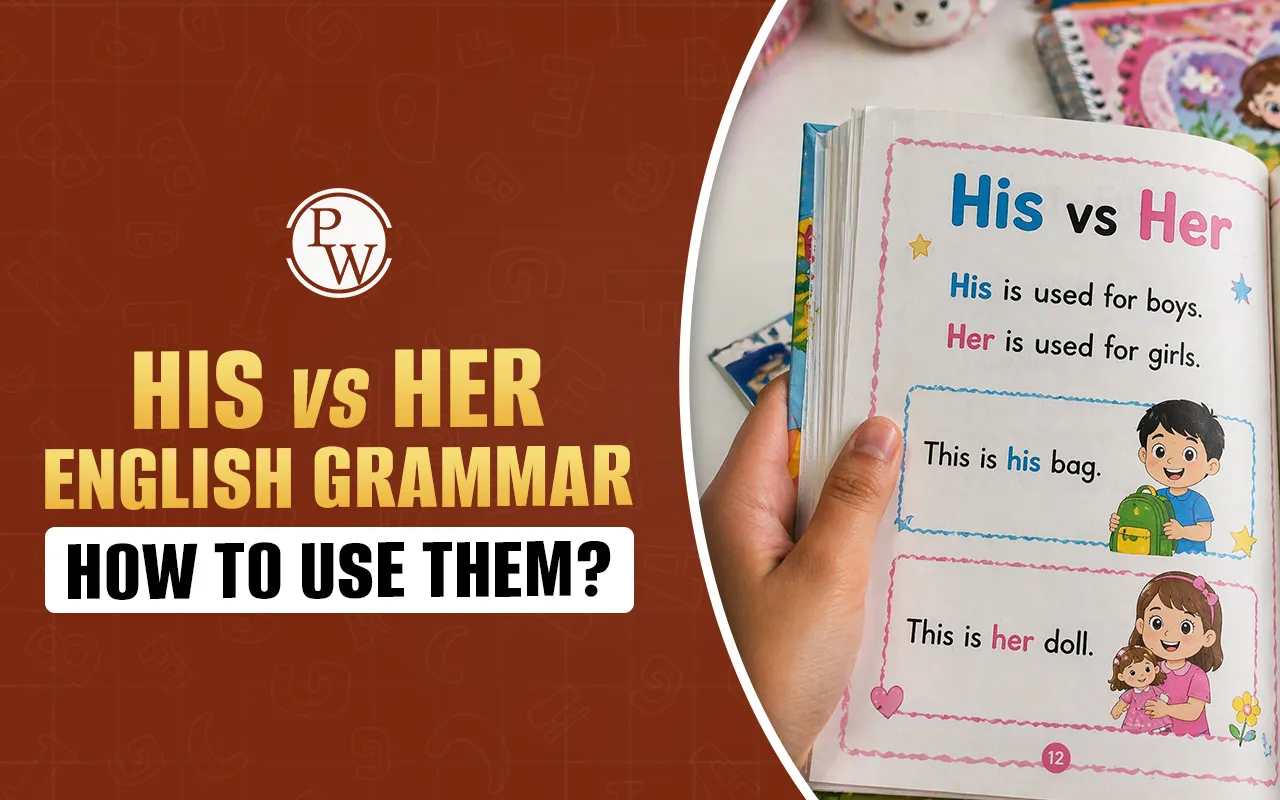
What Do His vs Her Mean?
Before knowing what his or her meaning is, we need to understand what these words really mean. His and her are collectively called pronouns.
These words are used to show that something belongs to someone or is related to them. His and her help us figure out who owns something or who is connected to someone.
When we talk about someone, we do not say their name all the time. We use words to make what we say sound natural.
For example, when discussing Rahul, instead of saying "Rahul lost Rahul's book", we say "Rahul lost his book", which sounds better.
Difference Between His vs Her
Understanding the his and her difference is straightforward once you focus on the gender of the person you are talking about.
|
Feature |
His |
Her |
|
Gender |
Masculine (Male) |
Feminine (Female) |
|
Usage |
Boys, Men, Male animals |
Girls, Women, Female animals |
|
Possessive Adjective |
His (His pen) |
Her (Her pen) |
|
Possessive Pronoun |
His (The pen is his) |
Hers (The pen is hers) |
When to Use His?
In English grammar, his is used for referring to a male person or animal. It represents the masculine gender. It can function in two ways: as a possessive adjective (placed before a noun) or as a possessive pronoun (standing alone).
-
As a Possessive Adjective: It describes a noun.
-
Example: That is his car.
-
As a Possessive Pronoun: It replaces a noun phrase entirely.
-
Example: That car is his.
Whether you are talking about a boy, a man, or a male pet, his is the correct choice to indicate that something belongs to him.
When to Use Her?
Similarly, her is used when we refer to a female person or animal. It represents the feminine gender. However, this word has a slight twist compared to its masculine counterpart.
In English, 'her' can be used as a possessive adjective, but when it acts as a standalone possessive pronoun, it usually changes to 'hers'.
-
As a Possessive Adjective: It comes before the noun.
-
Example: This is her umbrella.
-
As an Object Pronoun: It follows a verb or preposition.
-
Example: I saw her at the park.
Note on Possession: If you want to say "The umbrella is [belonging to her]," you must use hers.
The most important rule to remember is that these words point back to the owner, not the object being owned.
If a boy owns five dolls, you still use his because the owner is male. If a girl owns a football, you use her as the owner.
His vs Her Rules to Keep in Mind
To avoid confusion, follow these simple rules:
-
Use his → for a man who owns it
Example: His car is parked outside.
-
Use her → before a noun to show that a woman owns it
Example: Her dress is beautiful
-
Use hers when there is no noun after it.
Example: The dress is hers.
-
In both cases, "his" stays the same.
Example: This is his book / This book belongs to him.
-
Always pay attention to the owner, not the object.
Example, "her bike" means "a girl owns a bike."
Read More - Their vs There - Meaning, Rules, Examples
Common Mistakes with His vs Her
Below are some of the mistakes that students often make, even though his and her seem easy:
Mistake: This is her book. The book is her.
Correction: The book is hers.
Why: Use “hers” when there is no noun after it.
Mistake: This pen is hises.
Correction: This pen is his.
Why: “His” does not change form (no “-es” added).
Mistake: Rahul has a sister. His name is Priya.
Correction: Her name is Priya.
Why: Match the pronoun with the correct gender.
Mistake: The dog wagged her tail. (when dog is male)
Correction: The dog wagged his tail.
Why: Focus on the owner’s gender, not the object.
His vs Her Fill-in-the-Blanks Practice Question & Answers
Attempt the questions below to see how well you understood the concept:
-
This is ___ (his/her) notebook. (Aman)
-
The bag is ___ (his/hers). (Riya)
-
I met ___ (his/her) at the library. (Neha)
-
Rohit forgot ___ (his/her) wallet at home
-
This dog wagged ___ (his/her) tail happily. (male dog)
-
The red car is ___ (his/hers). (Arjun)
-
She loves ___ (his/her) new job.
-
The pencil is ___ (his/hers). (Anita)
Answers: his, hers, her, his, his, his, her, hers
Read More - Can vs Could: Meaning, Usage, Rules, Examples
His vs Her Sentence Examples
The best way to learn grammar is through practice. Here are some his and her sentence examples to show how these words function in daily conversation.
Examples for His:
-
David forgot his lunchbox on the kitchen table.
-
The little boy shared his sweets with everyone.
-
My father loves his new job at the hospital.
-
The dog wagged his tail when he saw the bone.
-
Is that coat his?
Examples for Her:
-
Sarah is doing her homework in the library.
-
The Queen wore her crown during the ceremony.
-
Alice asked her mother for a glass of water.
-
I really like her sense of style.
-
The cat licked her paws after eating.
Benefits of Using His vs Her
Using these pronouns accurately provides several advantages for your communication. Here is why mastering them is so beneficial:
-
Clarity and Precision: It stops people from getting confused. For example, if you say, "Rahul and Priya are here. I found Rahul's phone." The person listening will know immediately whose phone you are talking about, so you do not have to say Rahul's name again.
-
Better Sentence Flow: Constant repetition of names makes writing sound robotic. Using 'his' vs 'her' allows for a smoother, more professional rhythm in your speech.
-
Professionalism: Proper grammar shows that you have a strong grasp of the English language. This is particularly important for exams and school assignments.
-
Concise: These words act as shortcuts. They help you convey ownership in fewer words, making your communication more efficient.
-
Inclusivity and Respect: Using the correct gendered pronoun shows respect for the person you are talking about by acknowledging their identity correctly.
Build Your Child’s Confidence in Spoken English with CuriousJr
Is your child reluctant to speak English or struggling to construct sentences? This can affect their confidence, classroom participation, and communication skills. CuriousJr’s online English classes are designed to make language learning simple, engaging, and goal-oriented.
The program focuses on essential areas such as grammar, pronunciation, vocabulary development, and basic writing skills. Through interactive live sessions, children get regular speaking practice with guidance from experienced mentors. Fun activities like games, storytelling, and writing exercises make the learning process enjoyable and engaging. Parents also receive regular progress updates to track their child’s growth.
With structured levels suited to different learning speeds, CuriousJr helps children gradually build a strong foundation in English. Book a demo class today and help your child speak English with confidence.