Angle of Elevation - Definition, Formula, Examples
 Nikita Aggarwal6 May, 2026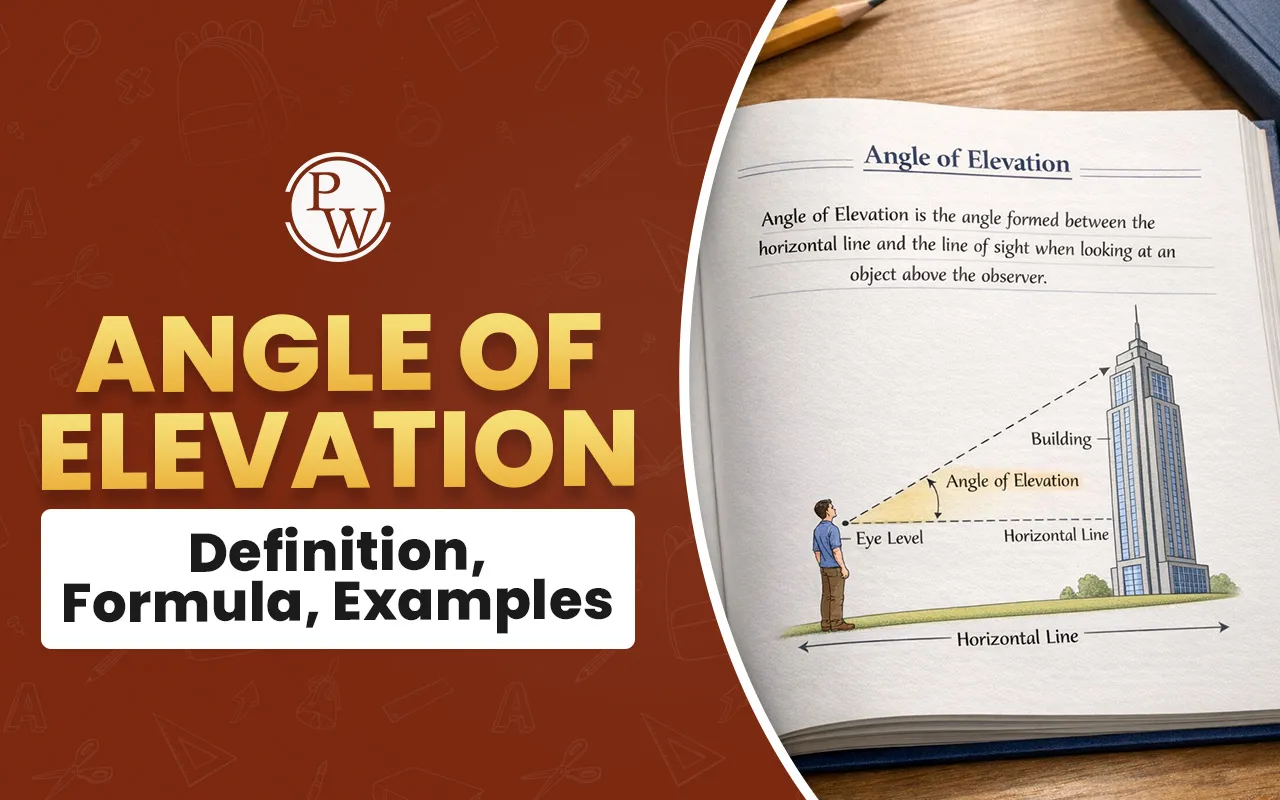
What is Angle of Elevation?
To understand the angle of elevation definition, consider a situation involving three elements: the observer, the object being observed, and the level ground.
When you look ahead parallel to the ground, you are looking along a horizontal line. If you tilt your head up to look at a bird or the top of a flagpole, your eyes follow a path that is the line of sight of the bird or the flagpole. The angle between the horizontal line and your line of sight upward is called the angle of elevation.
Parts of Angle of Elevation
-
The Observer: The point where we start measuring, and the observer's position is usually at eye level.
-
The Horizontal Line: A line that goes out from the observer's eye and stays parallel to the earth.
-
The Line of Sight: An imaginary line that goes from the observer's eye to the object that is above.
-
The Object: The thing we are looking at. It is higher up, than The Observer
In the angle of elevation in maths, this relationship always forms a right-angled triangle. The object's height is the "opposite" side, the distance from the observer to the object's base is the "adjacent" side, and your line of sight is the hypotenuse.
Angle of Elevation Formula
Because this concept creates a right-angled triangle, we use trigonometric ratios to find missing values. The most common ratio used for the angle elevation is the tangent (tan) function. This is because we often know (or can easily measure) the object's height and the horizontal distance on the ground.
The angle of elevation formula is expressed as:
Tan θ = Opposite Side / Adjacent Side
In simpler terms:
Tan θ = Height / Distance
Where:
-
θ (Theta): Represents the angle elevation.
-
Height: The vertical height of the object (the side opposite the angle).
-
Distance: The horizontal distance from the observer to the object (the side adjacent to the angle).
If you need to find the angle itself and you already know the height and distance, you would use the inverse tangent function:
θ = tan⁻¹ (Height / Distance)
Read More - Angles in Daily Life - Types & Applications
How to Find Angle of Elevation
If you are solving a problem in class or in the field, follow these logical steps to ensure accuracy:
-
Identify the Horizontal: Draw a flat line from the observer’s position.
-
Sketch the Line of Sight: Draw a diagonal line from the observer to the top of the object.
-
Label the Triangle: Mark the height of the object as the 'opposite' and the ground distance as 'adjacent'.
-
Apply the Formula: Plug your known numbers into the elevation formula.
-
Solve for θ: Use a scientific calculator to find the specific degree of the angle.
Angle of Elevation vs. Angle of Depression
People often get these two terms mixed up. There is a simple way to figure out the difference. Ultimately, the starting point is crucial.
-
Elevation: When you look UP from a point to a higher one, the angle you are looking at is above the line that is level with the ground. This means you must tilt your head to see what's above you.
-
Depression: You are looking DOWN from a high place like a cliff or a window to a spot that is lower than where you are standing. The angle you are looking at is below the line that's straight out, in front of you.
This concept shows the relationship between the two angles clearly. The angle you get when you look up from point A to point B is It is always the same as the angle you get when looking down from point B to point A. This occurs because these angles are like two matching angles formed by two parallel lines.
Read More - Straight Angle (180°) – Definition, Degree, Properties, Examples
Solved Examples of Angle of Elevation
To see how this concept works in real life, let’s look at some common angle of elevation examples.
Question 1: Finding the Height of a Tree An observer is standing 20 metres away from the base of a tree. The angle of elevation to the top of the tree is 30°. Calculate the height of the tree.
-
Solution:
-
Distance (Adjacent) = 20m
-
Angle (θ) = 30°
-
Tan 30° = Height / 20
-
0.577 = Height / 20
-
Height = 20 × 0.577 = 11.54 metres
Question 2: Finding the Angle of the Sun A vertical pole 6 metres high casts a shadow 6 metres long on the ground. What is the angle elevation of the sun?
-
Solution:
-
Height (Opposite) = 6m
-
Distance/Shadow (Adjacent) = 6m
-
Tan θ = 6 / 6 = 1
-
θ = tan⁻¹(1) = 45°
Question 3: Distance from a Building The angle elevation of the top of a building is 60°. If the building is 50 metres tall, how far is the observer from the base?
-
Solution:
-
Height (Opposite) = 50m
-
Angle (θ) = 60°
-
Tan 60° = 50 / Distance
-
1.732 = 50 / Distance
-
Distance = 50 / 1.732 = 28.87 metres
Components of Angle Elevation
|
Component |
Description |
Role in Triangle |
|
Horizontal Line |
The level line at the observer's eye height. |
Adjacent Side |
|
Line of Sight |
The path from the eye to the high object is clear. |
Hypotenuse |
|
Object Height |
The vertical measurement of the target. |
Opposite Side |
|
Theta (θ) |
The angle formed between horizontal and sight lines. |
The Angle of Elevation |
Make Maths Easy and Enjoyable with CuriousJr
CuriousJr empowers children to build a strong foundation in mathematics by removing fear and boosting confidence. Our online Mental Maths classes for students from Classes 1 to 8 are designed to improve speed, accuracy, and logical thinking through simple methods and interactive learning experiences.
With our dual-mentor approach, students participate in engaging live classes and receive personalized support to clear their doubts after every session. Animated lessons, fun activities, and exciting challenges make learning maths both enjoyable and effective.
Parents are kept updated through regular progress reports and review sessions, ensuring complete transparency in their child’s learning journey.
Book a demo class today and experience how CuriousJr transforms maths into a fun, engaging, and confidence-building subject for your child.