Centroid of Triangle – Definition, Formula, Examples
 Nikita Aggarwal10 Apr, 2026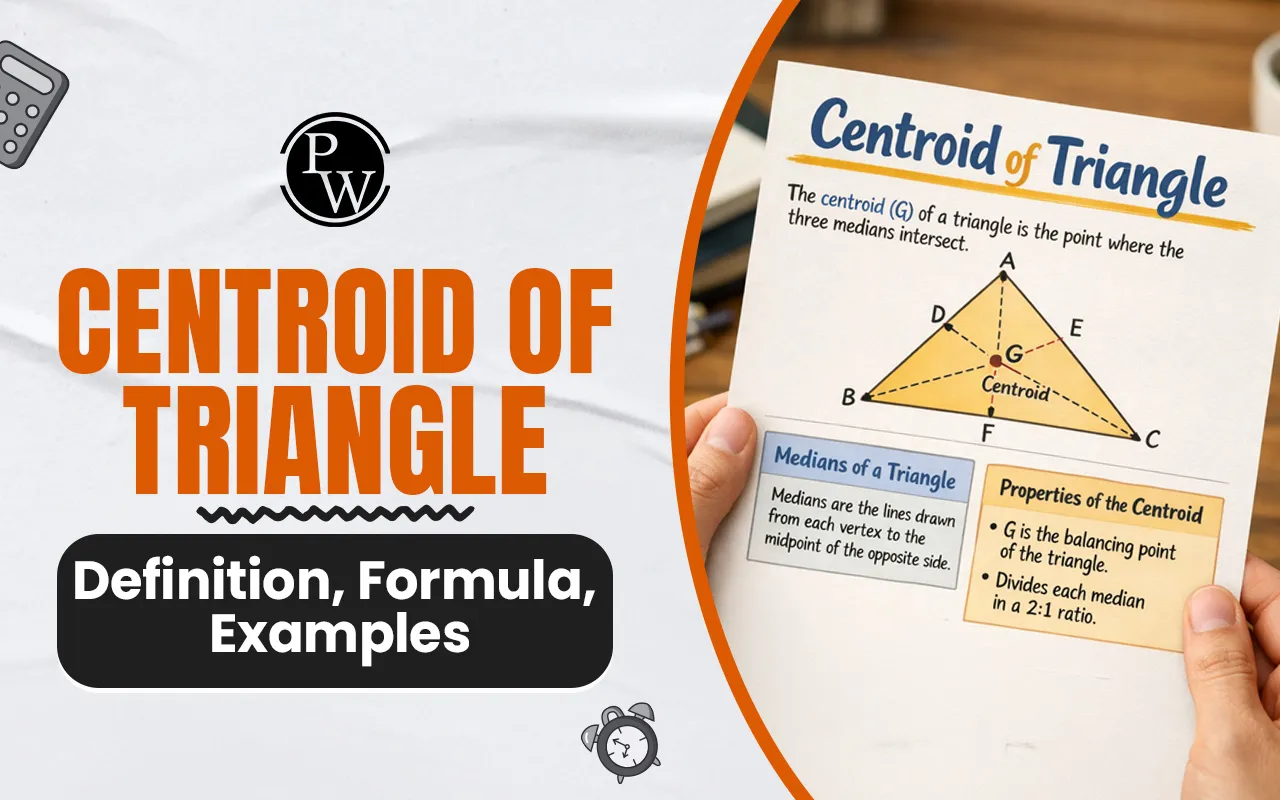
What is Centroid of Triangle?
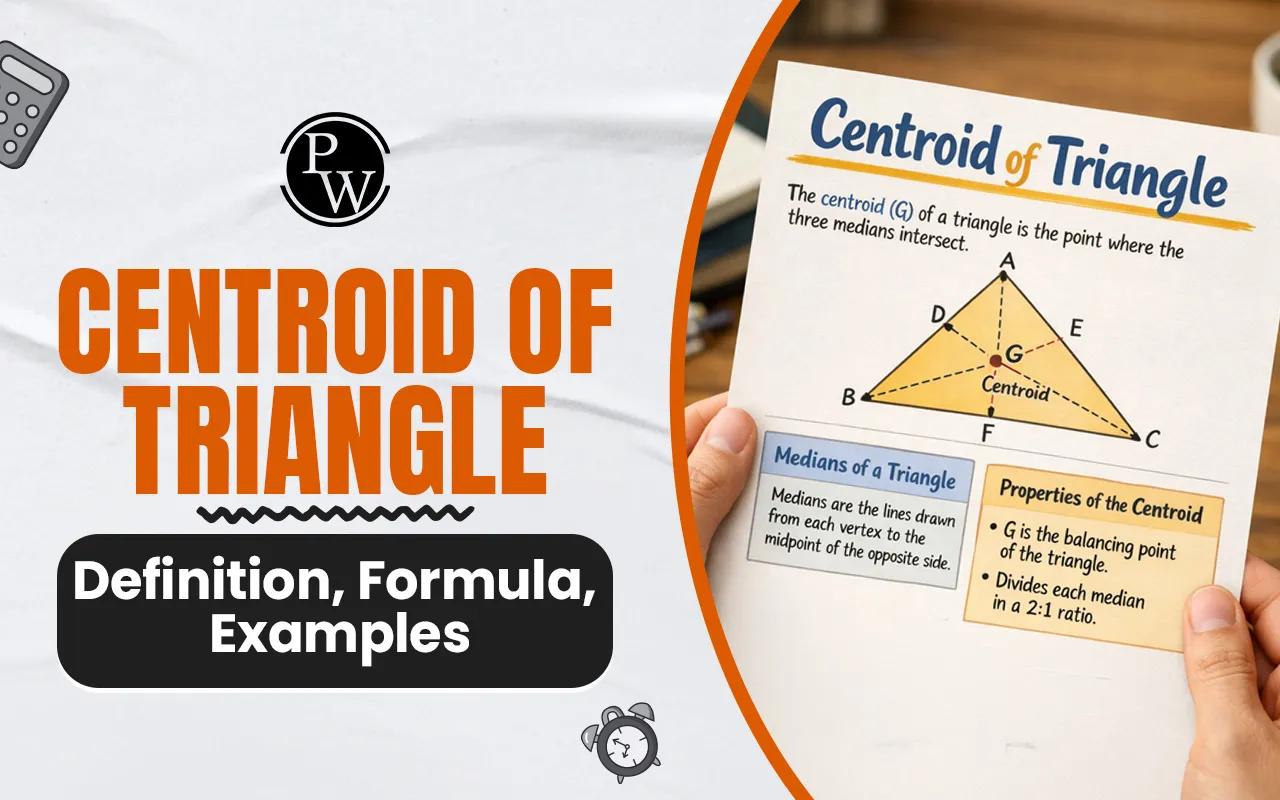
The centroid of triangle definition is simple: it is the point where the three medians of a triangle intersect. A median is a line segment drawn from one vertex to the midpoint of the opposite side. When all three medians are drawn, they meet at one common point inside the triangle.
So, it is the geometric centre or balancing point of the triangle. Unlike some other triangle centres, the centroid always lies inside the triangle, no matter what kind of triangle you draw.
Why is the Centroid Important?
The centroid is important because it shows how a triangle is evenly balanced. It also helps in coordinate geometry, mensuration, and geometry constructions. Once students understand this point, many triangle problems become easier to solve.
What Makes it Different From Other Triangle Centres?
The centroid is formed by medians, not by angle bisectors, altitudes, or perpendicular bisectors. That makes it different from the incenter, orthocenter, and circumcenter. One more key fact is that the centroid always remains inside the triangle.
Centroid of Triangle Formula
The centroid of triangle formula is used when the coordinates of the three vertices are known.
If the vertices of a triangle are: A (x1, y1), B (x2, y2), C (x3, y3),
then the centroid is: ((x1 + x2 + x3) / 3, (y1 + y2 + y3) / 3).
This means you add the x-coordinates of all three vertices and divide by 3. Then you do the same for the y-coordinates.
How does the formula work?
The formula works because the centroid acts like the average position of the three vertices. In coordinate geometry, averages often reveal the centre of a figure. That is why the centroid formula is short, clean, and easy to use.
Students should write the coordinates carefully and keep x-values and y-values separate. A tiny addition mistake can shift the answer. This is one of the most common slips when solving centroid questions in school maths.
Read More - Congruence in Triangles - Meaning, Conditions, Examples
Properties Of Centroid of Triangle in Maths
The centroid of triangle has a few important properties that appear again and again in questions. These are not just facts to memorise. They help explain how the point behaves inside the triangle.
The centroid is the point of intersection of medians
Each triangle has three medians. All of them meet at exactly one point, and that point is the centroid. This is the most basic property and the starting point of the whole topic.
The centroid divides each median in the ratio 2:1
This is a very important exam fact. The centroid divides every median in the ratio 2:1, with the longer part lying between the vertex and the centroid. Students are frequently asked this in MCQs and short-answer questions.
The centroid always lies inside the triangle
No matter whether the triangle is acute, right, or obtuse, the centroid always stays inside it. This is one feature that clearly separates it from points like the orthocenter or circumcenter in certain triangles.
Centroid of Triangle Examples
Learning through centroid of triangle examples makes the concept much more natural. Once the formula is used in a few questions, students usually find the topic easy and scoring.
Example 1: Find the centroid of a triangle
Find the centroid of a triangle whose vertices are (4,3), (6,5), and (5,4).
Using the formula -
((4+6+5)/3, (3+5+4)/3) = (15/3, 12/3) = (5,4)
So, the centroid is (5, 4).
Example 2: Right triangle question
Find the centroid of a triangle with vertices (0,5), (5,0), and (0,0).
((0+5+0)/3, (5+0+0)/3)
= (5/3, 5/3)
So, the centroid is (5/3, 5/3). This is one of the most useful centroid of triangle examples because it shows that the answer can be a fraction too.
Example 3: Find unknown coordinates
The vertices of a triangle are (1,2), (h,-3), and (-4,k), and the centroid is (5,-1). Find h and k.
Using the centroid formula:
((1+h-4)/3, (2-3+k)/3) = (5,-1)
So,
(h-3)/3 = 5 => h-3=15 => h=18
and
(k-1)/3 = -1 => k-1=-3 => k=-2 Therefore, h = 18 and k = -2.
Read More - Area of Isosceles Triangle - Formula, Definition, Examples
Difference Between Centroid, Orthocentre, and Incentre of a Triangle
A triangle has different special points, and each one is formed in a different way.
The table below shows how the centroid differs from the orthocentre and incentre in simple terms.
|
Basis |
Centroid of a Triangle |
Orthocentre of a Triangle |
Incentre of a Triangle |
|
Formed by |
Intersection of the three medians |
Intersection of the three altitudes |
Intersection of the three angle bisectors |
|
Main role |
Represents the balancing point of the triangle |
Represents the common meeting point of the altitudes |
Represents the centre of the inscribed circle |
|
Position |
Always lies inside the triangle |
May lie inside, outside, or on the triangle |
Always lies inside the triangle |
|
Common use |
Used in balance and coordinate-based problems |
Used in altitude-related constructions |
Used in incircle and angle-bisector problems |
Make Maths Simple and Fun with CuriousJr
CuriousJr helps children overcome their fear of maths while building a strong foundation with confidence. Our Mental Maths online classes for students from Classes 1 to 8 are designed to boost speed, accuracy, and logical thinking through easy methods and interactive learning.
With our dual-mentor system, students experience engaging live classes along with dedicated doubt-solving support after every session. Animated lessons, fun activities, and exciting challenges make maths easier to understand and more enjoyable.
Parents stay updated with regular progress reports and review sessions, ensuring complete transparency in their child’s learning journey.
Book a demo class today and see how CuriousJr makes maths learning simple, interactive, and confidence-building for your child.