Area of Isosceles Triangle - Formula, Definition, Examples
 Shivam Singh20 Jan, 2026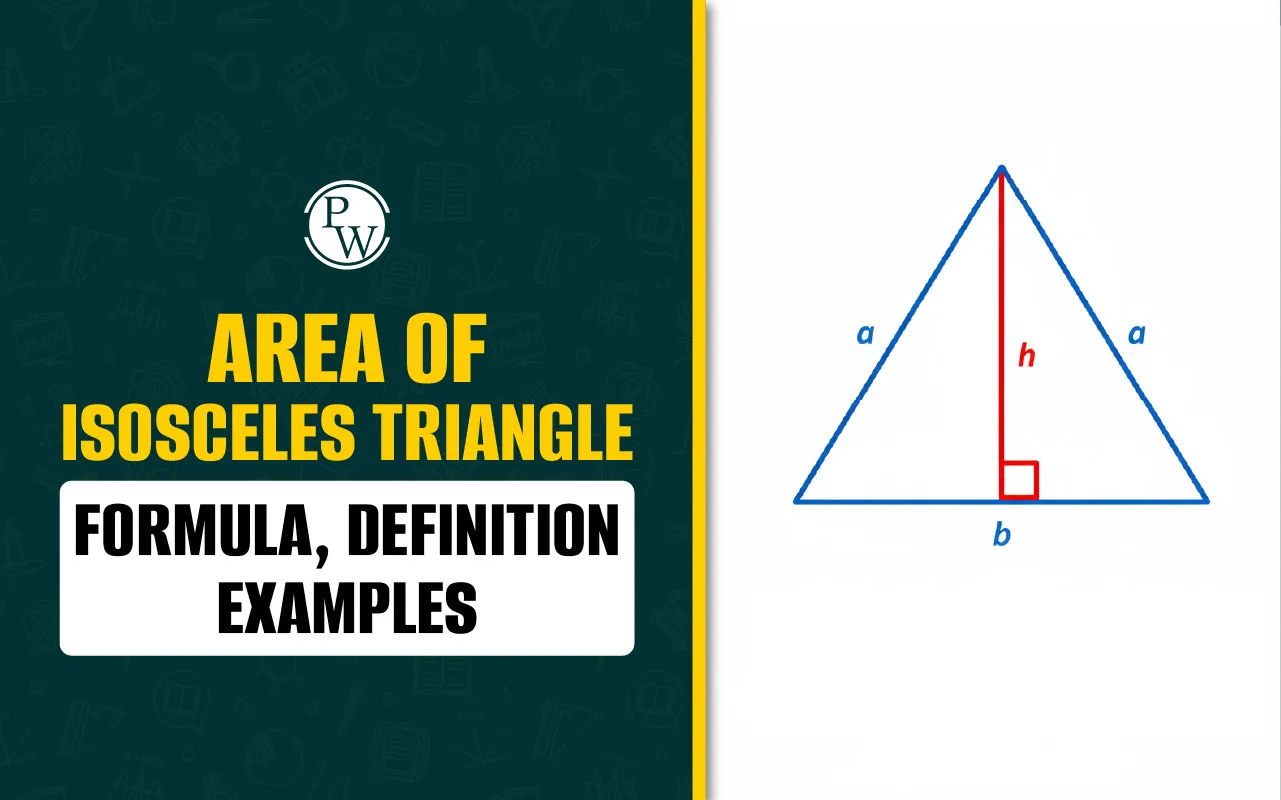
What is the Area of an Isosceles Triangle?
The area of an isosceles triangle refers to the space enclosed by its three sides. It is measured in square units such as cm², m², etc. depending on the given unit of measurements.
Just like other triangles, the area of an isosceles triangle can be calculated using different methods based on the information available, such as base and height, or side lengths of the isosceles triangle.
Area of Isosceles Triangle Formula
There are many formulas to find the area of an isosceles triangle. It uses the different parameters of the isosceles triangle. We have explained each of the area of isosceles triangle formula in detail, as given below:
-
When Base and Height of the Triangle Are Known
The standard formula for the area of a triangle involves the base (b) and height (h) of the triangle. The standard triangle area formula is given by:
Area = ½ x base x height
= ½ x b x h
Example:
If the base of an isosceles triangle is 12 cm and the height is 9 cm, then the area of the isosceles triangle will be:
Area = ½ x 12 x 9 = 54 cm²
-
Area of Isosceles Triangle Using Sides
The area of the isosceles triangle can be calculated even if the height is not given. In this case, students can find out the height using the Pythagoras theorem, as explained below.
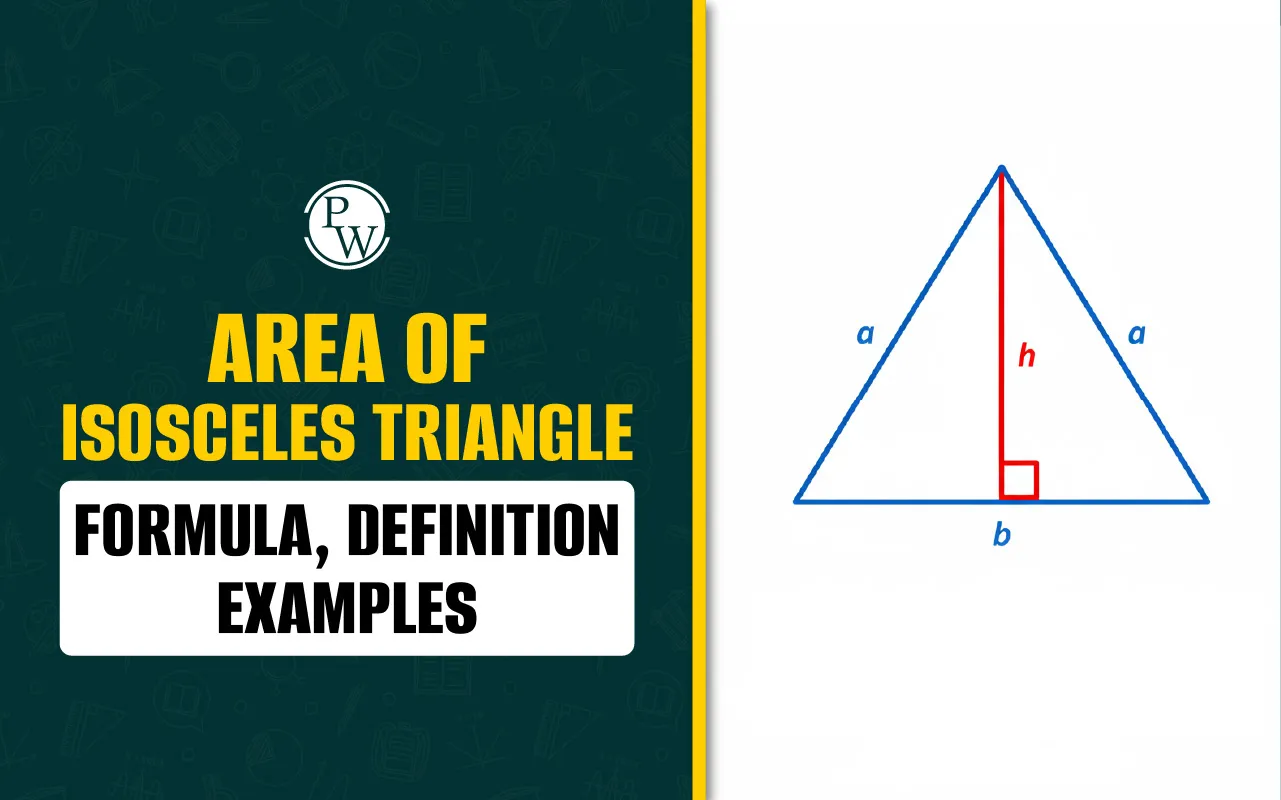
Isosceles triangle has two equal sides. Let the two equal sides be ‘a’ and the base be ‘b’.
The height (h) is the perpendicular drawn from the vertex of the isosceles triangle on the base. This perpendicular line divides the isosceles triangle into two equal right triangles.
For each of these right triangles,
-
Hypotenuse = a
-
Base = b/2 (because perpendicular bisects the base of isosceles triangle)
-
Height = h
So, using the Pythagoras theorem, we can say:
Or,
Or, h =
Therefore, the area of isosceles triangle using sides is given by:
Area = ½ x base x height
Or, Area = ½ x b x
Or, Area =
Example: If the equal sides of an isosceles triangle are 10 cm and the base is 12 cm, then its area is:
-
Area of Isosceles Triangle Using Heron’s Formula
Another useful method for calculating the area of an isosceles triangle is using Heron’s formula, when measurements of all the three sides are known.
Heron’s formula is as follows:
Where, a, b. and c are the three sides of the triangle and s = (a + b + c)/2
In an isosceles triangle, two sides are equal. let the equal sides be ‘a’ and the other side is ‘b’.
Then, s = (a + a + b)/2 = (2a + b)/2
We can substitute the value of ‘s’ in Heron's formula to get the area of the isosceles triangle.
Example: If a = 10 cm and b = 12 cm,
Therefore,
Read More: Congruence in triangle
Area of Isosceles Right Triangle
An isosceles right triangle is a special type of isosceles triangle which has the following features:
-
The two equal sides are the base and the perpendicular of the right triangle.
-
The third side is the hypotenuse having a different dimension.
-
The angle between the base and height is 90°.
-
The other two angles are equal, each having the value of 45°.
These special characteristics help finding the area of isosceles right triangle in an easier and simpler way, as explained below:
In an isosceles right triangle, let the length of each equal side is a, then the formula for the area of isosceles right triangle is given by:
Area = ½ x base x height
Area = ½ x a x a = a2/2
Example: If each equal side of an isosceles right triangle is 5 cm, then its area will be:
Area: 52/2 = 25/2 = 12.5 cm2
You can also find the hypotenuse using the Pythagoras theorem:
Hypotenuse = a√ 2
Read More: Right Angled Triangle
Area of Isosceles Triangle Solved Examples
After understanding what is the area of the isosceles triangle and the formula for the area of the isosceles triangle, students must learn how to apply these formulas through regular practice.
Here are some solved examples using formulas of isosceles triangles that can help your child get a conceptual clarity on this topic.
Example 1: Find the area of an isosceles triangle having the length of the base 8 cm and height is 14 cm?
Solution: Base of the triangle (b) = 8 cm
Height of the triangle (h) = 14 cm
Area of Isosceles Triangle = (1/2) × b × h
= (1/2) × 8 × 14
= 4 × 14
= 56 cm2
The area of the given isosceles triangle is 56 cm2.
Example 2: Find the length of the equal sides of an isosceles triangle whose base is 12 cm and the area is 48 cm2.
Solution: We know that,
The base of the isosceles triangle (b) = 12 cm
Let ‘a’ be the length of equal sides.
Area of isosceles triangle = b/4 × √(4a2 − b2)
Therefore,
48 = (12/4) x √(4a2 − 122)
48 = 3 x √(4a2 − 144)
16 = √(4a2−144)
Squaring both sides, we get,
256 = 4a2−144
4a2 = 400
a2 = 100
a = 10 cm
The length of the equal sides of the given isosceles triangle is 10 cm.
Also read: 30-60-90 Triangle
Turn Maths Fear into Fun with with CuriousJr Online Tuition
Is your child having trouble understanding maths or losing confidence in the subject? With the right guidance, they can grasp every concept easily and start enjoying what they learn. CuriousJr Online Maths Tuition builds interest and confidence while strengthening your child’s foundation in maths.
Here’s how CuriousJr supports your child:
-
Ensures concept clarity through clear and simple explanations
-
Keeps learning fun with friendly and encouraging teachers
-
Offers live interactive classes that promote active participation
-
Provides one-on-one mentor support for quick doubt solving
-
Covers the complete syllabus for every grade and board
-
Follows the curriculum of CBSE, ICSE, and major state boards
-
Prepares students for school exams and Olympiads
-
Shares regular progress reports through online PTMs
Book a demo today and help your child fall in love with maths through CuriousJr.