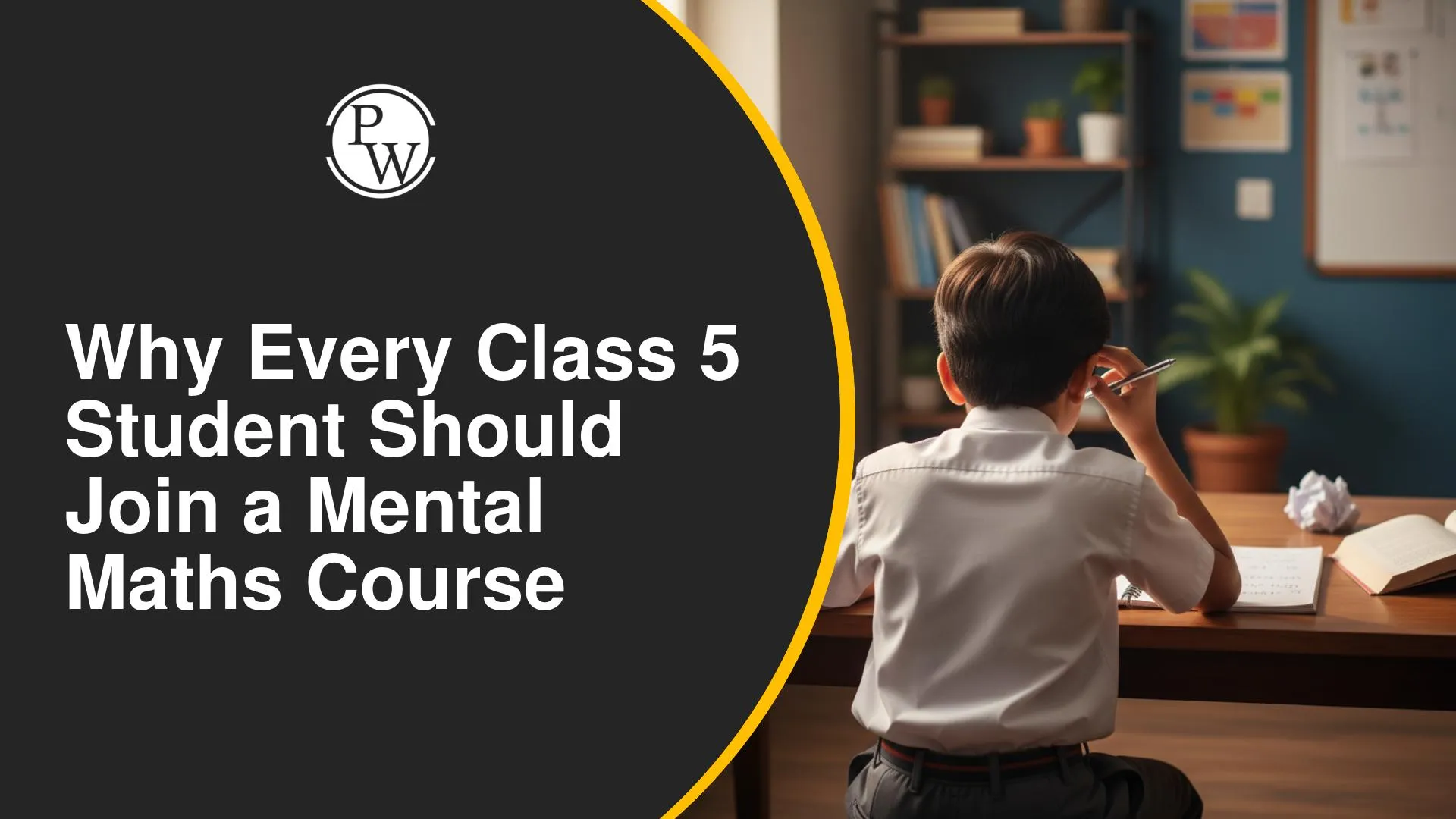
Why Kids Struggle with Multiplication in Class 5
 Nivedita Dar13 May, 2026

Moving into Class 5 is a big step for any young learner. It is often the year where math stops being about simple counting and starts requiring serious mental heavy lifting. One of the biggest roadblocks students encounter is multiplication problems class 5. If your child finds themselves staring at a page of numbers with a sense of dread, they are certainly not alone. The jump from two-digit numbers to three-digit or four-digit multiplication requires a level of focus and "mental stamina" that many kids haven't fully developed yet. This article breaks down why these struggles happen and how to fix them.
Common Multiplication Problems Class 5
For many students, the issue isn't that they "can't do math." Rather, it is that the methods taught in school can sometimes feel robotic or confusing. When kids hit Class 5, the curriculum moves quickly. If a student hasn't fully mastered their basic times tables, the more advanced long multiplication steps become nearly impossible to manage.
Before solving the problem, we have to look at where the "glitches" occur. Most Maths mistakes class 5 fall into a few specific categories:
-
Place Value Errors: Kids often forget to add the "placeholder zero" when moving to the tens or hundreds column in long multiplication.
-
Carrying Mistakes: Forgetting to add the number carried over from the previous step is a classic error that ruins the entire calculation.
-
Weak Tables: If a child has to stop and count on their fingers for 7 times 8, they lose the "thread" of the larger problem they are trying to solve.
-
Rushing through Questions: Believe it or not, many mistakes happen simply because columns aren't lined up correctly, leading to adding the wrong numbers together at the end.
Why Class 5 Multiplication Feels Difficult?
In earlier grades, multiplication is often taught as "repeated addition." While this works for 3 times 4, it becomes inefficient for 345 times 67. Class 5 demands a shift in thinking. Students are expected to handle:
-
Larger Numbers: Multiplying 4-digit numbers by 2-digit numbers.
-
Word Problems: Deciphering a paragraph of text to realize it requires multiplication.
-
Estimation: Rounding numbers to check if an answer "looks" right.
When these three things hit all at once, it is natural for a child to feel overwhelmed. This is where alternative methods can make a massive difference.
Read More - Learn Subtraction without Borrowing (Class 7)
Easy Vedic Maths Multiplication Tricks
One of the most effective ways to bypass the "boredom" and "confusion" of standard school methods is through Vedic Maths. This ancient system offers a completely different perspective on numbers. Instead of the slow, column-based approach, Vedic Maths focuses on patterns and mental shortcuts.
Standard multiplication is linear; you do one step, then another, then another. Vedic Maths is more holistic. It encourages kids to see the "big picture" of the numbers.
-
Nikhilam Sutra: This is perfect for numbers close to powers of 10 (like 98 or 105). It turns a difficult multiplication problem into a simple subtraction and addition task.
-
Urdhva-Tiryagbhyam: Also known as "Vertically and Crosswise." This method allows students to solve any multiplication problem in a single line. It reduces the need for massive "scratchpad" work.
By introducing multiplication tricks, we give children back their sense of play. Math stops being a chore and starts feeling like a puzzle or a "secret code" they have cracked.
Strategies to Solve Multiplication Problems Class 5
If you want to help a student improve right now, you don't need a PhD in mathematics. You just need a few targeted strategies to build their confidence.
Learn the Easy Tables First
Don't rush into the 7s, 8s, and 9s. Ensure the child is 100% confident with 2, 5, and 10. Once they feel "smart" with those, the harder ones feel less intimidating.
Use Grid Multiplication
Instead of the standard vertical method, try the "Area Model" or "Grid Method." Breaking 25 times 12 into (20 + 5) and (10 + 2) helps kids visualize exactly what is happening to the numbers.
Implement Fast Multiplication Tricks
Teach them the "9s trick" using their fingers or the "11s trick" (where you add the two digits of a number and put the sum in the middle). These small wins build the momentum needed for harder tasks.
Use Estimation
Teach kids to "guess" the answer first. If the problem is 49 times 11, tell them to think of it as 50 times 10. If their final answer isn't close to 500, they know they've made one of those common Maths mistakes class 5.
Read More - Mental Division Tricks for Class 8
Traditional Multiplication vs Fast Tricks
Here is a simple comparison between traditional multiplication methods and modern multiplication tricks used in mental math:
|
Feature |
Traditional Long Multiplication |
Vedic / Fast Tricks |
|
Speed |
Slower, requires multiple lines |
Very fast, often one line |
|
Mental Effort |
High (lots of carrying) |
Low (uses simple patterns) |
|
Error Rate |
High due to "zero" placement |
Lower once pattern is mastered |
|
Engagement |
Often seen as "boring" |
Seen as a "math hack" or fun |
How CuriousJr Helps Solve Multiplication Problems Class 5
Learning multiplication requires more than just a textbook; it requires an environment where a child feels safe to fail and excited to try again. This is exactly where CuriousJr makes an impact.
By turning abstract multiplication problems class 5 into interactive, gamified challenges, the platform removes the "fear factor" of mathematics. CuriousJr focuses on building a deep conceptual understanding rather than just rote memorization. Through bite-sized lessons, interactive quizzes, worksheets, and visual storytelling, kids learn the "why" behind the numbers, ensuring that multiplication tricks aren't just memorized but actually understood.
CuriousJr Mental Maths Classes are designed to improve mental maths skills, logical thinking, calculation speed, and accuracy through structured daily practice and engaging activities. CuriousJr also helps students build confidence while solving school-level maths and competitive exam questions by offering adaptive learning support and consistent progress tracking. It bridges the gap between school curriculum and mental agility, making sure no student is left behind by a "nagging" unsolved problem.