Black Hole Facts for Kids – A Complete Overview
 Nikita Aggarwal20 Jan, 2026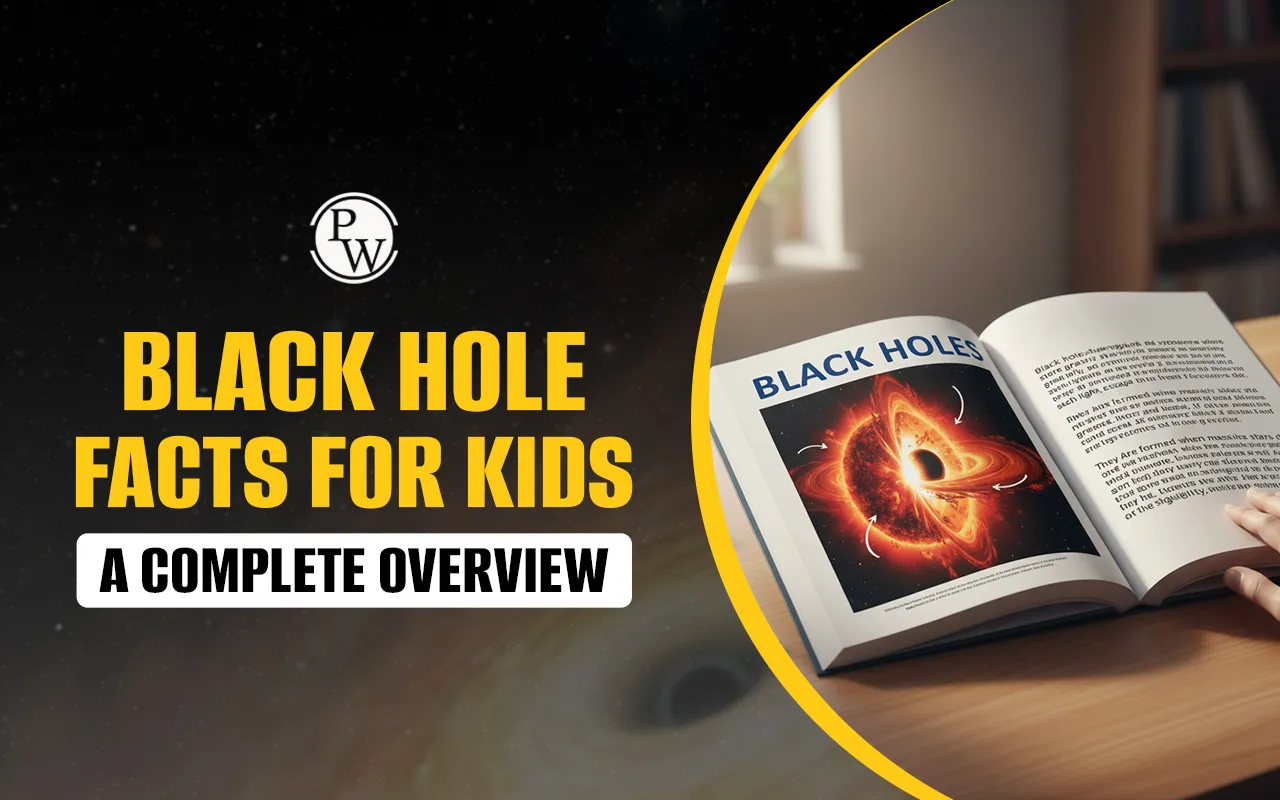
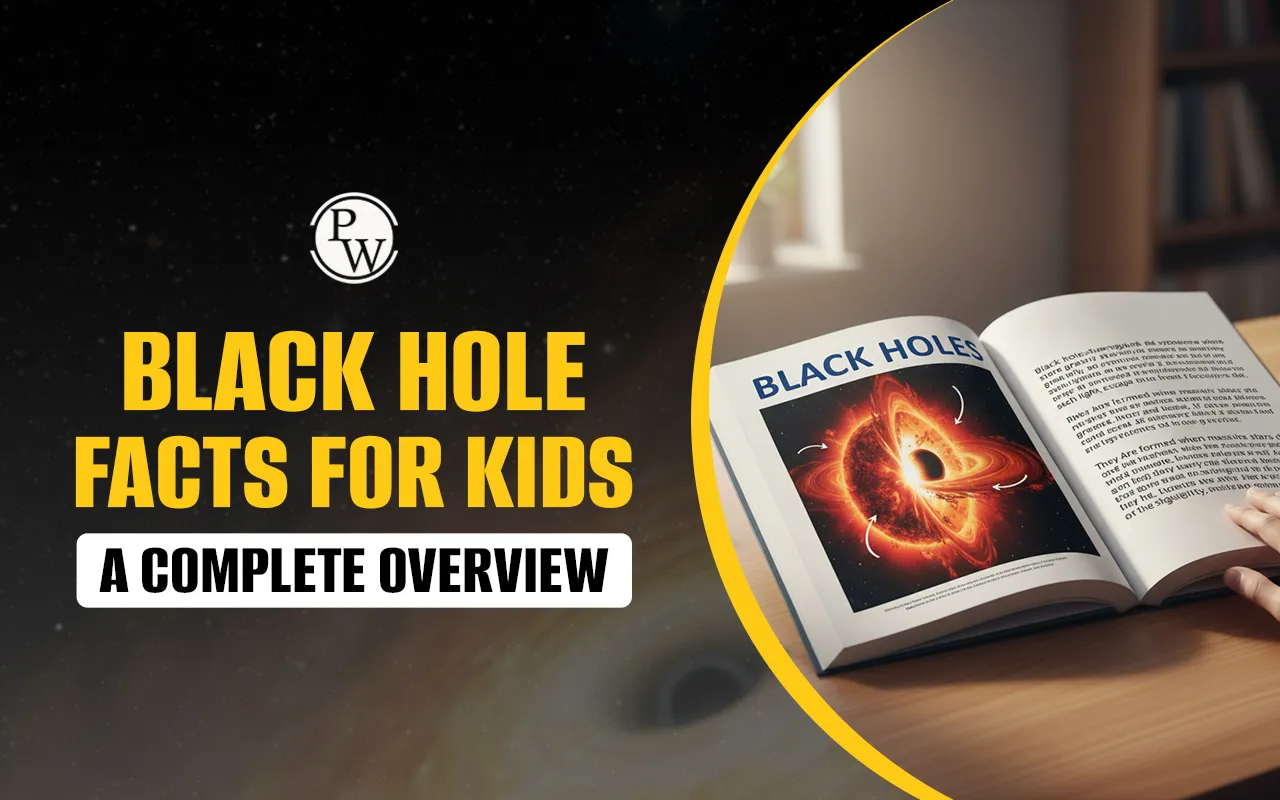
Black Hole Facts for Kids
-
A black hole is a place in space where gravity is so strong that nothing can escape, not even light.
-
Black holes form when very big stars die and collapse under their own weight.
-
Because light cannot escape, they look completely dark.
-
Scientists cannot see black holes directly but can find them by watching how nearby stars and gas move
-
Our galaxy, the Milky Way, has a huge black hole at its centre called Sagittarius A*.
These are just a few black hole facts to start with. Now let’s understand more.
Also read: Solar system - Facts, Formation & Composition
What Is a Black Hole?
To understand what is black hole, think of a star much bigger than our Sun. When the star runs out of fuel, it explodes in a huge blast called a supernova. The part that is left behind becomes very small and very heavy, and this is how a black hole is formed.
Its gravity becomes so strong that it pulls everything nearby toward it, and even light cannot escape, which is why it looks completely black. You can imagine it like a vacuum cleaner in space that pulls everything in, but once something goes inside, it never comes back out.
Types of Black Holes
Scientists believe there are three main types of black holes:
-
Stellar Black Holes – Formed when a large star collapses after it burns out.
-
Supermassive Black Holes – Found in the centre of galaxies and are millions of times heavier than the Sun.
-
Mini or Primordial Black Holes – Very small black holes that may have formed soon after the Big Bang.
Each type shows how black holes can exist in different sizes and conditions.
Also read: Reflection of Light | Law, Formula & Examples
How Do We Know Black Holes Are There?
Even though we cannot see black holes, scientists know they exist by studying what happens around them. They look for stars that move in unusual ways or for very hot gas spinning near something that cannot be seen.
When gas and dust fall toward a black hole, they become extremely hot and release light and X-rays. Special space telescopes can detect these signals, which helps scientists discover where black holes are hiding.
The First Black Hole in Ocean
You might have heard about the first black hole in the ocean, but it is not a real black hole like the ones found in space. It is actually a deep, dark hole underwater near the Bahamas called the Black Hole of Andros.
Scientists call it a “black hole” because it looks dark and very deep, but it is really a natural sinkhole formed by erosion. It has an interesting name, but it has nothing to do with real black holes in space.
Also read: Metals and non-metals - Key Differences
10 Facts About Black Holes
There are many amazing things about black holes that make them both mysterious and exciting to learn about. Here are 10 black hole facts for kids that explain how they work and why scientists study them so closely.
1. A black hole’s gravity is super strong:
A black hole has the strongest gravity in the universe. Its pull is so powerful that nothing can escape from it, not even light. That is why it looks completely black.
2. Black holes come in different sizes
Some black holes are small, called stellar black holes, and others are extremely large, called supermassive black holes. The biggest ones are millions of times heavier than the Sun and sit in the centres of galaxies.
3. Time slows down near a black hole
Einstein’s theory of relativity tells us that time moves more slowly when gravity is very strong. So, if you were near a black hole, time would pass slower for you compared to someone far away in space.
4. Our galaxy has a black hole at its centre.
The Milky Way, which is our home galaxy, has a supermassive black hole called Sagittarius A* at its centre. It is about four million times heavier than the Sun.
5. Scientists can find black holes without seeing them.
Black holes are invisible because no light comes out of them. But scientists can watch how nearby stars move or how gas glows as it spins around the black hole. These clues help them find where the black hole is hiding.
6. Some black holes spin very fast.
Black holes can rotate at incredible speeds, close to the speed of light. When they spin, they pull gas and dust around them in a swirling pattern called an accretion disk.
7. When two black holes join, they make waves in space.
When two black holes crash into each other, they create ripples in space called gravitational waves. These waves travel across the universe and can be detected by special instruments on Earth.
8. The first real photo of a black hole was taken in 2019.
For the first time, scientists used powerful telescopes around the world to capture an image of a black hole in another galaxy. It looked like a glowing ring of orange light surrounding a dark centre.
9. Black holes can grow bigger over time.
A black hole can become larger by pulling in gas, stars, and even other black holes that come too close. The more matter it eats, the bigger and heavier it becomes.
10. There are no black holes near Earth.
Even though black holes sound scary, they are far away from our planet. None are close enough to harm Earth, so we are completely safe. Scientists study them only through powerful telescopes and computer models.
Black holes may be invisible, but they play an important role in the universe. They help scientists understand gravity, time, and the life of stars. These 10 facts about black holes show that space is full of surprises waiting to be explored.
Also read: Types of natural disaster - Causes, Types, & Facts
Make Science Fun and Easy for Your Child with CuriousJr Online Science Classes
Does your child find science confusing even after memorising all the facts? That often happens when they learn only from textbooks instead of practical examples. CuriousJr Online Science Classes for kids make learning enjoyable by connecting real-world experiences with classroom concepts.
Here’s how CuriousJr Online Science Classes help your child:
-
Builds understanding of science concepts through activities and discussions instead of memorisation
-
Uses visual lessons, stories, and interactive examples to make tough topics simple
-
Provides one-on-one guidance and doubt-solving sessions with expert mentors
-
Shares regular progress reports and holds parent–teacher meetings to track learning
-
Encourages curiosity, exploration, and critical thinking beyond classroom boundaries
Book a demo class today and see how CuriousJr turns science learning into a fun and engaging experience for your child.