What is an Appositive phrase?
 Amit Lingwal12 Sept, 2025
Appositive phrases give a sentence a new structure that conveys information with more clarity while maintaining compactness. When learning English grammar or writing techniques, the concept of appositive phrases helps students describe the subjects and objects in the sentences with better clarity and quality.
Whether in academics or in the professional environment, appropriate and accurate use of appositives can add variety, provide details, and make communication more effective.
If you want your child to gain better insights into appositive phrases and their uses, we will guide them to learn every aspect of appositives through simple examples and explanations.
What is an Appositive Phrase?
The word “appositive” originates from the Latin term “appositus,” which means “placed near” or “placed beside.”
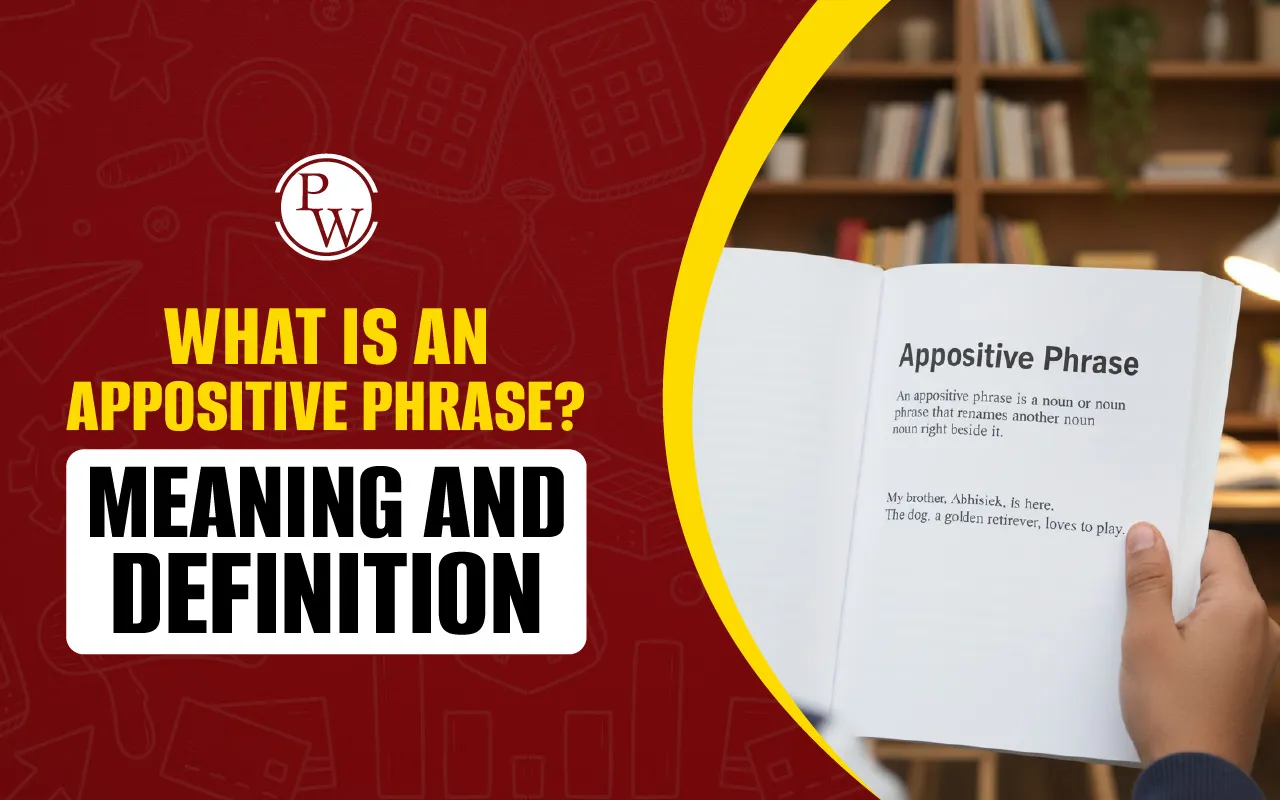
In English grammar, an appositive refers to a group of words placed near a noun or pronoun to describe it or provide more information about it.
An appositive phrase is a phrase that carries the appositive meaning and is used along with a noun or pronoun to rename, clarify, or explain it.
Example:
Anjali, my cousin-sister, is getting married this November.
Here, the phrase “my cousin sister” is an appositive phrase. It explains more about the noun “Anjali.”
Read more: Assertive sentence - Definition and Example
Why Do We Use Appositives?
Appositives serve important functions in writing by combining and communicating information concisely with more clarity and variety. The positive aspects of using appositive phrases include the following:
-
Clarify meaning: They remove confusion by explaining the noun or pronoun.
-
Add variety: They restructure the sentences to make them less repetitive and pleasing to read.
-
Descriptive writing: They add more detail and specific information without creating long, complex sentences.
Read more: Interrogative sentence - Definition and example
Key Characteristics of Appositive Phrases
After knowing the appositive definition and appositive meaning, students must know about the main features of appositive phrases to identify and use them appropriately in different contexts. The key characteristics of appositive phrases are mentioned below:
-
An appositive phrase gives a new name to a noun or explains it further.
-
The appositive word or phrase can act as a noun or an adjective.
-
It is usually placed after the noun it modifies but can also be at the beginning or end of a sentence.
-
Appositive phrases are typically accompanied by commas, placed according to the type of appositives used in the sentence.
Types of Appositives
There are two main types of appositives, based on the purpose they serve. These categories also decide whether to use punctuation marks, such as commas, in the sentence. Let’s explain both types with examples:
Restrictive Appositives
These appositives carry information that is essential to the meaning of the sentence. It helps to specify which of the many things or people is being referred to. In this case, no commas are used.
Example:
The famous musician Pandit Vikram Ghosh will be the chief guest.
In this sentence the appositive Pandit Vikram Ghosh specifies the famous musician to avoid confusion because there are many famous musicians.
Non-Restrictive Appositives
These types of appositives add extra information, but the sentence still makes sense without it. In this case, commas are used.
Example:
Pandit Vikram Ghosh, the famous musician, will be the chief guest.
Here, we place the appositive "the famous musician" with commas because we know that Pandit Vikram Ghosh can only refer to one person. Adding the appositive to the sentence is just to provide a little more information.
Read more: What Is Gender in Grammar? – Meaning and Definition
Appositive Examples in Sentences
Students must gain clarity about the use of appositive phrases in sentences. The following appositive examples will help them understand the appropriate use of appositives:
Appositive Phrases in the Middle of a Sentence
-
Mrs. Sharma, our school principal, distributed the prizes.
-
Her father, a renowned cardiologist with years of experience, performed the surgery.
Appositive Phrases at the End of a Sentence
-
Have you visited Paris, the world’s fashion capital?
-
My friend bought an iPhone 13, the latest one on the market.
Appositives at the Beginning of a Sentence
-
The highest wicket-taker Hardik was declared the Man of the Match.
-
The topper of the class XI, Rajiv, has been selected as the head boy.
Read more: What Are Modal Verbs? Definition and Examples
Appositive Grammar Rules
After getting clarity on the appositive phrase and its uses, students can easily form sentences using appositive phrases suitably. Let’s take a note of the following points that you need to consider when using an appositive phrase.
-
An appositive phrase should be placed adjacent to the noun. It can either be placed before or after the noun it modifies.
-
When the appositive phrase describes the noun, it can be considered an adjective.
-
An appositive phrase is placed adjacent to the noun to complement the subject or the object in the sentence.
-
A comma can be used after or before the appositive phrase to connect the noun and the noun phrase.
-
In some cases, when you use a restrictive phrase, you need not use a comma.
Read more: List of Tricky Words in english
Mistakes to Avoid while Using Appositive Phrases
It’s very important to follow the rules for proper use of appositives that make sense. However, students must be aware of the common mistakes as mentioned below:
Position: An appositive always comes immediately after the noun it explains.
-
Incorrect: A golden retriever, my pet, accompanied me on the trip.
-
Correct: My pet, a golden retriever, accompanied me on the trip.
Punctuation: Do not use commas for restrictive appositives.
-
Incorrect: The poet, William Wordsworth, wrote famous poems.
-
Correct: The poet William Wordsworth wrote famous poems.
Placement: Do not place the appositive too far from the noun.
-
Incorrect: My aunt gave me a gift, a book about animals, with a colorful cover.
-
Correct: My aunt gave me a book about animals, a gift with a colorful cover.
Understanding what is an appositive phrase is not just about learning grammar rules; it is about improving your overall writing skills. Appositives help you describe people, places, and things clearly and effectively. While writing essays, stories, or reports, proper use of appositive phrases can make your communication more meaningful.
Also read: List of Most Commonly Confused Words
Strengthen Your Child’s English Grammar Skills With CuriousJr
Speaking, reading, and writing English with confidence is an important part of your child’s learning journey. Many children understand English but struggle with grammar rules and sentence-making. This not only affects how they express their thoughts but also lowers their performance in school.
CuriousJr’s online English classes make grammar learning simple, structured, and enjoyable for children. Here’s what your child will gain:
-
Step-by-step learning program aligned with the Cambridge English Scale and CEFR.
-
Live interactive classes with two teachers. One explains the concepts while the other provides instant support and even clears doubts after the class.
-
Easy-to-understand grammar lessons that allow children to start forming correct sentences independently without memorizing too many rules.
-
Vocabulary building and pronunciation practice to help children speak more clearly, confidently, and naturally in everyday conversations.
-
Fun and engaging activities like games, creative writing tasks, role plays, and speaking exercises that make children enjoy learning instead of feeling stressed.
-
Flexible after-school timings so children can attend classes comfortably from home without disturbing their daily routine.
-
Parent progress tracking with regular updates, so you always know how your child is improving week by week.
With CuriousJr, your child develops the skills to become fluent, accurate, and confident in English both inside and outside the classroom. Book a demo today.