Angle of Depression - Definition, Formula, Examples
 Nikita Aggarwal25 Mar, 2026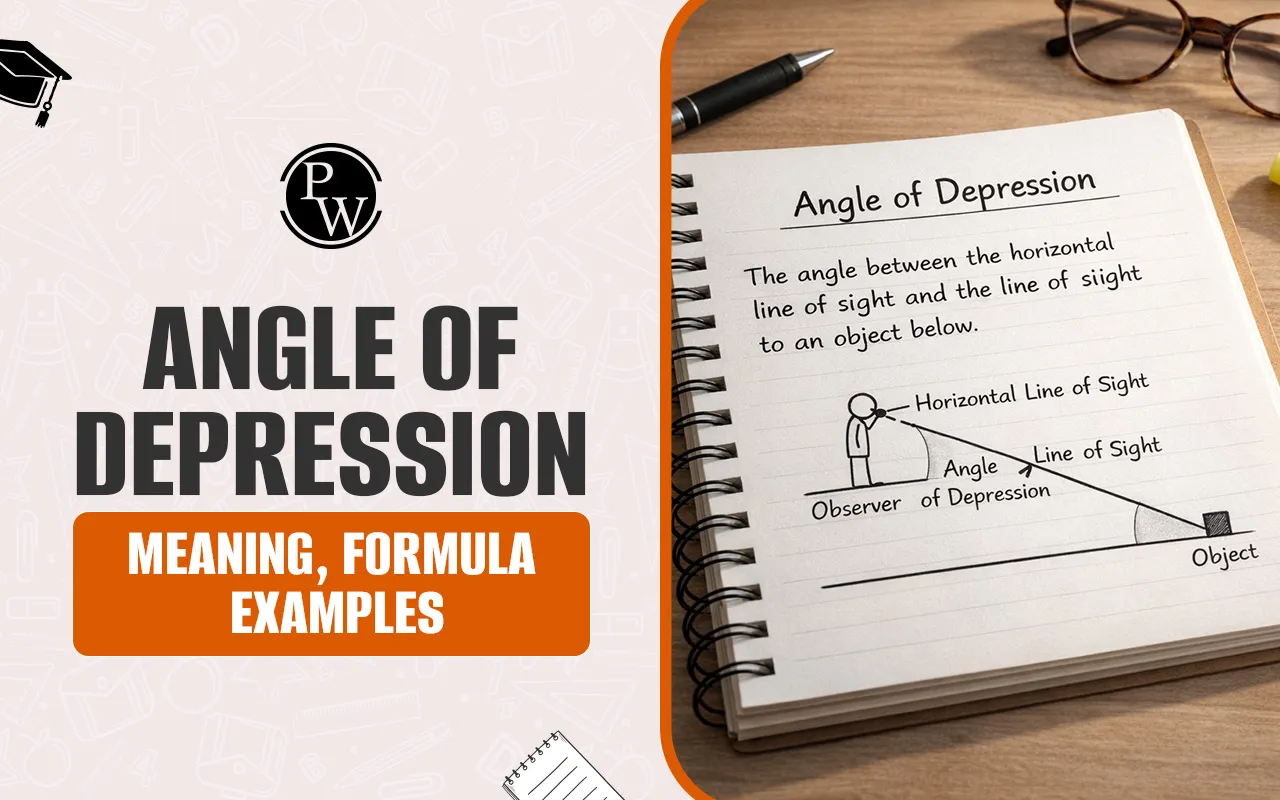
What is Angle of Depression?
Angle of depression because it is not directly visible in a triangle.
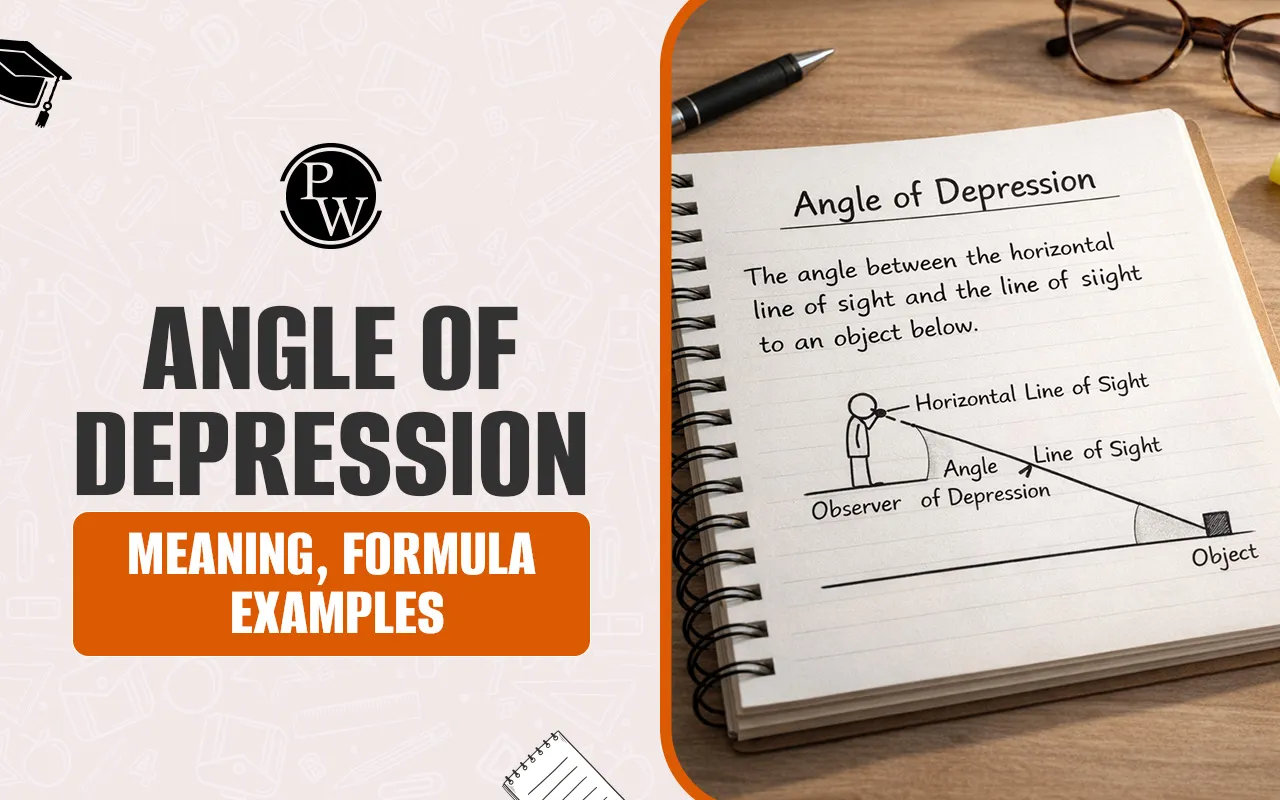
The angle of depression is the angle formed between the horizontal line and the line of sight when an observer looks downwards at an object.
Imagine you are standing at the top of a cliff. If you look straight ahead, your eyes follow a horizontal line. If you then look down at a boat in the ocean, your line of sight moves downwards. The "gap" or angle created between that straight-ahead horizontal line and your downward gaze is exactly what is angle of depression.
Important Terms in Angle of Depression
To solve problems accurately, you must be familiar with these four components:
-
The Observer: The person or point from which the observation is made.
-
The Object: The item located below the observer's eye level.
-
Horizontal Line: A straight line extending horizontally from the observer’s eyes.
-
Line of Sight: The imaginary straight line connecting the observer’s eye to the object.
Angle of Depression Formula
Calculating the angle of depression does not require a new set of rules; instead, it uses the standard trigonometric ratios. Since the horizontal line, the vertical height, and the line of sight form a right-angled triangle, we use:
|
Trigonometric Ratio |
Formula |
Use Case |
|
Sine (sin) |
Opposite / Hypotenuse |
When height and the slant distance (line of sight) are known. |
|
Cosine (cos) |
Adjacent / Hypotenuse |
When the horizontal distance and slant distance are known. |
|
Tangent (tan) |
Opposite / Adjacent |
When the height and horizontal distance are known. |
In most angle of depression problems, the Tangent formula is the most common because we are usually dealing with the height of a structure and the distance along the ground.
Angle of Depression in a Triangle and Alternate Interior Angles Theorem
When solving angle of depression questions, the angle outside the triangle is linked to the angle inside the triangle through alternate interior angles. Since the observer’s horizontal line and the ground are parallel, the angle of depression is equal to the angle formed at the object inside the right triangle. This helps us use trigonometric ratios like sine, cosine, or tangent easily while finding height, distance, or line-of-sight measurements.
Read More - Alternate Interior Angles - How to Find Alternate Interior Angles
How to Calculate Distance or Height with Angle of Depression?
Stepwise method using tangent:
1. To find distance:
Formula: Distance = Height ÷ tan(angle)
Example:
-
Height of tower: 20 m
-
Angle of depression: 30°
-
Step 1: tan(30°) ≈ 0.577
-
Step 2: Distance = 20 ÷ 0.577 ≈ 34.65 m
Answer: The object is approximately 34.65 m away.
2. To find height:
Formula: Height = Distance × tan(angle)
Example:
-
Distance to object: 50 m
-
Angle of depression: 25°
-
Step 1: tan(25°) ≈ 0.466
-
Step 2: Height = 50 × 0.466 ≈ 23.3 m
Answer: The height is approximately 23.3 m.
Read More - Angle Worksheet for Students to Practice
Angle of Depression vs Angle of Elevation
Although their quantities are the same in a specific problem, their viewpoint is distinct:
-
Angle of Depression: The observer is high up, looking down.
-
Angle of Elevation: The observer is on the ground, looking up.
Both are crucial for surveyors, pilots, and engineers to determine heights of buildings or the distance of landmarks without needing a physical measuring tape.
Angle of Depression Examples
Let's look at how to apply these concepts to solve real-world problems.
Example 1: Finding the Angle of Depression
A person stands at the top of a building that is 50 feet high. They see a ball on the ground 30 feet away from the base of the building. Find the angle of depression.
-
Height (Opposite side) = 50 ft
-
Horizontal distance (Adjacent side) = 30 ft
Formula:
tan θ = Opposite / Adjacent
Substitute the values:
tan θ = 50 / 30
tan θ = 5 / 3
Now take the inverse tangent:
θ = tan⁻¹(5 / 3)
θ ≈ 59°
Answer: The angle of depression is approximately 59°.
Example 2: Finding the Distance
A hot air balloon is flying at a height of 100 feet. The angle of depression from the balloon to a person on the ground is 30°. Find the distance between the person and the balloon.
-
Height (opposite side) = 100 ft
-
Angle of depression = 30°
-
Required = Distance between the balloon and the person (hypotenuse)
Formula:
sin θ = Opposite / Hypotenuse
Substitute the values:
sin 30° = 100 / x
Since sin 30° = 1 / 2,
1 / 2 = 100 / x
Cross-multiply:
x = 100 × 2
x = 200 ft
Answer: The distance between the person and the balloon is 200 feet.
Make Maths Easy and Enjoyable with CuriousJr
At CuriousJr, we help children overcome their fear of maths and develop a strong foundation with confidence. Our Mental Maths online classes for students from Classes 1 to 8 focus on improving speed, accuracy, and logical thinking through simple techniques and interactive learning.
With our dual-mentor system, students attend engaging live classes and also receive dedicated support for doubt-solving after every session. Animated explanations, fun activities, and exciting challenges make maths easier to understand and more enjoyable.
Parents are kept informed through regular progress updates and review sessions, ensuring full transparency in their child’s learning journey.
Book a demo class today and discover how CuriousJr makes maths learning simple, interactive, and confidence-building for your child.