Alternate Interior Angles - How to Find Alternate Interior Angles
 Nikita Aggarwal23 Mar, 2026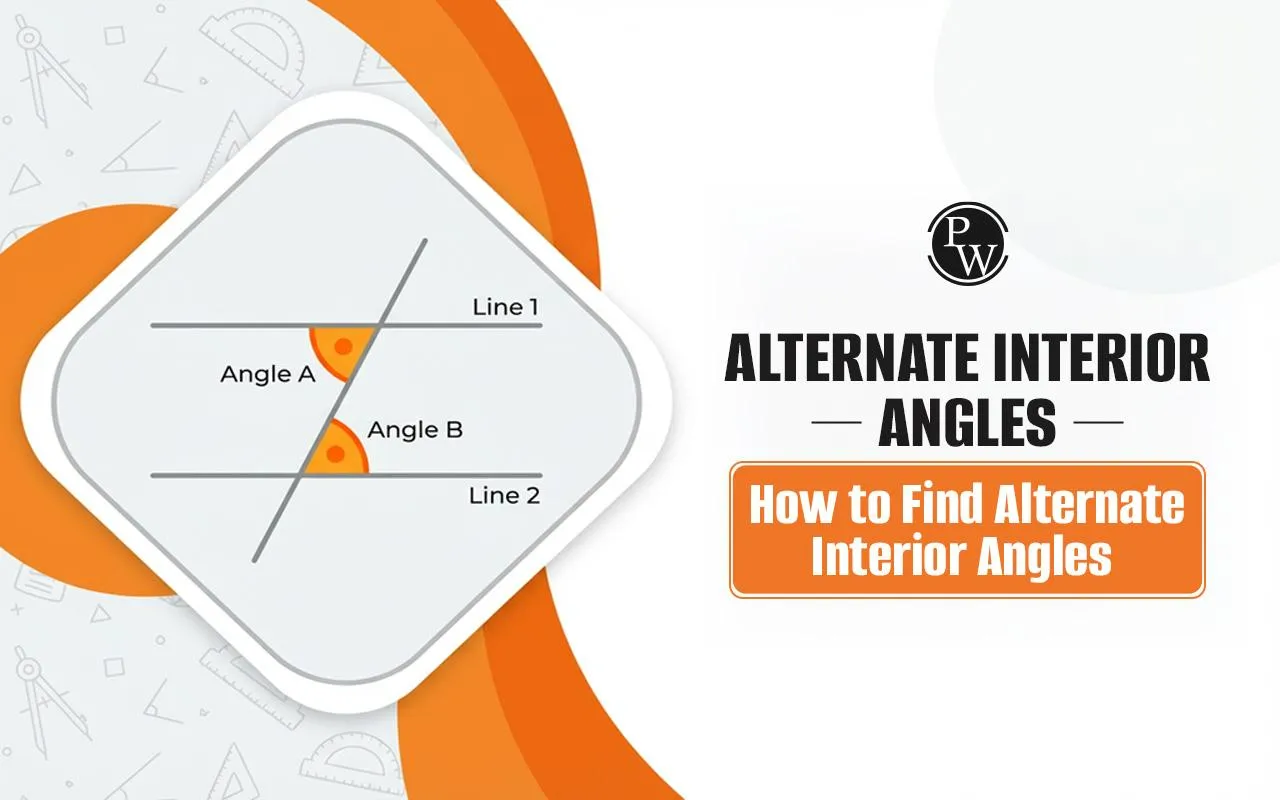
What Are Alternate Interior Angles?
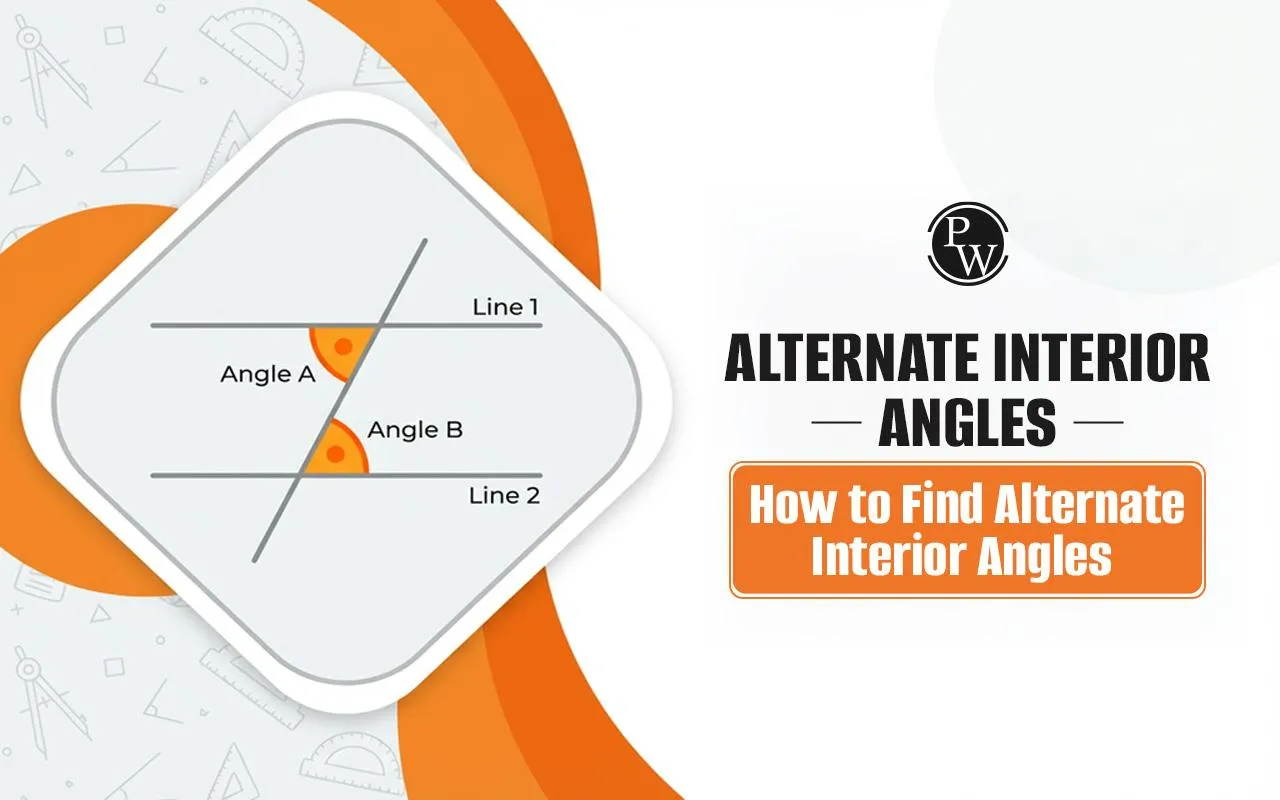
When two parallel lines are intersected by a transversal, angles form inside the parallel lines on opposite sides of the transversal. These angles are called alternate interior angles.
Key Points to Remember:
-
They are located between the parallel lines, on opposite sides of the transversal.
-
Their measures are always equal.
-
Identifying them helps determine relationships between angles and verify whether lines are truly parallel.
Example Visualisation:
If AB and CD are parallel lines and EF is a transversal, the angles on opposite sides of EF, inside the parallel lines, form alternate interior angles.
Alternate Interior Angles Meaning With Explanation
The term alternate interior angles meaning can be understood by breaking the words:
-
Alternate: They are on opposite sides of the transversal.
-
Interior: They lie between the two parallel lines.
So, when a transversal cuts across parallel lines, these angles appear inside the lines and on opposite sides, forming a matching pair that looks balanced.
Alternate Interior Angles Definition
Alternate interior angles are pairs of angles formed inside two parallel lines when a transversal intersects them, and these angles are always equal in measure.
Understanding the alternate interior angles meaning is only the first step. To use them in calculations, you must understand their properties, especially when dealing with parallel lines.
-
Equality in Parallel Lines: If the two lines being crossed are parallel, the alternate interior angles are exactly equal in measure.
-
The Transversal Connection: A transversal is the line that intersects two or more other lines. Without a transversal, these angles cannot exist.
-
Non-Adjacent Positioning: These angles are never right next to each other; they are always separated by the transversal and the space between the lines.
-
Supplementary Relationships: While alternate interior angles are equal to each other, they often work alongside consecutive interior angles, which add up to 180 degrees.
Types of Alternate Interior Angles
While the position is standard (opposite sides inside parallel lines), alternate interior angles appear in different contexts:
Adjacent Parallel Lines
-
Formed when a single transversal crosses two parallel lines.
-
Example: Angle A on the left of the transversal and Angle B on the right of the transversal are alternate interior angles.
Multiple Parallel Lines
-
With several parallel lines, multiple sets of alternate interior angles form.
-
Example: In a grid of streets with parallel roads, alternate interior angles appear wherever a transversal crosses two parallel streets.
Alternate Interior Angles Formula
While there is no numeric formula, the property can be expressed simply:
Alternate Interior Angle = Opposite Angle Across Transversal (Inside Parallel Lines)
-
Knowing one angle is enough to find its alternate.
-
For instance, if one angle measures 40 degrees, its alternate interior angle also measures 40 degrees.
How to Find Alternate Interior Angles?
Finding alternate interior angles can be done with simple steps:
Method 1: Using Parallel Lines
-
Identify the two parallel lines.
-
Locate the transversal crossing these lines.
-
Pick an angle on one side of the transversal inside the parallel lines.
-
Its alternate interior angle is directly across the transversal.
-
Measure or calculate the angle; it is equal to the first angle.
Method 2: Using Geometry Problems
-
Example: A transversal crosses two parallel streets. If one interior angle measures 50°, the alternate interior angle is also 50°.
-
This principle simplifies many angle calculations in triangles, quadrilaterals, and geometric proofs.
Read More - Angles in Daily Life - Types & Applications
Alternate Interior Angles Examples
Example 1: Simple Calculation
A transversal crosses two parallel lines. One interior angle measures 25°.
-
Its alternate interior angle is also 25°.
Example 2: Real-Life Streets
Two parallel roads are crossed by a diagonal road. If one angle formed is 50°, the angle directly opposite on the other side of the transversal is 50°.
Example 3: Classroom Problem
In a diagram, MN || OP and ON is the transversal. If angle MNO = 55°:
-
Its alternate interior angle on the opposite side is 55°, which helps solve related angles in triangles.
M -------------------- N
/
/ ON
/
/
/
O -------------------- P
∠MNO = 55° and ∠NOP = 55°
These examples show that recognising alternate interior angles can simplify many geometry problems.
Alternate Interior Angles Theorem
When two parallel lines are cut by a transversal, the alternate interior angles formed are always equal. This theorem helps students quickly find unknown angles in geometry figures.
Converse of Alternate Interior Angles Theorem
If a pair of alternate interior angles are equal, then the two lines cut by the transversal are parallel. This rule is useful when checking whether lines are parallel in a diagram.
Difference Between Alternate Interior Angles and Corresponding Angles
Alternate interior angles lie inside the two lines and on opposite sides of the transversal. Corresponding angles lie in the same relative position at each intersection. Both are equal when the lines are parallel, but their positions are different.
Read More - Straight Angle (180°) – Definition, Degree, Properties, Examples
Summary of Interior Angle Types
|
Angle Type |
Position |
Relationship (Parallel Lines) |
|
Alternate Interior |
Inside lines, opposite sides |
Equal |
|
Consecutive Interior |
Inside lines, same side |
Supplementary (Add to 180) |
|
Alternate Exterior |
Outside lines, opposite sides |
Equal |
Make Maths Simple and Fun with CuriousJr
At CuriousJr, we help children overcome their fear of maths and build a strong foundation with confidence. Our Mental Maths Online Classes for students from Classes 1 to 8 are designed to improve speed, accuracy, and logical thinking through easy techniques and interactive learning.
With our dual-mentor system, students enjoy engaging live classes along with dedicated doubt-solving support after every session. Animated explanations, fun activities, and exciting challenges make maths easier to understand and more enjoyable.
Parents stay involved with regular progress updates and review sessions, ensuring complete transparency in their child’s learning journey.
Book a demo class today and see how CuriousJr makes maths learning simple, interactive, and confidence-building for your child.