
Preposition of Direction - Definition, List, Examples
 Nikita Aggarwal10 Apr, 2026
What is Preposition of Direction?
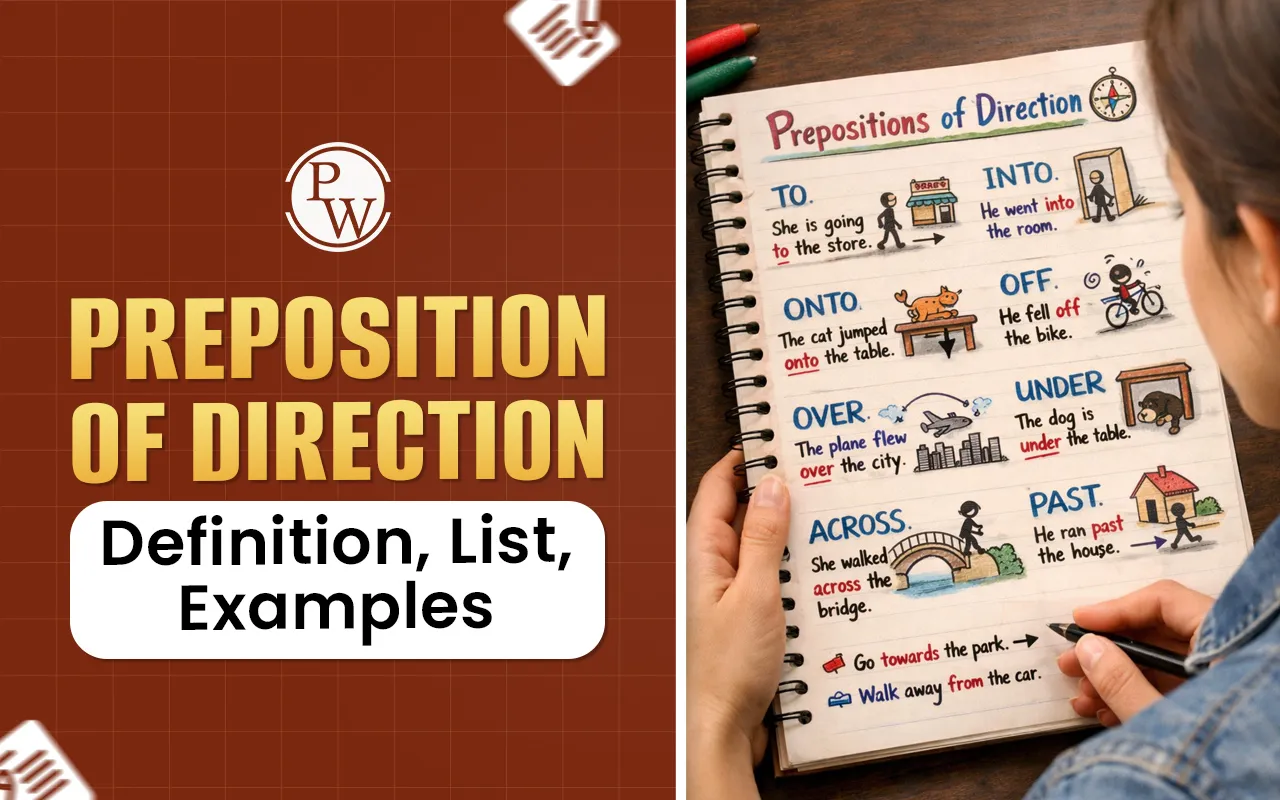
These are basically words that connect nouns and pronouns to other sections of a phrase to show how something moves. While a preposition of place tells you where something is stationary (like "on the table"), the direction preposition tells you where it is heading.
The formal definition is a word or group of words that indicates movement from one point to another. These prepositions are almost always used with verbs of motion, such as "go," "run," "walk," "travel," or "throw." They help clarify the "whither" of an action, providing a clear trajectory for the listener.
A complete idea of direction includes both the starting point and the destination. While many prepositions show where something is going, some also show where the movement begins.
-
From: Indicates the starting point or origin of movement.
Example: She walked from the school to the market.
This “from → to” structure helps describe the full journey, making your sentences clearer and more precise.
Important Preposition of Direction List
You need to learn the most popular words to understand this subject. Here is a complete list of things you will find in common English:
-
To: The most common preposition used to point to a certain place.
-
Towards: Shows movement in a general direction, but not necessarily to a final point.
-
inside: Used to talk about moving inside a closed space or volume.
-
Onto: Used to describe moving toward the top of something.
-
Across: Moving from one side to the other.
-
Through: Moving from one end of a place to the other.
-
Over: Moving over something at a higher level.
-
Under: Moving under something.
-
Along: Moving in a queue or on a path.
-
Around: Moving in a circle or around something.
-
Up: Moving to a higher place.
-
Down: Moving to a lower place.
-
Out of: Moving from the interior to the outside.
-
Off: Moving away from a surface.
-
Past: Movement beyond a point.
Preposition of Direction Examples in Sentences
Seeing these words in action is the best way to learn. Here are several examples categorised by how they are typically used in conversation and writing.
Movement Toward a Destination (To vs. Towards)
-
She is walking to the library. (The library is the final destination).
-
He ran towards the park. (He is moving in that direction, but might not go inside).
Movement Into or Onto Surfaces
-
The cat jumped into the cardboard box.
-
Please place the books onto the top shelf.
Movement Through or Across Spaces
-
We walked across the bridge to get to the station.
-
The train sped through the dark tunnel.
-
The hikers trekked along the narrow mountain path.
Read More - Reported Speech: Definition and Examples
Key Prepositions of Direction
Let us dive deeper into how some of these words function differently to ensure you use the right preposition every time.
1. Using "To" and "Into"
"To" is the standard way to show a destination. However, "into" adds a layer of depth. If you say "I went to the room," it is simple. If you say "I walked into the room," you are emphasising the act of entering the physical space.
2. The Nuance of "Across" and "Through"
"Across" is often used for flat surfaces or boundaries (like a road or a river). "Through" is used when you are surrounded by something on all sides, such as walking through a forest or through a crowd.
3. "Onto" vs. "On"
Remember that "on" usually describes a position, while "onto" describes the movement that gets you there.
-
Static: The bird is on the branch.
-
Directional: The bird flew onto the branch.
Preposition of Direction vs Movement
Students often confuse prepositions of direction with prepositions of movement, but there is a subtle difference between the two.
-
Prepositions of direction focus on where something is going (destination or path).
-
Prepositions of movement describe how something moves from one place to another.
In many cases, the same word can serve both roles, but understanding the intent of the sentence helps you use them correctly.
Example:
-
She walked to the park. (Direction — destination)
-
She walked across the park. (Movement — path taken)
Preposition of Direction Chart with Examples
This table helps you quickly identify which word fits your sentence based on the type of movement involved.
|
Preposition |
Movement Type |
Example Sentence |
|
To |
Specific destination |
He sent a letter to his grandmother. |
|
Towards |
General direction |
The storm is moving towards the coast. |
|
Into |
Entering a space |
The swimmers dived into the cold lake. |
|
Onto |
Moving to a surface |
The fallen leaves landed onto the driveway. |
|
Across |
From one side to another |
They rowed the boat across the river. |
|
Through |
Inside a 3D space |
The light filtered through the curtains. |
|
Along |
Following a path |
We drove along the scenic highway. |
|
Past |
Moving near/beyond |
She walked past the shop without looking. |
|
Over |
Above something |
The plane flew over the Atlantic Ocean. |
|
Around |
Circular movement |
The earth revolves around the sun. |
|
From |
Starting point |
She came from the office early. |
|
Up |
Upward movement |
He ran up the stairs. |
|
Down |
Downward movement |
The child slid down the slide. |
|
Out of |
Exiting a space |
They rushed out of the building. |
|
Off |
Away from surface |
The book fell off the table. |
Read More - 20 Types of Figures of Speech: Definitions and Examples
Common Mistakes in Prepositions of Direction
Even advanced learners sometimes stumble when choosing it. A frequent error is using "to" when "into" is more appropriate for 3D spaces.
Another common slip-up involves "towards." In UK English, we use "towards" (with an 's'), whereas in US English, "toward" is more common. Since we are using UK English, stick to towards for better consistency in your writing.
Also, be careful not to confuse "along" with "across."
-
Use along if you are following the length of something (like a corridor).
-
Use across if you are moving from one side of it to the other (like a street).
Practice Questions on Preposition of Direction
Test your understanding with these simple exercises:
Fill in the blanks:
-
She walked ___ the room. (into / on)
-
The dog ran ___ the road. (across / along)
-
He jumped ___ the chair. (off / into)
-
They came ___ the village early in the morning. (from / to)
Choose the correct option:
-
The bird flew ___ the tree. (onto / into)
-
We walked ___ the river bank. (along / across)
Identify the Prepositions of Direction:
-
The boy ran towards the gate.
-
She climbed up the ladder.
Practising these regularly will help you use prepositions of direction more confidently in real-life situations.