What is Mass? - Definition, Formula, and Unit
 Shivam Singh20 Jan, 2026
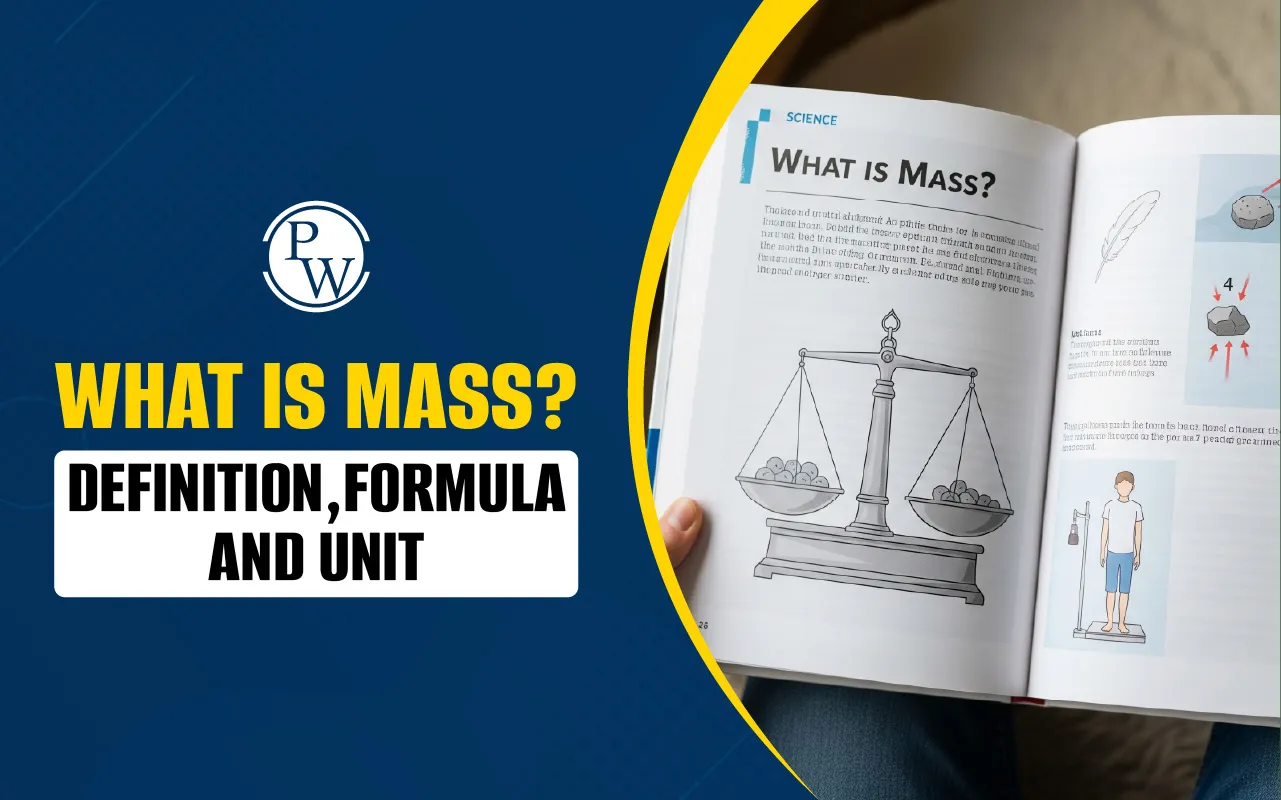
What is Mass?: Mass tells us how much matter or substance is present in an object. Everything you see or touch, like your school bag, a pencil, a football, or even the air around us, has mass. That’s why some things feel heavy to lift while others feel light.
So the answer to the question "What is mass?" in simple words is, "Mass is a measure of how much material makes up an object." It also explains why some objects are harder to push or pull than others. To understand it better, keep reading to learn the mass definition, the mass formula, and the difference between mass and weight.
Read more: Periodic Table
What is Mass?
Mass is the amount of matter present in an object or body. It tells us how much "stuff" is inside something, whether it is solid, liquid, or gas. Mass does not change no matter where the object is, unlike weight that changes with gravity. For example, a rock has more mass than a feather because it contains more matter. Mass helps us understand how difficult it is to move or stop an object.
What is the Meaning of Mass?
“What is the Meaning of Mass?” is a common question that you may see in your exams. That’s why understanding its meaning can help you answer it correctly. Mass is a basic property of all objects that tells us how much matter is inside them.
For example, a large rock needs more effort to push than a small stone because it has more mass. Mass is not the same as weight because weight changes depending on gravity, but mass remains the same no matter where the object is.
Mass is always constant. Even if you take an object to the Moon or outer space, its mass does not change. Mass is also a simple quantity to measure because it only tells us how much matter is present; it does not have a direction like some other properties. The standard unit for measuring mass is the kilogram (kg), which helps us compare objects easily.
Mass Definition
According to the mass definition, it is a stored energy in particles. Mass is a measurement of how much matter an object contains, whether it is big or small. Mass is an important property because it remains the same no matter where the object is.
Mass can be found in different forms: solids, liquids, and gases. For example, a book has solid mass, a bottle of water has liquid mass, and the air around us has gas mass. Mass does not change unless something unusual happens, like in certain scientific reactions where matter can turn into energy.
Mass Formula
Mass formula helps us calculate the mass of an object using different methods depending on what information we have.
1. Using Density and Volume: The most common mass formula is:
Mass = Density × Volume
This means if you know the density of a substance and the space it takes (its volume), you can find its mass. For example, if a wooden block has a certain density and size, using this formula, you can calculate its mass.
2. Using Force and Acceleration: You can also calculate mass using force and acceleration. The formula for mass here is:
Mass = Force ÷ Acceleration
This formula is useful when an object is moving, and you know the push or pull applied to it.
3. Using Weight and Gravity: Mass can also be calculated if you know the weight of an object and gravity. You can use this mass formula:
Mass = Weight ÷ Gravitational Acceleration
For example, if a ball has a known weight on Earth, this formula helps you find its mass. These different mass formulas help us measure how much matter is present in an object.
Read more: 5 Sense Organs
What is the Unit of Mass?
While learning about mass, another question that comes up is "what is the unit of mass?" So, the unit of mass tells us how we measure the amount of matter in an object. The standard unit of mass or SI unit of mass in science is the kilogram (kg).
We can also measure mass in grams, pounds, or other units. While these different units can be converted into each other using simple formulas, the mass of the object does not change.
Unit of Mass in Other Systems
Different systems of measurement use different units for mass, like:
-
CGS (Centimeter-Gram-Second) System: The unit of mass is gram (g).
-
MKS (Meter-Kilogram-Second) System: The unit of mass is kilogram (kg).
-
British Gravitational System: The unit of mass is slug.
-
Imperial System: The unit of mass is pound (lb).
Formula of Mass in Physics
In physics, mass is often calculated using Newton’s second law, which relates force, mass, and acceleration. The formula is m=Fa, where mm is mass, FF is force, and aa is acceleration. Additionally, mass can be obtained by dividing the weight of an object by the acceleration due to gravity as m=Wg.
How to Calculate Mass?
To calculate mass, you can measure the density of an object and multiply it by its volume. Alternatively, if you know the force applied on an object and the acceleration it causes, dividing force by acceleration gives mass. Another option is to measure weight on a scale and divide it by the acceleration due to gravity, which depends on location (usually 9.8 m/s² on Earth).
What is the Unit of Mass?
The unit of mass in the International System of Units (SI) is the kilogram (kg). It is the standard unit used worldwide to measure mass. Sometimes, grams (g) or metric tonnes (t) are also used for smaller or larger quantities. The kilogram remains constant and does not change with location or gravity.
Mass Calculation Formula
Mass can be calculated in several ways depending on the known parameters. Common formulas include:
-
Mass=Density×Volume
-
Mass=ForceAcceleration
-
Mass=WeightGravitational acceleration
These formulas help find mass in different physics problems or practical measurements.
Solved Examples on Unit of Mass
To understand how to convert mass from one unit to another, go through these solved examples on units of mass carefully:
Example 1. Convert 4.2 kilograms to grams.
Solution: We know that 1 kg = 1000 g.
So, to convert 4.2 kg to g:
4.2 × 1000 = 4200 g
Hence, 4.2 kg is equal to 4200 g.
Example 2. Convert 750 grams to kilograms.
Solution: We know that 1 kg = 1000 g, so 1 g = 1/1000 kg.
To convert 750 g to kg:
750 ÷ 1000 = 0.75 kg
Hence, 750 g is equal to 0.75 kg.
Example 3. Convert 2500 milligrams to grams.
Solution: We know that 1 g = 1000 mg.
To convert 2500 mg to g:
2500 ÷ 1000 = 2.5 g
Hence, 2500 mg is equal to 2.5 g.
Read More: Types of Magnets
Difference Between Mass and Weight
Many students think mass and weight are the same and get confused while solving questions based on them. That's why understanding the difference between mass and weight becomes important. Here are some key points you need to remember:
Weight vs Mass Definition:
-
Mass is the amount of matter in an object. It stays the same no matter where the object is.
-
On the other hand, weight is the force of gravity acting on that mass. Weight can change depending on where the object is, like on Earth or the Moon.
SI Units of Mass vs Weight:
-
Mass is measured in kilograms (kg).
-
Weight is measured in Newtons (N).
Mass vs Weight Quantity Type:
-
Mass is a scalar quantity. It means it only has size.
-
Weight is a vector quantity, as it has size and direction (toward the center of gravity).
Mass vs Weight Measurement Tools:
-
Mass can be measured with a balance, like a pan balance, beam balance, or lever balance.
-
Weight is measured using a spring balance or by calculation using the formula.
Weight vs Mass Formulas:
-
Mass formula: Mass = Density × Volume
-
Weight formula: Weight = Mass × Gravitational Acceleration
Constancy:
-
Mass never changes, no matter where the object is.
-
Weight changes with the strength of gravity.
Also Read: Health and Hygiene
Make After-School Learning Fun and Effective For Your Child With CuriousJr
Many parents worry that their child spends too much time on homework but still does not understand the lessons properly. This could happen because your child needs extra support and guidance to understand the lessons better.
CuriousJr’s Online Tuition Classes are designed to give your child that extra much-needed support. These classes are fun, interactive, and make learning enjoyable.
-
Live online classes with trained teachers in small batches.
-
Homework helps so your child gets proper guidance.
-
Daily practice and assignments to stay ahead in class.
-
Regular feedback and reports so you know how your child is improving.
-
One-on-one attention for kids who need extra help to clear doubts and gain confidence.
Book a demo class today to see how CuriousJr can help your child enjoy learning and get better marks in school subjects.