Types of Magnets - A Complete Overview
 Shivam Singh19 Jan, 2026
Magnets are used in many everyday items and applications, but not all magnets are the same. They can differ in shape, size, strength, and the way they are made. Some magnets occur naturally, while others are specially manufactured using different materials. They can also be grouped based on how long they stay magnetized or how their magnetic force is produced.
The uses of magnet are seen in compasses, electric motors, generators, magnetic locks, data storage devices, and even in medical equipment like MRI machines. Thus, when asked what is the use of magnet, the answer lies in its wide applications in science, technology, industry, and everyday life, making it a highly valuable material.
Read More: 5 Sense Organs
Definition of Magnet
A device that attracts iron and produces a magnetic field. A magnet is a piece of metal with a strong attraction to another metal object. The attraction a magnet produces is called a "magnetic field." Understanding the types of magnets helps us learn how they function and why certain types are used for specific purposes. In this blog, you will explore the different types of magnets based on their shape, material, and magnetic behavior
What is a Magnet
Learn what is magnet here. Magnets are defined as objects that have the ability to attract metals like iron, nickel, and cobalt toward them. This attractive force is called magnetism. The word "magnet" comes from a place called Magnesia in Greece, where natural magnets were first discovered thousands of years ago.
Magnets can be natural or man-made. Some stones found in nature, like lodestone, are naturally magnetic. However, most magnets used today are artificial and created in factories using special materials.
Properties of Magnet
The properties of magnets include the presence of two poles, the ability to attract ferromagnetic substances, and the tendency to align in the north-south direction when freely suspended. These properties of magnet make them essential in daily life. Before we learn about the different types of magnets, let's explore what are the properties of magnet that make them special.
Attract Magnetic Materials
Magnets can attract objects made of magnetic materials. These include iron, steel, nickel, and cobalt. Plastic, wood and rubber, and are non-magnetic materials, so they do not get attracted to magnets.
Poles of a Magnet
Each magnet has two poles, called the North and South poles, where its magnetic strength is the greatest.
Like Poles Repel, Unlike Poles Attract
When two magnets are brought close:
-
North and North (or South and South) will repel each other.
-
North and South will attract each other.
Magnetic Field
A magnetic field is the area around a magnet where its force can be felt. We can’t see it, but we can observe it using iron filings. When the filings are sprinkled near a magnet, they line up in curved paths. These lines show how the magnet’s force spreads through space and where it is the strongest.
A Freely Suspended Magnet Always Points North-South
If you hang a bar magnet with a thread and let it swing freely, it will always come to rest in the north-south direction. This is because Earth itself behaves like a giant magnet!
Read More: Facts About the Earth
Types of Magnet (Based on Shape)
We have understood properties of magnets. Let’s look at all types of magnet based on their shapes:
Bar Magnet
A bar magnet is one of the most common and simplest shapes of magnets. It has a straight, rectangular shape and features a North pole at one end and a South pole at the other.
This type of magnet is often used in school laboratories and science kits for experiments because its shape makes it easy to handle, observe, and test magnetic interactions.
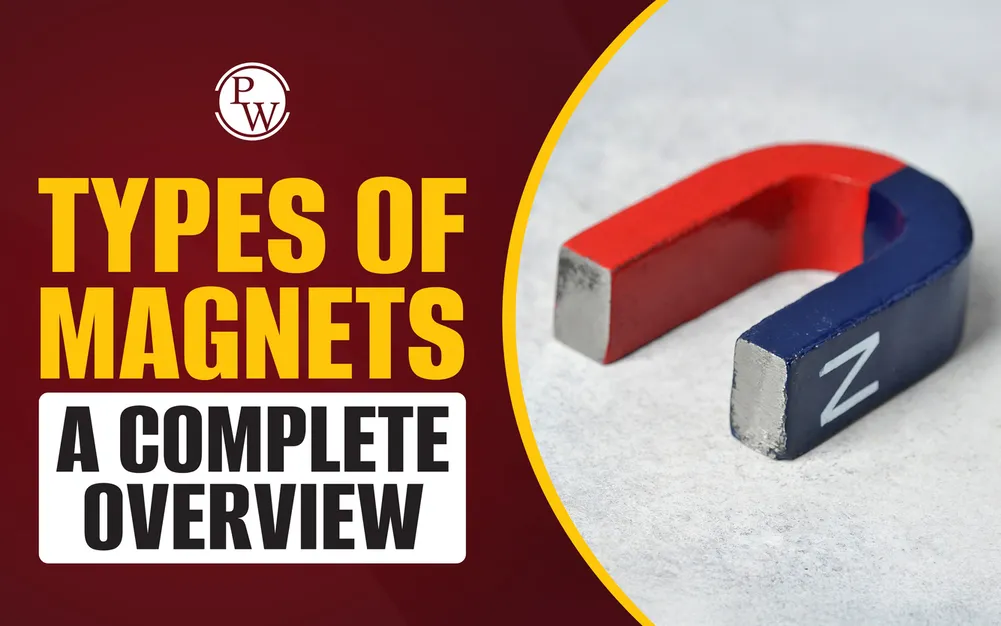
Horseshoe Magnet
The horseshoe magnet has a distinctive U-shape that brings the two poles, i.e. North and South, closer together. This design creates a stronger and more concentrated magnetic field between the poles.
Due to this high strength, horseshoe magnets are often used to pick up or hold heavy iron objects. They are also popular in industrial and mechanical applications where a compact but powerful magnet is needed.
Ring Magnet
A ring magnet is shaped like a circle with a hole in the middle, resembling a doughnut. The magnetic field runs from the inner edge to the outer edge or from one flat face to the other, depending on how it is magnetized. Ring magnets are commonly used in loudspeakers, electric motors, and magnetic levitation systems because of how the magnetic field behaves in this form
Disc Magnet
The disc magnet looks similar to a coin, flat and round in shape. These magnets are often used in medical devices, magnetic toys, and various small appliances. Their flat surface area allows them to be easily inserted or embedded into compact gadgets. Despite their small size, disc magnets can hold strong magnetic force, especially when made from rare-earth materials.
Cylinder Magnet
A cylinder magnet has a long, rod-like shape similar to a pencil or pen. This type of magnet has its poles at the two flat ends, creating a long magnetic path. Cylinder magnets are widely used in electronic devices, sensors, and switches. Their shape helps direct the magnetic field over a longer distance compared to shorter, flat magnets.
Ball or Sphere Magnet
A ball or spherical magnet is round in shape, with the North and South poles located on opposite sides of the surface. These magnets are popular in science kits and magnetic construction toys. They allow for smooth rolling and can connect in many directions, which makes them ideal for experimenting with 3D magnetic fields and building flexible magnetic structures.
Read More: Types of natural disaster
Types of Magnets (Based on Material and Strength)
There are different types of magnet, such as natural magnets, artificial magnets, and electromagnets, which are widely used in various applications. Now let’s explore the different kinds of magnets based on what they are made of and how strong or long-lasting they are.
Natural Magnets
Natural magnets are magnets that occur in nature without any human intervention. A well-known example of a natural magnet is lodestone, a naturally magnetized mineral composed of iron oxide.
Lodestone was the first magnetic material discovered by ancient civilizations and was used in the earliest compasses for navigation. However, natural magnets are relatively weak compared to the ones made by modern technology. Because of this, they are rarely used in today’s tools or machinery.
Artificial Magnets
Most of the magnets we use in daily life are artificial magnets. These magnets are created by humans in factories using various combinations of metals and alloys. Artificial magnets can be made stronger than natural magnets, and they can also be shaped and sized as needed for different uses.
Artificial magnets are further categorised into two types:
-
Permanent magnets and
-
Temporary magnets.
Permanent magnets are made from materials such as hardened steel or special alloys that keep their magnetism for a long time. Once magnetized, these materials do not easily lose their magnetic properties.
Permanent magnets are found in many common devices such as electric fans, refrigerator doors, speakers, and microphones. They are reliable, long-lasting, and do not require any external power to function.
Temporary magnets, in contrast, are made from soft iron or other materials that become magnetic only when they are placed near a strong magnet or when an electric current passes through them. These magnets lose their magnetism when the external force is removed.
Temporary magnets are especially useful in devices that need to switch magnetic power on and off. They are used in electromagnets, electric motors, and telephones, where temporary magnetic fields are necessary for controlled movement and signal flow.
Read More: How to Write Fast
Types of Magnets (Based on Magnetism)
Here are the three most common types of magnets based on how they produce magnetic force and how powerful that force is:
Ferromagnets
These are made from elements such as iron, nickel, or cobalt, all of which have naturally strong magnetic properties. These magnets are known for their ability to attract magnetic materials and retain magnetism over time.
Ferromagnetic materials are used in most household magnets and are essential in manufacturing appliances, tools, and electronic equipment. Because they offer both strength and stability, ferromagnets are widely used in both permanent and temporary forms.
Electromagnets
These are a special type of temporary magnet that is created by passing an electric current through a coil of wire that is wrapped around a piece of soft iron. When electricity flows through the wire, the iron becomes magnetized. As soon as the current is switched off, the magnetism disappears.
Electromagnets are used in cranes for lifting scrap metal, in electric bells, and in medical machines such as MRI scanners. Their main advantage is that their magnetic force can be turned on and off as needed.
Rare-Earth Magnets
These magnets are made from rare-earth elements such as neodymium and samarium, which allow for very strong magnetic fields in very small sizes. These magnets are capable of lifting objects many times their own weight, even if they are no bigger than a coin. Due to their strength, rare-earth magnets are used in advanced technologies like computer hard drives, wind turbines, electric vehicles, and high-performance motors.
Uses of Magnets
We can learn what is the use of magnet. Magnets are used in many different ways in our daily life. Let’s look at the uses of magnets in various fields.
-
At Home: Magnets are used in fridge doors, bags, pencil boxes, and toys to hold things in place or create movement.
-
In Schools: They help stick notes on magnetic boards and are commonly used in science experiments.
-
In Transport: Maglev trains use magnets to float above tracks, allowing faster and smoother travel.
-
In Medicine: MRI machines and hearing aids rely on magnets to function effectively.
-
In Electronics: Magnets are found in speakers, headphones, microphones, and hard drives for sound and data storage.
-
In Industry: They are used in cranes to lift heavy metals and in factories to separate materials.
Also read: Herbivorous Animal Names
How to Take Care of Magnets?
Magnets are very useful in our daily lives, but they need gentle care to keep working well. If you drop a magnet or hit it against something hard, it may lose its magnetic ability or even break.
Heat can also affect a magnet by changing the way it works inside, so it’s best to keep magnets away from things like stoves or hot sunlight.
Magnets should also be kept at a distance from mobile phones, remote controls, and other electronic items, as they might disturb how these gadgets function. When not in use, store magnets with opposite ends facing each other and place a piece of wood or iron between them.
Fun Facts About Magnets
-
The Earth acts like a magnet because its deep core is made of molten iron, which creates a magnetic field around the planet.
-
A compass needle always points toward the north because it aligns with Earth’s magnetic field, helping people find directions.
-
The earliest magnetic compass was invented in ancient India and was known as the Matsya-yantra. It was shaped like a fish and floated in oil to show direction.
Make Science Learning Fun for Your Child with CuriousJr
Looking for an online tuition class that keeps your child interested and eager to learn? CuriousJr offers live classes for students, led by two dedicated mentors who explain concepts in a simple and engaging way.
Each session encourages children to think, participate, and enjoy the subject without pressure. The learning environment is friendly and well-suited for young minds.
Why do parents choose CuriousJr?
-
Interactive classes that keep children involved and curious
-
Limited batch size so every child gets the attention they need
-
Dedicated mentors who connect well with young learners
-
A positive, distraction-free online space for learning at home
Book your demo class today.