Silent Letters in English – Meaning, Rules & Examples
 Shivam Singh20 Jan, 2026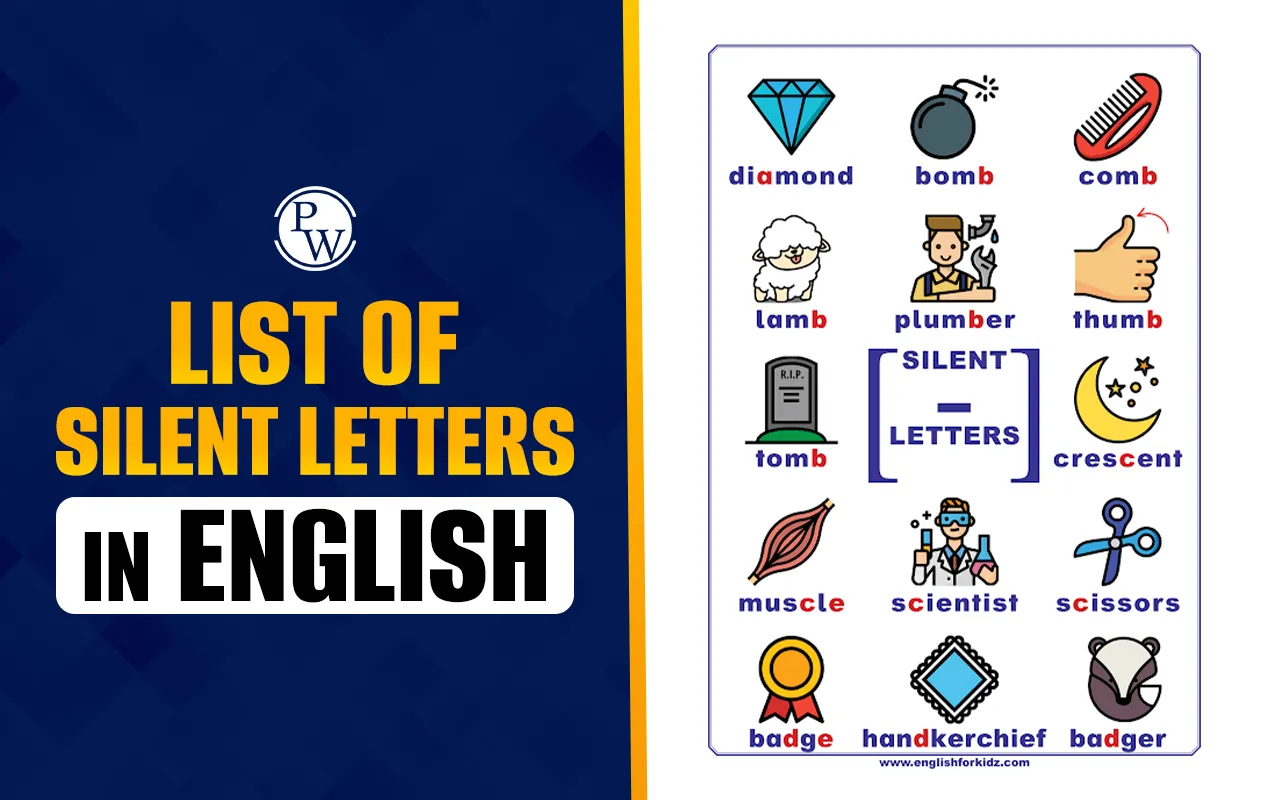
Silent Letters in English
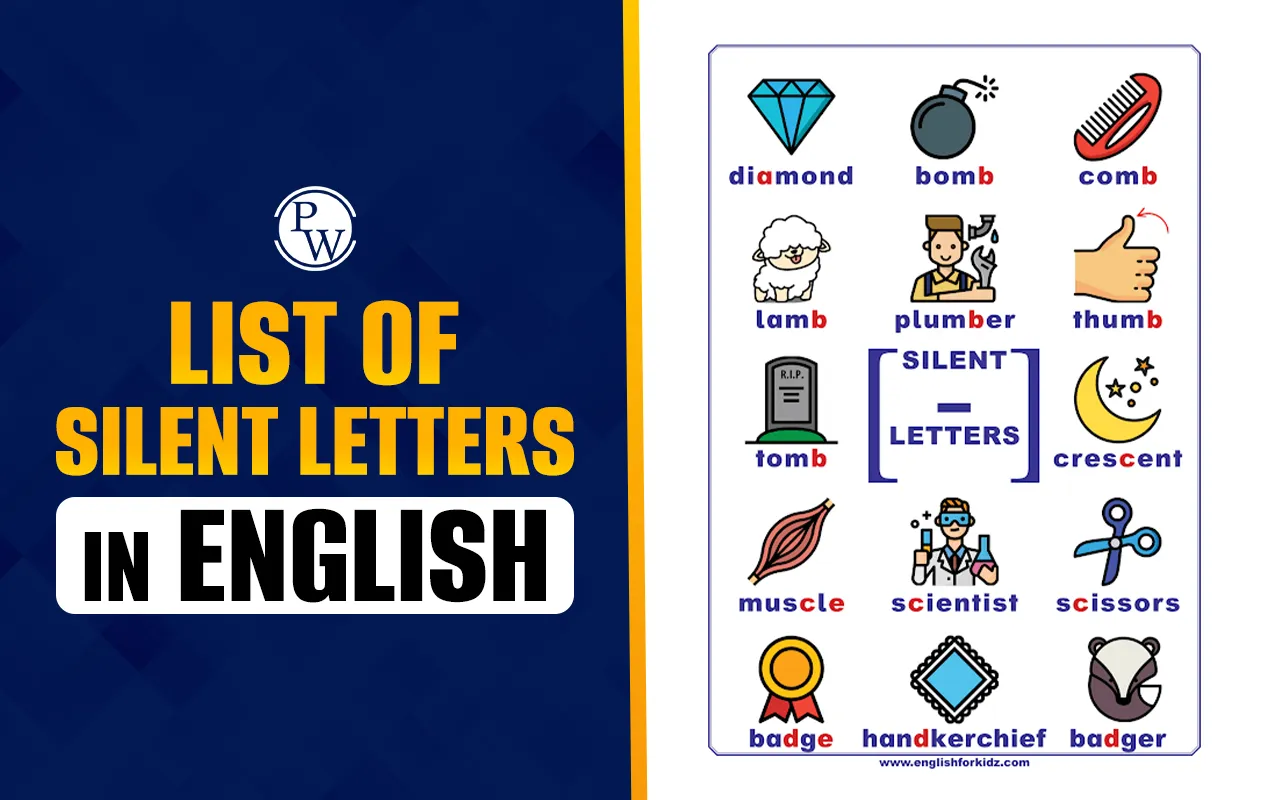
Silent letters in English generally confuse children because they are written but not spoken. Unlike other languages, English has many such words where letters like k, b, or w remain silent in pronunciation. For example, in some common silent letter words like knife and thumb, the letters k and b are not heard when we say them.
These silent letters are found in thousands of words, from common silent letter words like when and which, to difficult silent letter words that take more time to learn. Knowing them is important because they affect children's spelling, reading, and correct pronunciation in English.
Read More: Wh-Questions in English For Kids
10 Silent Letters Words
Silent letters in English are those letters that we write but do not pronounce. They sometimes come from old spellings or other languages. Learning them helps you read and spell better without confusion. Check 10 words with silent letters that we commonly use:
|
10 Words with Silent Letters |
||
|
Word |
Silent Letter |
Explanation |
|
Answer |
w |
The w is not spoken; we pronounce it as “anser.” |
|
Bomb |
b |
The last b is silent; we pronounce it as“bom.” |
|
Calf |
l |
The l is silent; we pronounce it as “caf.” |
|
Debt |
b |
The b is not pronounced; we say “det.” |
|
Hour |
h |
The h is silent; we pronounce it as “our.” |
|
Knife |
k |
The k is silent; we pronounce it as “nife.” |
|
Listen |
t |
The t is silent; we pronounce it as “lisen.” |
|
Psychology |
p |
The p is silent; we pronounce it as “sychology.” |
|
Talk |
l |
The l is silent; we pronounce it as “tak.” |
|
Write |
w |
The w is silent; we pronounce it as “rite.” |
Patterns of Silent Letters in English
While learning grammar, silent letters may look confusing to you, but they generally follow some simple patterns. Once you know these patterns, it becomes easy for you to understand how to pronounce such words. Let’s check some common patterns of silent letters:
Silent “k” before “n”
In English, whenever the letter k comes before n, the k is not spoken. For example, in knife, knot, know, knight, we only hear the n sound. The k is written, but we don’t say it.
Silent “g” before “n”
The letter g is also silent if it comes before n. Words like gnome, gnaw, and gnat all start with the n sound, not g. So when you say them, you completely drop the g sound.
Silent “b” after “m”
When b follows m in a word, the b is silent. For example: comb, limb, climb, dumb. You pronounce only the m sound and leave the b unspoken.
Silent “p” in Greek words
Many words that come from Greek have a silent p at the start. For instance, psychology, pneumonia, and phonics. In these words, the p does not have a sound. Sometimes it joins with another letter to create a new sound, like “ph,” making the sound of f in physics.
Silent “h” in some words
The letter h is silent in words like honest, hour, heir. In such cases, the word starts directly with the vowel sound after h. In other words, like school, the h is also silent, but here it gives a strong k sound with c.
Read more: Direct and Indirect Speech
List of Common Silent Letter Words
To understand it better, check the list of common silent letter words in English here, and practice reading them aloud to notice which letters are not pronounced:
|
List of Common Silent Letter Words |
|
|
Word |
Silent Letter |
|
Thumb |
b |
|
Comb |
b |
|
Debt |
b |
|
Knee |
k |
|
Know |
k |
|
Hour |
h |
|
Honest |
h |
|
Listen |
t |
|
Castle |
t |
|
Wrong |
w |
|
Autumn |
n |
|
Hymn |
n |
|
Island |
s |
|
Aisle |
s |
|
Gnome |
g |
|
Sign |
g |
|
Salmon |
l |
Read More: List of Singular and Plural Words
Difficult Silent Letter Words
Silent letters in English can be difficult to learn, as they don’t follow easy spelling or pronunciation rules and often come from old languages like Greek, Latin, or French. Because of this, children and even grown-ups may find them tricky to read, spell, or remember.
One reason these words are hard is that the silent letters do not always follow a fixed pattern. Let's check some difficult silent letter words in English:
-
P: pneumonia, psychology, receipt, pseudo
-
W: wrestle, wreck, wrist, write, sword
-
K: knee, knight, know, knowledge
-
GH: thought, high, through, daughter
-
C: muscle, scissors, acquaintance, scent
-
B: dumb, debt, doubt, subtle
-
D: Wednesday, handsome, bridge, ledge
-
T: castle, listen, fasten, whistle
-
H: rhino, honour, heir, rhythm
-
G: sign, design, foreign, gnat
Also Read: Abstract Nouns
Why Silent Letters in English Are Important
Silent letters in English are important for learning proper reading, writing, and speaking. They are part of the spelling of many words, even though we don’t pronounce them. Knowing about silent letters helps you understand the history of words, rectify spelling, and speak clearly. Here are some reasons why all silent letters in English are important:
-
Helps with Correct Spelling: Silent letters explain why words are spelled a certain way, even if the sound is different.
-
Shows the Origins of Words: Many silent letters come from old languages like Latin, Greek, and French.
-
Improves Pronunciation: Understanding silent letters helps avoid mistakes when speaking.
-
Builds Strong English Skills: Learning silent letters improves overall grammar, reading, and writing.
-
Supports Better Understanding of Words: It helps you connect words with their meaning and usage.
Build Your Child's Foundational English Skills With CuriousJr
Topics like Silent letters in English grammar can be tricky for children, but mastering them builds strong reading, spelling, and pronunciation skills. CuriousJr’s Online English Course is curated to help your child learn such important topics in a simple and fun way. These live, interactive classes use engaging teaching methods to make learning easy.
Here is how CuriousJr’s English by Cambridge program helps your child improve:
-
Easy and Fun Grammar Lessons: Children learn silent letters and other grammar topics step by step so they can read and write confidently.
-
Live Interactive Classes: Teachers explain foundational English topics using examples and practice activities to strengthen understanding.
-
Vocabulary and Pronunciation: Children build strong word knowledge and speak clearly while improving grammar skills.
-
Fun Activities: Games, speaking tasks, and exercises make learning enjoyable and memorable.
-
Progress Reports: Parents get regular updates on their child’s progress to track improvement.
Book a demo class today with CuriousJr and help your child build a strong foundation in English.