
NCERT Solutions for Class 8 Maths Chapter 4 Data Handling
 Shivam Singh29 May, 2026
Class 8 Maths Data Handling focuses on collecting, organizing, and presenting information in a clear and meaningful way. This chapter teaches students how to record data using tally marks and represent it through bar graphs, pie charts, and double bar graphs. By learning these methods, students can easily compare values and understand patterns in real-life situations. The data handling class 8 questions answers explain each concept step by step with solved examples. These solutions help students improve logical thinking, interpret data correctly, and score better in school exams by practicing different types of data-based problems.
Class 8 Maths Chapter 4 Data Handling Questions Answers
1. For which of these would you use a histogram to show the data?
(a) The number of letters for different areas in a postman’s bag.
(b) The height of competitors in an athletics meet.
(c) The number of cassettes produced by 5 companies.
(d) The number of passengers boarding trains from 7.00 a.m. to 7.00 p.m. at a station. Give a reason for each.
Solution: We know that a Histogram is a graphical representation of data if the data is represented using class interval. Since the cases mentioned in options (b) and (d) can be divided into class intervals, the histogram can be used to show the data. Similarly, since the cases mentioned in options (a) and (c) cannot be divided into class intervals, histograms cannot be used to represent the data.
2. The shoppers who come to a departmental store are marked as man (M), woman (W), boy (B) or girl (G). The following list gives the shoppers who came during the first hour of the morning.
W W W G B W W M G G M M W W W W G B M W B G G M W W M M W W W M W B W G M W W W W G W M M W M W G W M G W M M B G G W. Make a frequency distribution table using tally marks. Draw a bar graph to illustrate it. Solution: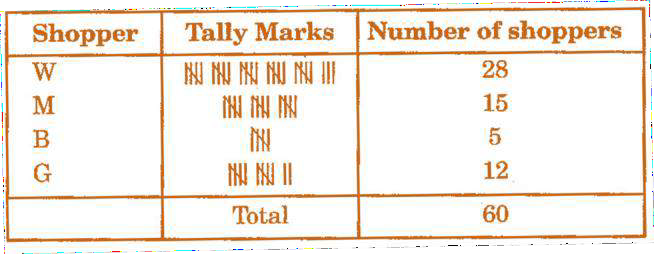 Frequency distribution table: Bar-graph:
3. The weekly wages (in ₹) of 30 workers in a factory are:
830, 835, 890, 810, 835, 836, 869, 845, 898, 890, 820, 860, 832, 833, 855, 845, 804, 808, 812, 840, 885, 835, 835, 836, 878, 840, 868, 890, 806, 840. Using tally marks, make a frequency table with intervals as 800 – 810, 810 – 820 and so on. Solution: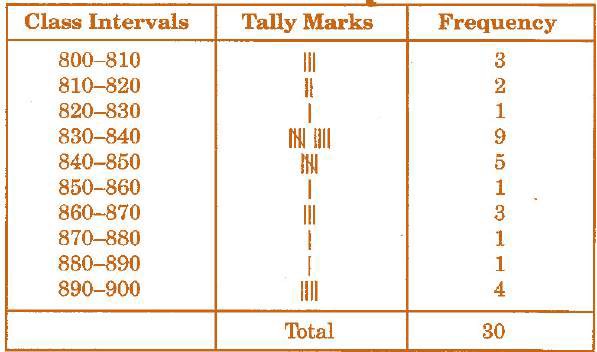
The frequency table with intervals as 800 – 810, 810 – 820 and so on, using tally marks, is given below:
4. Draw a histogram for the frequency table made for the data in Question 3 and answer the following questions.
(i) Which group has the maximum number of workers?
(ii) How many workers earn ₹ 850 and more?
(iii) How many workers earn less than ₹ 850?
Solution: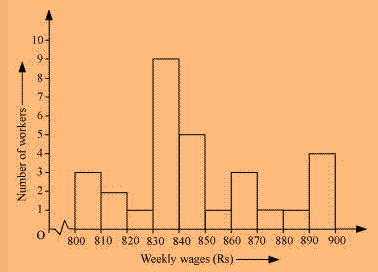 (i) 830-840 is the group having a maximum number of workers, 9, compared to other groups. (ii) Workers earning ₹ 850 and more= 1+3+1+1+4=10 (iii) Workers earning less than ₹ 850= 3+2+1+9+5=20
5. The number of hours for which students of a particular class watched television during holidays is shown in the given graph.
Answer the following:
(i) For how many hours did the maximum number of students watch TV?
(ii) How many students watched TV for less than 4 hours?
(iii) How many students spent more than 5 hours watching TV?

Solution: (i) 32 students watched TV for 4-5 hours. ∴ The maximum number of students who watched TV for 4 – 5 hours. (ii) The number of students who watched TV less than 4 hours= 22+8+4=34 (iii) The number of students who spent more than 5 hours watching TV =8+6=14
NCERT Solutions for Class 8 Maths Chapter 5 Data Handling Exercise 4.2 Page: 82
1. A survey was made to find the type of music that a certain group of young people liked in a city.
An adjoining pie chart shows the findings of this survey. From this pie chart, answer the following:
(i) If 20 people liked classical music, how many young people were surveyed?
(ii) Which type of music is liked by the maximum number of people?
(iii) If a cassette company were to make 1000 CDs, how many of each type would they
make?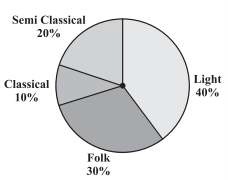
Solution:
(i) 10% represents 100 people. ⟹20% represents = (100×20)/10 = 200 ∴ 200 people were surveyed. (ii) Since 40% of the total people surveyed liked light music and no other form of song was liked more than that, we can conclude that light music is liked by the maximum number of people. (iii) CDs of classical music = (10 × 1000)/100 = 100 CDs of semi-classical music = (20 × 1000)/100 = 200 CDs of light music = (40 × 1000)/100 = 400 CDs of folk music = (30 × 1000)/100 = 300
2. A group of 360 people were asked to vote for their favourite season from the three:
seasons rainy, winter and summer.
(i) Which season got the most votes?
(ii)Find the central angle of each sector.
(iii) Draw a pie chart to show this information

Solution:
(i) According to the table given in the question, the winter season got the most votes. (ii) Central angle of summer season= (90×360)/360= 90o Central angle of rainy season= (120×360)/360= 120o Central angle of winter season= (150×360)/360= 150o (iii)
3. Draw a pie chart showing the following information. The table shows the colours preferred by a group of people.

Solution:
Here, central angle = 360o Total number of people = 36

4. The adjoining pie chart gives the marks scored in an examination by a student in Hindi, English, Mathematics, Social Science and Science. If the total marks obtained by the students were 540, answer the following questions.
(i) In which subject did the student score 105 marks?
(Hint: for 540 marks, the central angle = 360°. So, for 105 marks, what is the central angle?)
(ii) How many more marks were obtained by the student in Mathematics than in Hindi?
(iii) Examine whether the sum of the marks obtained in Social Science and Mathematics is more than that in Science and Hindi (Hint: Just study the central angles).
 Solution:
(i) The student scored 105 marks in Hindi.
(ii) Marks obtained in Mathematics = 135 Marks obtained in Hindi = 105 Difference = 135 – 105 = 30
Thus, 30 more marks were obtained by the student in Mathematics than in Hindi.
(iii) The sum of marks in Social Science and Mathematics = 97.5 + 135 = 232.5 The sum of marks in Science and Hindi = 120 + 105 = 225
∴ the sum of the marks in Social Science and Mathematics is more than in Science and Hindi.
5. The number of students in a hostel speaking different languages is given below. Display the data in a pie chart.

Solution:
NCERT Solution for Class 8 Maths Chapter 5 – Data Handling

NCERT Solutions for Class 8 Maths Chapter 5 Data Handling Exercise 4.3 Page: 87
1. List the outcomes you can see in these experiments.
(a) Spinning a wheel (b) Tossing two coins together
 Solution:
(a) There are four letters A, B, C and D in a spinning wheel. So, there are 4 outcomes.
(b) When two coins are tossed together. There are four possible outcomes HH, HT, TH, and TT.
2. When a die is thrown, list the outcomes of an event of getting
(i) (a) a prime number (b) not a prime number
(ii) (a) a number greater than 5 (b) a number not greater than 5
Solution:
(i) (a) Outcomes of the event of getting a prime number are 2, 3 and 5.
(b) Outcomes of the event of not getting a prime number are 1, 4 and 6.
(ii) (a) Outcomes of the event of getting a number greater than 5 is 6.
(b) Outcomes of the event of not getting a number greater than 5 are 1, 2, 3, 4 and 5.
3. Find the.
(a) Probability of the pointer stopping on D in (Question 1-(a)).
(b) Probability of getting an ace from a well-shuffled deck of 52 playing cards.
(c) Probability of getting a red apple. (See figure below)
 Solution:
(a) In a spinning wheel, there are five pointers A, A, B, C, D. So, there are five
outcomes. The pointer stops at D, which is one outcome. So, the probability of the pointer stopping on D = 1/5
(b) There are 4 aces in a deck of 52 playing cards. So, there are four events for getting an ace.
So, the probability of getting an ace = 4/52 = 1/13
(c) Total number of apples = 7
Number of red apples = 4 Probability of getting a red apple = 4/7
4. Numbers 1 to 10 are written on ten separate slips (one number on one slip), kept in a box and mixed well. One slip is chosen from the box without looking into it. What is the probability of
(i) getting a number 6?
(ii) getting a number less than 6? (iii) getting a number greater than 6? (iv)getting a 1-digit number?
Solution:
(i) Outcome of getting a number 6 from ten separate slips is one.
∴ probability of getting a number 6 = 1/10
(ii) Numbers less than 6 are 1, 2, 3, 4 and 5, which are five. So, there are 5 outcomes.
∴ probability of getting a number less 6 =5/10 = ½
(iii) Number greater than 6 out of ten that are 7, 8, 9, 10. So there are 4 possible outcomes.
∴ probability of getting a number greater than 6 = 4/10 = 2/5
(iv) One-digit numbers are 1, 2, 3, 4, 5, 6, 7, 8, 9 out of ten.
∴ probability of getting a 1-digit number = 9/10
5. If you have a spinning wheel with 3 green sectors, 1 blue sector and 1 red sector, what is the probability of getting a green sector? What is the probability of getting a non-blue sector?
Solution:
A total of five sectors are present. Out of the five sectors, three sectors are green. ∴ probability of getting a green sector = 3/5 Out of the five sectors, one sector is blue. Hence, non-blue sectors = 5 – 1 = 4 sectors ∴ probability of getting a non-blue sector= 4/5
6. Find the probabilities of the events given in Question 2.
Solution:
When a die is thrown, there is a total of six outcomes, i.e., 1, 2, 3, 4, 5 and 6. (i)
(a) 2, 3, 5 are the prime numbers. So, there are 3 outcomes out of 6.
∴ probability of getting a prime number =3/6 = ½
(b) 1, 4, 6 are not the prime numbers. So, there are 3 outcomes out of 6.
∴ probability of getting a prime number =3/6 = ½ (ii)
(c) Only 6 is greater than 5.
So there is one outcome out of 6. ∴ probability of getting a number greater than 5= 1/6
(d) Numbers not greater than 5 are 1, 2, 3, 4 and 5. So there are 5 outcomes out of 6.
∴ probability of not getting a number greater than 5= 5/6
What is Data Handling?
Imagine you ask 20 friends what their favorite ice cream flavor is. Some say chocolate, some say vanilla, and others say strawberry. If you just write their names and flavors in a long list, it looks messy. Class 8 maths data handling teaches you how to group these answers together.
Data is just another word for information. Handling data means we are the "boss" of that information. We sort it, count it, and draw it. Whether you are a student in class 4th or class 7th, learning this skill is very helpful because it shows up in news reports, weather forecasts, and even sports scores.
Organizing Data with Tally Marks
The first step in class 8 maths data handling solutions is often making a frequency distribution table. To do this, we use tally marks. Tally marks are just straight lines we draw to count things.
For every one item, we draw one line |. When we get to five, we draw a slanted line across the four lines to make a "bundle." This makes it very easy to count by fives. For example, if you see two bundles and three lines, you know the total is 13 without counting every single one. This is a basic part of class 8 maths data handling that helps prevent mistakes when you are dealing with a lot of numbers.
Grouping Data for Better Clarity
Sometimes we have too much data to show every single number. If you have the marks of 60 students, the table would be too long. In class 8 maths data handling exercise, you learn how to make "groups" or "classes."
For example, you can group marks like this:
-
0 to 10
-
10 to 20
-
20 to 30
This is called grouped data. The width of these groups (like 10 in this case) is called the "class size." The middle of the group is the "class mark." When you look at class 8 maths data handling solutions, you will see that grouping makes the information look much cleaner and easier to study.
Read More - NCERT Solutions for Class 8 English Chapter 5 Princess September
Understanding the Pie Chart (Circle Graph)
One of the most fun parts of this chapter is the pie chart. A pie chart is a circle divided into slices. Each slice shows a part of the whole. In class 8 maths data handling exercise, you might have to find the "central angle" to draw these slices.
To find the angle for a slice, you take the value of that item, divide it by the total, and multiply by 360. Why 360? Because a full circle has 360 degrees! If half the people like chocolate, then the chocolate slice will be 180 degrees (which is half of 360).
Many students find class 8 maths data handling extra questions that focus on pie charts because they are very common in real life. If you see a circle showing how you spend your day (sleeping, playing, studying), that is a pie chart!
Exploring Probability and Chance
In class 8 maths data handling exercise, the topic shifts to something called probability. This is just a fancy word for "how likely is it that something will happen?"
Think about tossing a coin. There are only two results: Heads or Tails. So, the chance of getting a Head is 1 out of 2. If you throw a dice, there are 6 numbers. The chance of getting a 4 is 1 out of 6.
We use class 8 maths data handling solutions to calculate these chances using a simple formula:
-
Probability = (Number of successful outcomes) / (Total number of possible outcomes)
This part of math is like being a detective. You look at the clues (the total outcomes) and figure out the mystery of what might happen next!
Read More - NCERT Solutions for Class 8 History Chapter 3 Ruling the Countryside
Why Study Class 8 Maths Data Handling?
You might wonder why we need to learn this. Well, class 8 maths data handling is used by scientists, doctors, and even game developers!
-
Predicting Trends: It helps us see if things are going up or down.
-
Making Choices: Businesses use data to decide which toys or snacks to make more of.
-
Saving Time: A graph tells a story in 5 seconds that a list of 100 numbers might take 10 minutes to explain.
By practicing class 8 maths data handling extra questions, you train your brain to see patterns. This makes you much better at solving puzzles and understanding the world around you.
Solving Typical Exam Questions
When you are getting ready for your test, you should focus on the main types of problems found in class 8 maths data handling solutions.
-
Constructing a Histogram: This looks like a bar graph but there are no gaps between the bars. It is used for grouped data.
-
Drawing a Pie Chart: Always remember to calculate your angles carefully using the 360-degree rule.
-
Finding Probability: Be careful to count all possible results so your bottom number is correct.
If you find a question difficult, looking at class 8 maths data handling extra questions from previous years can show you the common tricks teachers use in exams.
Summary of Key Terms
Here is a quick list of words you will see in class 8 maths data handling exercises
-
Raw Data: Information that has not been organized yet.
-
Range: The difference between the highest and lowest numbers.
-
Frequency: How many times a particular number appears.
-
Outcomes: The possible results of an experiment (like flipping a coin).
Mastering these terms makes the class 8 maths data handling solutions feel much simpler.
How CuriousJr Makes Online Learning Easy and Enjoyable
Supporting a child’s education requires the right guidance, patience, and encouragement. With CuriousJr, learning at home becomes a smooth, positive, and enjoyable experience for both children and parents.
Parents choose CuriousJr online school tuition classes because they keep children interested, confident, and motivated to learn. We create a friendly and supportive environment where students feel comfortable asking questions and learning without pressure.
Our online tuition classes help children understand concepts clearly while boosting creativity and curiosity. Interactive activities, play-based learning, and regular practice make lessons fun and engaging.
Experienced mentors offer personalized attention, especially to students who need extra support. Parents also receive clear feedback to track progress and improve learning outcomes. Book a demo class today to experience joyful online learning with CuriousJr.





NCERT Solutions for Class 8 Maths Chapter 4 FAQs
What is the difference between a bar graph and a histogram?
How do I calculate the central angle for a pie chart?
Is probability hard to learn in class 8?
Where can I find more class 8 maths data handling extra questions?
Can a class 4th student understand this chapter?









Get Free Counselling Today
and Clear up all your Doubts
 Live & recorded classes available at easeDashboard for progress trackingLakhs of practice questions

