NCERT Solutions for Class 8 Maths Chapter 3 Understanding Quadrilaterals
 Shivam Singh6 Feb, 2026
NCERT Solutions for Class 8 Maths Chapter 3 help students understand quadrilaterals, which are shapes with four sides. This chapter explains different types of quadrilaterals such as squares, rectangles, parallelograms, rhombuses, trapeziums, and kites. Students learn about their properties, sides, angles, and diagonals in a simple way. The understanding quadrilaterals class 8 solutions provide clear explanations and step-by-step answers to textbook questions. By practicing these solutions, students can easily find interior angles, identify special features of each shape, and build a strong foundation for geometry topics covered in higher classes.
Class 8 Maths Chapter 3 Understanding Quadrilaterals Questions Answers
Here we have provided NCERT Solutions for Class 8 Maths Chapter 3 Understanding Quadrilaterals for the ease of students so that they can prepare better for their exams.
NCERT Solutions for Class 8 Maths Chapter 3 Understanding Quadrilaterals Exercise 3.1 Page: 41
1. Given here are some figures.

Classify each of them on the basis of the following.
Simple curve (b) Simple closed curve (c) Polygon
(d) Convex polygon (e) Concave polygon
Solution: a) Simple curve: 1, 2, 5, 6 and 7 b) Simple closed curve: 1, 2, 5, 6 and 7 c) Polygon: 1 and 2 d) Convex polygon: 2 e) Concave polygon: 1
2. How many diagonals does each of the following have?
a) A convex quadrilateral (b) A regular hexagon (c) A triangle
Solution: a) A convex quadrilateral: 2. b) A regular hexagon: 9.
 c) A triangle: 0
3. What is the sum of the measures of the angles of a convex quadrilateral? Will this property hold if the quadrilateral is not convex? (Make a non-convex quadrilateral and try!)
Solution: Let ABCD be a convex quadrilateral. From the figure, we infer that the quadrilateral ABCD is formed by two triangles, i.e. ΔADC and ΔABC. Since we know that sum of the interior angles of a triangle is 180°, the sum of the measures of the angles is 180° + 180° = 360°
 Let us take another quadrilateral ABCD which is not convex . Join BC, such that it divides ABCD into two triangles ΔABC and ΔBCD. In ΔABC, ∠1 + ∠2 + ∠3 = 180° (angle sum property of triangle) In ΔBCD, ∠4 + ∠5 + ∠6 = 180° (angle sum property of triangle) ∴, ∠1 + ∠2 + ∠3 + ∠4 + ∠5 + ∠6 = 180° + 180° ⇒ ∠1 + ∠2 + ∠3 + ∠4 + ∠5 + ∠6 = 360° ⇒ ∠A + ∠B + ∠C + ∠D = 360° Thus, this property holds if the quadrilateral is not convex.
4. Examine the table. (Each figure is divided into triangles and the sum of the angles deduced from that.)
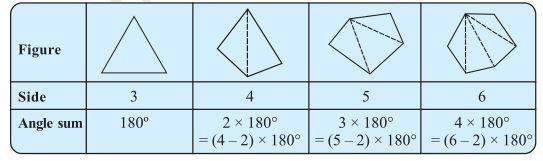
What can you say about the angle sum of a convex polygon with number of sides? (a) 7 (b) 8 (c) 10 (d) n
Solution: The angle sum of a polygon having side n = (n-2)×180° a) 7 Here, n = 7 Thus, angle sum = (7-2)×180° = 5×180° = 900° b) 8 Here, n = 8 Thus, angle sum = (8-2)×180° = 6×180° = 1080° c) 10 Here, n = 10 Thus, angle sum = (10-2)×180° = 8×180° = 1440° d) n Here, n = n Thus, angle sum = (n-2)×180°
5. What is a regular polygon?
State the name of a regular polygon of
(i) 3 sides (ii) 4 sides (iii) 6 sides
Solution: Regular polygon: A polygon having sides of equal length and angles of equal measures is called a regular polygon. A regular polygon is both equilateral and equiangular. (i) A regular polygon of 3 sides is called an equilateral triangle. (ii) A regular polygon of 4 sides is called a square. (iii) A regular polygon of 6 sides is called a regular hexagon.
6. Find the angle measure of x in the following figures.
 Solution: a) The figure has 4 sides. Hence, it is a quadrilateral. Sum of angles of the quadrilateral = 360° ⇒ 50° + 130° + 120° + x = 360° ⇒ 300° + x = 360° ⇒ x = 360° – 300° = 60° b) The figure has 4 sides. Hence, it is a quadrilateral. Also, one side is perpendicular forming a right angle. Sum of angles of the quadrilateral = 360° ⇒ 90° + 70° + 60° + x = 360° ⇒ 220° + x = 360° ⇒ x = 360° – 220° = 140° c) The figure has 5 sides. Hence, it is a pentagon.
 Sum of angles of the pentagon = 540° Two angles at the bottom are a linear pair. ∴, 180° – 70° = 110° 180° – 60° = 120° ⇒ 30° + 110° + 120° + x + x = 540° ⇒ 260° + 2x = 540° ⇒ 2x = 540° – 260° = 280° ⇒ 2x = 280° = 140° d) The figure has 5 equal sides. Hence, it is a regular pentagon. Thus, all its angles are equal. 5x = 540° ⇒ x = 540°/5 ⇒ x = 108°
7.
 Solution: a) Sum of all angles of triangle = 180° One side of triangle = 180°- (90° + 30°) = 60° x + 90° = 180° ⇒ x = 180° – 90° = 90° y + 60° = 180° ⇒ y = 180° – 60° = 120° z + 30° = 180° ⇒ z = 180° – 30° = 150° x + y + z = 90° + 120° + 150° = 360° b) Sum of all angles of quadrilateral = 360° One side of quadrilateral = 360°- (60° + 80° + 120°) = 360° – 260° = 100° x + 120° = 180° ⇒ x = 180° – 120° = 60° y + 80° = 180° ⇒ y = 180° – 80° = 100° z + 60° = 180° ⇒ z = 180° – 60° = 120° w + 100° = 180° ⇒ w = 180° – 100° = 80° x + y + z + w = 60° + 100° + 120° + 80° = 360°
NCERT Solutions for Class 8 Maths Chapter 3 Understanding Quadrilaterals Exercise 3.2 Page: 44
1. Find x in the following figures.
 Solution: a)
 125° + m = 180° ⇒ m = 180° – 125° = 55° (Linear pair) 125° + n = 180° ⇒ n = 180° – 125° = 55° (Linear pair) x = m + n (The exterior angle of a triangle is equal to the sum of the two opposite interior angles) ⇒ x = 55° + 55° = 110° b)
 Two interior angles are right angles = 90° 70° + m = 180° ⇒ m = 180° – 70° = 110° (Linear pair) 60° + n = 180° ⇒ n = 180° – 60° = 120° (Linear pair) The figure is having five sides and is a pentagon. Thus, sum of the angles of a pentagon = 540° ⇒ 90° + 90° + 110° + 120° + y = 540° ⇒ 410° + y = 540° ⇒ y = 540° – 410° = 130° x + y = 180° (Linear pair) ⇒ x + 130° = 180° ⇒ x = 180° – 130° = 50°
2. Find the measure of each exterior angle of a regular polygon of
(i) 9 sides (ii) 15 sides
Solution: Sum of the angles of a regular polygon having side n = (n-2)×180° (i) Sum of the angles of a regular polygon having 9 sides = (9-2)×180°= 7×180° = 1260° Each interior angle=1260/9 = 140° Each exterior angle = 180° – 140° = 40° Or, Each exterior angle = Sum of exterior angles/Number of angles = 360/9 = 40° (ii) Sum of angles of a regular polygon having side 15 = (15-2)×180° = 13×180° = 2340° Each interior angle = 2340/15 = 156° Each exterior angle = 180° – 156° = 24° Or, Each exterior angle = sum of exterior angles/Number of angles = 360/15 = 24°
3. How many sides does a regular polygon have if the measure of an exterior angle is 24°?
Solution: Each exterior angle = sum of exterior angles/Number of angles 24°= 360/ Number of sides ⇒ Number of sides = 360/24 = 15 Thus, the regular polygon has 15 sides.
4. How many sides does a regular polygon have if each of its interior angles is 165°?
Solution: Interior angle = 165° Exterior angle = 180° – 165° = 15° Number of sides = sum of exterior angles/exterior angles ⇒ Number of sides = 360/15 = 24 Thus, the regular polygon has 24 sides.
5. a) Is it possible to have a regular polygon with measure of each exterior angle as 22°?
b) Can it be an interior angle of a regular polygon? Why?
Solution: a) Exterior angle = 22° Number of sides = sum of exterior angles/ exterior angle ⇒ Number of sides = 360/22 = 16.36 No, we can’t have a regular polygon with each exterior angle as 22° as it is not a divisor of 360. b) Interior angle = 22° Exterior angle = 180° – 22°= 158° No, we can’t have a regular polygon with each exterior angle as 158° as it is not a divisor of 360.
6. a) What is the minimum interior angle possible for a regular polygon? Why?
b) What is the maximum exterior angle possible for a regular polygon?
Solution: a) An equilateral triangle is the regular polygon (with 3 sides) having the least possible minimum interior angle because a regular polygon can be constructed with minimum 3 sides. Since the sum of interior angles of a triangle = 180° Each interior angle = 180/3 = 60° b) An equilateral triangle is the regular polygon (with 3 sides) having the maximum exterior angle because the regular polygon with the least number of sides has the maximum exterior angle possible. Maximum exterior possible = 180 – 60° = 120°
Also Read - NCERT Solution for class 8 chapetr 2
NCERT Solutions for Class 8 Maths Chapter 3 Understanding Quadrilaterals Exercise 3.3 Page: 50
1. Given a parallelogram ABCD. Complete each statement along with the definition or property used.

(i) AD = …… (ii) ∠DCB = …… (iii) OC = …… (iv) m ∠DAB + m ∠CDA = ……
Solution: (i) AD = BC (Opposite sides of a parallelogram are equal) (ii) ∠DCB = ∠DAB (Opposite angles of a parallelogram are equal) (iii) OC = OA (Diagonals of a parallelogram are equal) (iv) m ∠DAB + m ∠CDA = 180°
2. Consider the following parallelograms. Find the values of the unknown x, y, z

Solution: (i) y = 100° (opposite angles of a parallelogram) x + 100° = 180° (adjacent angles of a parallelogram) ⇒ x = 180° – 100° = 80° x = z = 80° (opposite angles of a parallelogram) ∴, x = 80°, y = 100° and z = 80°
 (ii) 50° + x = 180° ⇒ x = 180° – 50° = 130° (adjacent angles of a parallelogram) x = y = 130° (opposite angles of a parallelogram) x = z = 130° (corresponding angle) (iii)
 x = 90° (vertical opposite angles) x + y + 30° = 180° (angle sum property of a triangle) ⇒ 90° + y + 30° = 180° ⇒ y = 180° – 120° = 60° also, y = z = 60° (alternate angles) (iv)
 z = 80° (corresponding angle) z = y = 80° (alternate angles) x + y = 180° (adjacent angles) ⇒ x + 80° = 180° ⇒ x = 180° – 80° = 100° (v)
 x=28o y = 112o z = 28o
3. Can a quadrilateral ABCD be a parallelogram if (i) ∠D + ∠B = 180°?
(ii) AB = DC = 8 cm, AD = 4 cm and BC = 4.4 cm?
(iii)∠A = 70° and ∠C = 65°?
Solution: (i) Yes, a quadrilateral ABCD can be a parallelogram if ∠D + ∠B = 180° but it should also fulfil some conditions, which are: (a) The sum of the adjacent angles should be 180°. (b) Opposite angles must be equal. (ii) No, opposite sides should be of the same length. Here, AD ≠ BC (iii) No, opposite angles should be of the same measures. ∠A ≠ ∠C
4. Draw a rough figure of a quadrilateral that is not a parallelogram but has exactly two opposite angles of equal measure.
Solution: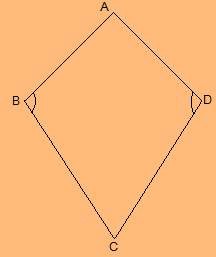
ABCD is a figure of quadrilateral that is not a parallelogram but has exactly two opposite angles, that is, ∠B = ∠D of equal measure. It is not a parallelogram because ∠A ≠ ∠C.
5. The measures of two adjacent angles of a parallelogram are in the ratio 3 : 2. Find the measure of each of the angles of the parallelogram.
Solution: Let the measures of two adjacent angles ∠A and ∠B be 3x and 2x, respectively in parallelogram ABCD. ∠A + ∠B = 180° ⇒ 3x + 2x = 180° ⇒ 5x = 180° ⇒ x = 36° We know that opposite sides of a parallelogram are equal. ∠A = ∠C = 3x = 3 × 36° = 108° ∠B = ∠D = 2x = 2 × 36° = 72°
6. Two adjacent angles of a parallelogram have equal measure. Find the measure of each of the angles of the parallelogram.
Solution: Let ABCD be a parallelogram. Sum of adjacent angles of a parallelogram = 180° ∠A + ∠B = 180° ⇒ 2∠A = 180° ⇒ ∠A = 90° also, 90° + ∠B = 180° ⇒ ∠B = 180° – 90° = 90° ∠A = ∠C = 90° ∠B = ∠D = 90
7. The adjacent figure HOPE is a parallelogram. Find the angle measures x, y and z. State the properties you use to find them.

Solution: y = 40° (alternate interior angle) ∠P = 70° (alternate interior angle) ∠P = ∠H = 70° (opposite angles of a parallelogram) z = ∠H – 40°= 70° – 40° = 30° ∠H + x = 180° ⇒ 70° + x = 180° ⇒ x = 180° – 70° = 110°
8. The following figures GUNS and RUNS are parallelograms. Find x and y. (Lengths are in cm)

Solution: (i) SG = NU and SN = GU (opposite sides of a parallelogram are equal) 3x = 18 x = 18/3 ⇒ x =6 3y – 1 = 26 ⇒ 3y = 26 + 1 ⇒ y = 27/3=9 x = 6 and y = 9 (ii) 20 = y + 7 and 16 = x + y (diagonals of a parallelogram bisect each other) y + 7 = 20 ⇒ y = 20 – 7 = 13 and, x + y = 16 ⇒ x + 13 = 16 ⇒ x = 16 – 13 = 3 x = 3 and y = 13
9. In the above figure both RISK and CLUE are parallelograms. Find the value of x.

Solution: ∠K + ∠R = 180° (adjacent angles of a parallelogram are supplementary) ⇒ 120° + ∠R = 180° ⇒ ∠R = 180° – 120° = 60° also, ∠R = ∠SIL (corresponding angles) ⇒ ∠SIL = 60° also, ∠ECR = ∠L = 70° (corresponding angles) x + 60° + 70° = 180° (angle sum of a triangle) ⇒ x + 130° = 180° ⇒ x = 180° – 130° = 50°
10. Explain how this figure is a trapezium. Which of its two sides are parallel? (Fig 3.32)

Solution: When a transversal line intersects two lines in such a way that the sum of the adjacent angles on the same side of transversal is 180°, then the lines are parallel to each other. Here, ∠M + ∠L = 100° + 80° = 180° Thus, MN || LK As the quadrilateral KLMN has one pair of parallel lines, it is a trapezium. MN and LK are parallel lines.
11. Find m∠C in Fig 3.33 if AB || DC.

Solution: m∠C + m∠B = 180° (angles on the same side of transversal) ⇒ m∠C + 120° = 180° ⇒ m∠C = 180°- 120° = 60°
12. Find the measure of ∠P and ∠S if SP || RQ ? in Fig 3.34. (If you find m∠R, is there more than one method to find m∠P?)

Solution: ∠P + ∠Q = 180° (angles on the same side of transversal) ⇒ ∠P + 130° = 180° ⇒ ∠P = 180° – 130° = 50° also, ∠R + ∠S = 180° (angles on the same side of transversal) ⇒ 90° + ∠S = 180° ⇒ ∠S = 180° – 90° = 90° Thus, ∠P = 50° and ∠S = 90° Yes, there are more than one method to find m∠P. PQRS is a quadrilateral. Sum of measures of all angles is 360°. Since, we know the measurement of ∠Q, ∠R and ∠S. ∠Q = 130°, ∠R = 90° and ∠S = 90° ∠P + 130° + 90° + 90° = 360° ⇒ ∠P + 310° = 360° ⇒ ∠P = 360° – 310° = 50°
NCERT Solutions for Class 8 Maths Chapter 3 Understanding Quadrilaterals Exercise 3.4 Page: 55
1. State whether True or False.
(a) All rectangles are squares.
(b) All rhombuses are parallelograms.
(c) All squares are rhombuses and also rectangles.
(d) All squares are not parallelograms.
(e) All kites are rhombuses.
(f) All rhombuses are kites.
(g) All parallelograms are trapeziums.
(h) All squares are trapeziums.
Solution: (a) False Because all squares are rectangles but all rectangles are not squares. (b) True (c) True (d) False Because all squares are parallelograms as opposite sides are parallel and opposite angles are equal. (e) False. Because, for example, the length of the sides of a kite are not of the same length. (f) True (g) True (h) True
2. Identify all the quadrilaterals that have.
(a) four sides of equal length (b) four right angles
Solution: (a) Rhombus and square have all four sides of equal length. (b) Square and rectangle have four right angles.
3. Explain how a square is
(i) a quadrilateral (ii) a parallelogram (iii) a rhombus (iv) a rectangle
Solution (i) Square is a quadrilateral because it has four sides. (ii) Square is a parallelogram because it’s opposite sides are parallel and opposite angles are equal. (iii) Square is a rhombus because all the four sides are of equal length and diagonals bisect at right angles. (iv)Square is a rectangle because each interior angle, of the square, is 90°
4. Name the quadrilaterals whose diagonals.
(i) bisect each other (ii) are perpendicular bisectors of each other (iii) are equal
Solution (i) Parallelogram, Rhombus, Square and Rectangle (ii) Rhombus and Square (iii)Rectangle and Square
5. Explain why a rectangle is a convex quadrilateral.
Solution A rectangle is a convex quadrilateral because both of its diagonals lie inside the rectangle.
6. ABC is a right-angled triangle and O is the mid-point of the side opposite to the right angle. Explain why O is equidistant from A, B and C. (The dotted lines are drawn additionally to help you).
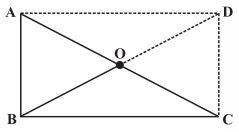
Solution AD and DC are drawn so that AD || BC and AB || DC AD = BC and AB = DC ABCD is a rectangle as opposite sides are equal and parallel to each other and all the interior angles are of 90°. In a rectangle, diagonals are of equal length and also bisect each other. Hence, AO = OC = BO = OD Thus, O is equidistant from A, B and C.
Read More - NCERT Solutions for Class 8 Maths Chapter 8 Algebraic Expressions and Identities
What are Quadrilaterals in Simple Words?
When you look around your room, you see many shapes. Your book, your window, and even your mobile screen have something in common. They all have four straight sides. In math, any flat shape with four sides and four corners is called a quadrilateral. The word "quad" means four, and "lateral" means side.
When you start studying the understanding of quadrilaterals class 8 solutions, you will learn that these shapes can look very different. Some are perfectly even, like a square. Others might look a bit tilted, like a diamond or a kite. The cool thing about all these shapes is that if you add up all four of their inside angles, the total is always 360 degrees.
Learning About Polygons
Before we dive deep into understanding quadrilaterals class 8 solutions in ncert, we need to know about polygons. A polygon is just a simple closed curve made up of only line segments.
-
Triangle: 3 sides
-
Quadrilateral: 4 sides
-
Pentagon: 5 sides
-
Hexagon: 6 sides
In your class 8 book, we focus mostly on convex polygons. These are shapes where all the corners point outwards. If even one corner points inward (like a cave), it is called a concave polygon. We mostly use the understanding quadrilaterals class 8 solutions to solve problems about regular polygons, where all sides and all angles are equal.
Deep Dive into Parallelograms
A very important part of this chapter is the parallelogram. This is a quadrilateral where the opposite sides are parallel to each other. Parallel means the lines run like railway tracks and never meet.
Properties of a Parallelogram:
-
The opposite sides are equal in length.
-
The opposite angles are equal.
-
The angles next to each other (adjacent angles) add up to 180 degrees.
-
The diagonals (lines connecting opposite corners) cut each other exactly in half.
If you are looking at understanding quadrilaterals class 8 solutions 3.3, you will find many questions about finding missing angles in a parallelogram. Remember, if you know just one angle, you can often find all the others using these simple rules!
Read More - NCERT Solutions for Class 8 Maths Chapter 7 Comparing Quantities
Solving Exercises with Ease
Many students find Exercise 3.3 and Exercise 3.4 a bit tricky. That is why having an understanding quadrilaterals class 8 solutions pdf is very helpful.
Exploring Exercise 3.3
In understanding quadrilaterals class 8 solutions 3.3, the questions ask you to find the values of unknowns like x, y, and z. Usually, these shapes are parallelograms. You just need to remember that the opposite angles are the same. So, if one corner is 100 degrees, the corner opposite to it is also 100 degrees!
Exploring Exercise 3.4
When you move to understanding quadrilaterals class 8 solutions ex 3.4, the focus changes to "True or False" questions and identifying shapes based on their properties. For example, is every square a rectangle? Yes, because a square has all the features that a rectangle has! Is every rectangle a square? No, because a rectangle does not have to have four equal sides.
Special Shapes: Rhombus, Rectangle, and Square
As we go further into understanding quadrilaterals class 8 solutions, we meet the "celebrity" shapes.
-
Rhombus: Think of this as a tilted square. All four sides are equal, but the corners don't have to be 90 degrees. However, its diagonals cross each other at a perfect 90-degree angle.
-
Rectangle: This shape has four right angles (90 degrees). The opposite sides are equal, and the diagonals are also equal in length.
-
Square: This is the most perfect shape. It is a rectangle with all sides equal and a rhombus with all angles 90 degrees.
Understanding these differences is key to mastering the understanding quadrilaterals class 8 solutions ncert.
Why Should You Practice These Solutions?
Geometry can feel like a puzzle. When you use the understanding quadrilaterals class 8 solutions, you are learning the rules of the puzzle.
-
Visual Learning: These solutions help you "see" the math. Instead of just numbers, you work with drawings.
-
Step-by-Step Help: The understanding quadrilaterals class 8 solutions pdf breaks down big problems into tiny steps that are easy to follow for class 4th or class 7th students too.
-
Exam Readiness: Most school questions come directly from the NCERT book. By practicing these, you will feel very confident during your tests.
Summary of Quadrilateral Rules
To make things easy for you, here is a quick list of rules you will find in the understanding quadrilaterals class 8 solutions:
-
The sum of exterior angles (outside angles) of any polygon is always 360 degrees.
-
For a regular polygon with 'n' sides, each exterior angle is 360 divided by n.
-
In a kite, the diagonals are perpendicular (they make a plus sign), and one diagonal bisects the other.
-
A trapezium is a shape with at least one pair of parallel sides.
By keeping these rules in your mind, you can solve any question in the understanding quadrilaterals class 8 solutions ex 3.4 without any help!
How CuriousJr Makes Online Learning Simple and Fun
A child’s learning journey needs proper guidance, patience, and positive motivation. With CuriousJr, studying at home becomes a joyful and meaningful experience for both students and parents.
Parents rely on CuriousJr online school tuition classes because they keep children attentive, motivated, and confident. We provide a friendly and encouraging environment where learning feels relaxed and enjoyable instead of stressful.
Our online tuition classes focus on clear concept understanding while nurturing creativity and curiosity. Play-based lessons, interactive tools, and regular practice activities make learning more engaging.
Experienced mentors offer personalized attention to support every child, especially those who need extra help. Parents also receive detailed feedback to track progress and improve learning. Book a demo class today and explore enjoyable online learning with CuriousJr.