Chemical Mixtures: Meaning, Types, Examples
 Shivam Singh27 Nov, 2025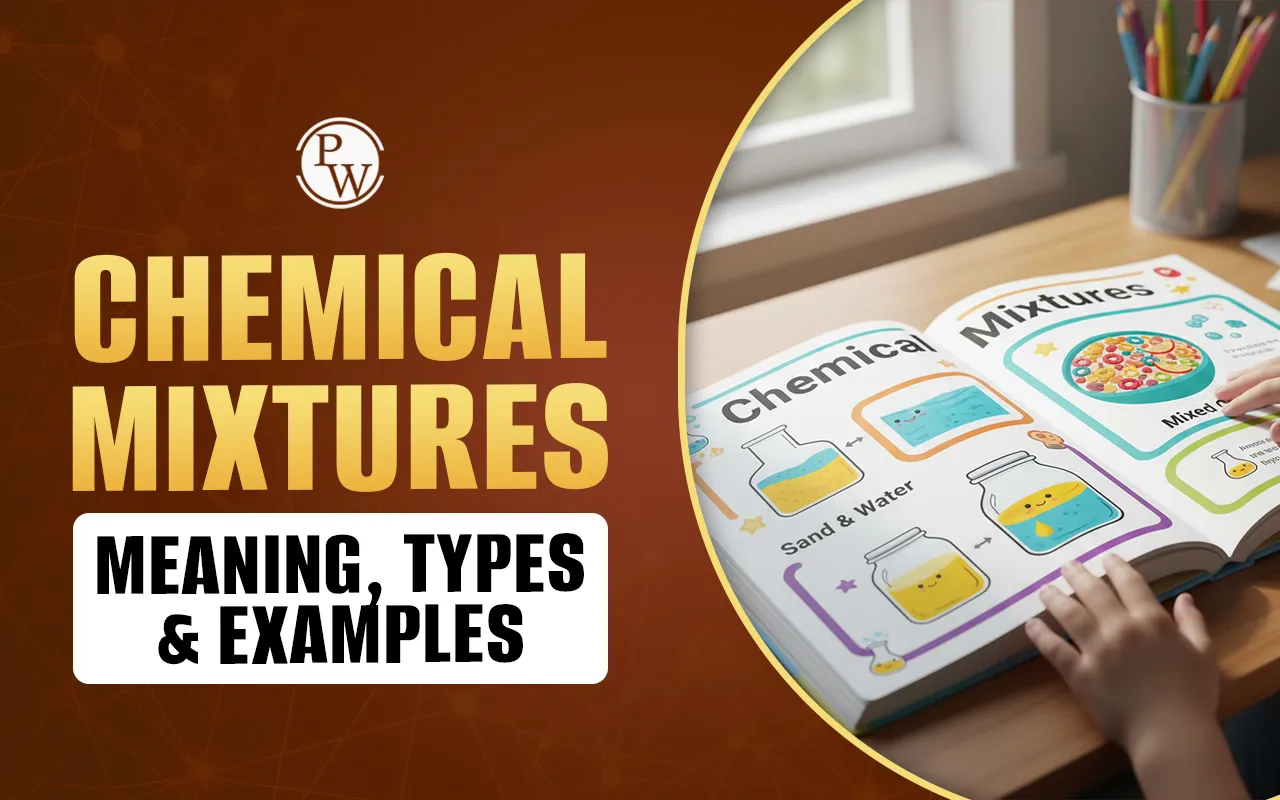
Chemical Mixtures
Have you ever wondered what happens when you mix different substances? Sometimes the new substance looks uniform, and sometimes you can still see the original parts. This is where the idea of Chemical Mixtures becomes important.
Chemical Mixtures play a major role in our daily life. From the air we breathe to the juice we drink, mixtures make our world work smoothly. Here, we have explained their meaning, types, differences, and examples.
Read More: Metals and Non-metals
What is a Chemical Mixtures?
A mixture is formed when two or more substances are combined without any chemical reaction. In Chemical Mixtures, the substances do not create a new material. They only stay together physically. Each part keeps its own nature, shape, and behaviour.
For example, when you mix sugar in water, the sugar dissolves. But it does not lose its sweetness. A mixture is different from a compound. Compounds form when elements react chemically and lose their own properties. But in mixtures, each substance remains the same. Some of the important properties of chemical mixtures are as follows:
-
They don’t involve chemical bonding.
-
They can be separated by simple physical methods.
-
Their composition can change from one sample to another.
-
No energy is released or absorbed because nothing new is created.
Types of Chemical Mixtures
Chemical Mixtures are primarily of two types. These are homogeneous mixtures and heterogeneous mixtures. Each type looks and behaves differently.
Homogeneous Mixture
In this mixture, all the substances are spread out evenly. We cannot see the separate parts with our eyes. The mixture looks the same throughout.
-
Saltwater is a good example. When salt dissolves in water, we cannot see the salt anymore. The mixture stays uniform, smooth, and clear.
-
Key points about homogeneous mixtures are:
-
Only one visible phase.
-
Particles are very small.
-
Substances spread completely.
-
It looks uniform from top to bottom.
Heterogeneous Mixture
Here, the substances do not mix evenly. You can easily see different parts or layers. These mixtures are not uniform and often look rough or uneven.
-
Sand and water are a common example. The sand settles at the bottom. Water stays above. They do not blend completely.
-
Key points about heterogeneous mixtures are:
-
More than one visible phase.
-
Components stay separate.
-
Substances can be removed easily.
-
Not uniform throughout.
Read More: Relationship Between Photosynthesis and Respiration
Difference Between Mixture and Solution
A solution is actually a special type of mixture. But there are key differences between a mixture and a solution:
-
A mixture can be either homogeneous or heterogeneous. It may or may not appear uniform. Substances may dissolve or remain separate.
-
A solution, however, is always uniform. It is always homogeneous. A solution contains two parts, a solute and a solvent. The solute dissolves completely in the solvent.
The differences between a Mixture and a Solution are provided in the table below:
|
Difference between Mixture and Solution |
||
|
Features |
Mixture |
Solution |
|
Uniformity |
May be uniform or non-uniform |
Always uniform |
|
Visibility of Parts |
Components may be seen |
Components cannot be seen |
|
Dissolving |
Substances may or may not dissolve |
Solute dissolves completely |
|
Separation |
Simple physical methods |
Also physical, but sometimes slower |
|
Examples |
Sand + water, oil + water |
Salt + water, sugar + water |
Read More: Why is the Sky Blue
Chemical Elements and Compounds
Before understanding more about Chemical Mixtures, it is helpful to know about elements and compounds.
-
A chemical element is a pure substance. It contains only one type of atom. Elements cannot be broken down into simpler substances by physical or chemical methods. Examples include oxygen, iron, gold, hydrogen, and carbon.
-
When two or more elements join through a chemical reaction, they form a compound. In compounds, the atoms bond chemically. These bonds change the properties of the original elements.
Chemical Mixture Examples
There are various examples of Chemical Mixtures around us. Some mixtures are very simple, whereas others can be complex. But all mixtures follow the same basic rule where the parts do not lose their identity. Some of the common examples of chemical mixtures are as follows:
-
Air: Air is a homogeneous mixture of gases like nitrogen, oxygen, carbon dioxide, and others. Everything mixes evenly, so we cannot see separate gases.
-
Saltwater: When salt dissolves in water, it forms a smooth, clear mixture. This is a homogeneous mixture.
-
Sand and Water: This is a heterogeneous mixture. The sand settles at the bottom.
-
Oil and Water: Oil floats on water because they do not mix. This is heterogeneous.
-
Fruit Salad: A mix of many fruits. Each fruit can be seen clearly.
-
Soil: Soil contains sand, clay, plant matter, and tiny rocks. It is a heterogeneous mixture.
-
Mixtures of Metals: Some metals mix to form alloys. Examples include brass (copper + zinc) and bronze (copper + tin). These are homogeneous mixtures.
-
Sugar and Tea: Sugar dissolves, but tea is still a mixture of many substances, like water, milk, tea leaves, and sugar.
-
Flour and Butter: A simple kitchen mixture. The parts do not mix completely.
-
Petroleum and Water: These remain separate and form a heterogeneous mixture.
Make Science Fun and Easy for Your Child with CuriousJr Online Science Classes
Does your child find science confusing even after memorising all the facts? That often happens when they learn only from textbooks instead of practical examples. CuriousJr Online Science Classes for kids make learning enjoyable by connecting real-world experiences with classroom concepts.
Here’s how CuriousJr Online Science Classes help your child:
-
Builds understanding of science concepts through activities and discussions instead of memorisation
-
Uses visual lessons, stories, and interactive examples to make tough topics simple
-
Provides one-on-one guidance and doubt-solving sessions with expert mentors
-
Shares regular progress reports and holds parent–teacher meetings to track learning
-
Encourages curiosity, exploration, and critical thinking beyond classroom boundaries
Book a demo class today and see how CuriousJr turns science learning into a fun and engaging experience for your child.
-
Chemical Mixtures FAQs
What is a mixture in chemistry?
What are the main types of Chemical Mixtures?
How is a mixture different from a solution?
What is the difference between an element and a compound?
What are some common examples of Chemical Mixtures?