Factoring Polynomials – Methods, Examples & Steps
 Study Abroad6 Feb, 2026
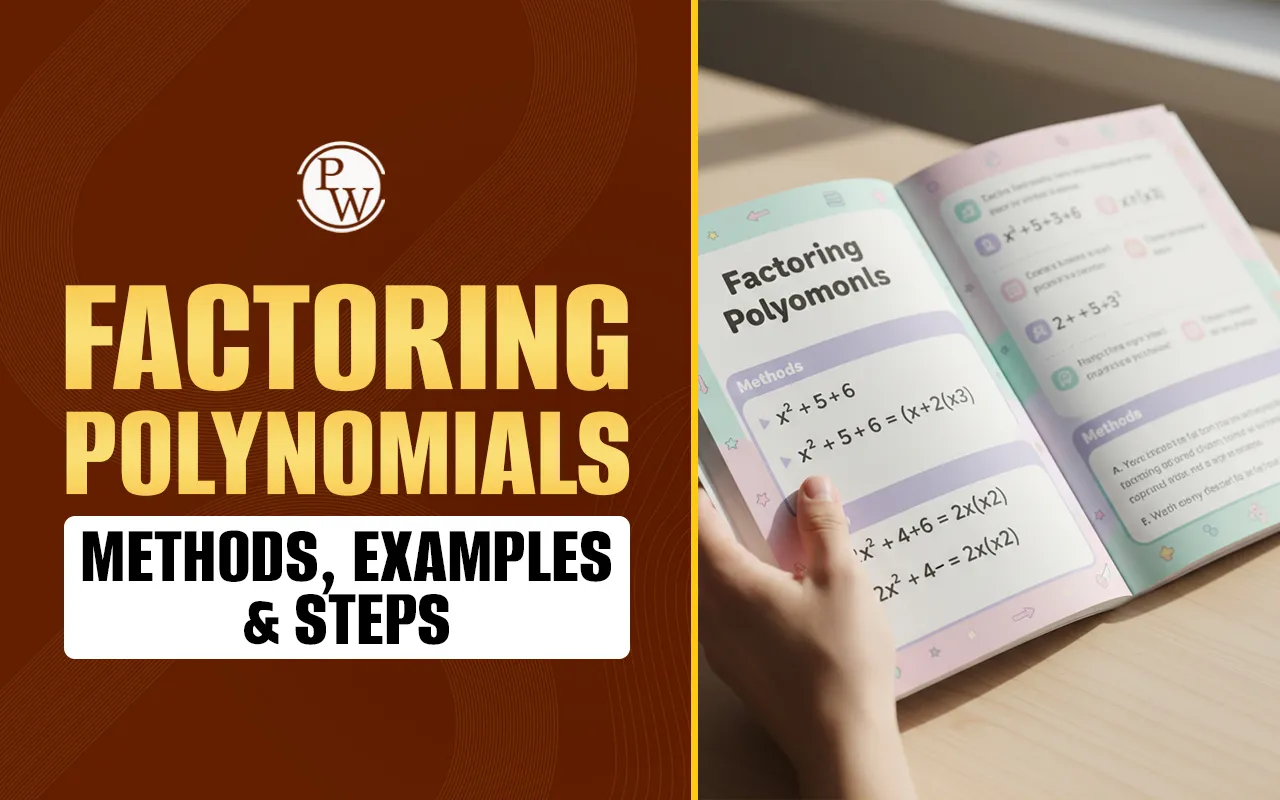
Factoring polynomials is the mathematical process of breaking down a complex algebraic expression into a product of simpler factors. By identifying common terms or using specific identities, you transform an addition-based expression into a multiplication-based one. This essential skill simplifies equations, helping students find roots, solve for variables, and understand the core structure of functions.
Exploring Factoring Polynomials Examples and Practice Techniques
When you first start working with algebra, the whole idea of "factoring" can feel a bit backwards. That is because it actually is! If you think of expanding brackets (multiplication) as building a house, then factoring is like taking that house apart to see the original blueprints. When we look at factoring polynomials examples, we are essentially looking for the "DNA" of the expression—the smaller pieces that were multiplied together to create it.
Mastering this skill takes a lot of factoring polynomials practice. It isn’t just about memorizing formulas; it is about training your eyes to see patterns. For instance, when you see a subtraction sign between two perfect squares, your brain should automatically jump to a specific shortcut. Many students like to use a factoring polynomials calculator to check their work, which is a great habit, but the real magic happens when you can look at a messy expression on a factoring polynomials worksheet and know exactly which tool to pull out of your belt.
In most math classes, the expressions you’ll see are categorized by how many parts (or terms) they have. A binomial has two parts, like x + 5. A trinomial has three, and anything bigger is just a general polynomial. The absolute "golden rule" of practice is this: always check for a Greatest Common Factor (GCF) before you do anything else. It makes the numbers smaller and the rest of the problem much easier to manage.
Methods of Factoring Polynomials: Step-by-Step Guide
Based on the core techniques used in algebra, there are four main ways to break these expressions down. Let’s walk through them one by one.
1. The Greatest Common Factor (GCF) Method
Think of this as the "un-distributive" property. You are looking for the biggest number or the highest power of a letter that every single term in the expression shares.
-
Step 1: Look at the numbers (coefficients). What is the biggest number that divides into all of them?
-
Step 2: Look at the letters (variables). What is the highest power of the variable that appears in every term?
-
Step 3: Put that GCF outside a set of parentheses and divide every term inside by it.
Example: Factor 3x^2 - 6x. Both terms can be divided by 3, and both terms have at least one x. So, the GCF is 3x. When you divide 3x^2 by 3x, you're left with x. When you divide 6x by 3x, you're left with 2. Result: 3x(x - 2).
2. Factoring by Grouping
This method is usually your best bet when you are staring at a long expression with four terms. Often, there isn't one single thing that all four share, but if you split them into two teams, you can find a pattern.
-
Step 1: Split the expression down the middle into two pairs.
-
Step 2: Factor out the GCF from the first pair and then from the second pair.
-
Step 3: If the stuff inside the parentheses matches for both, you've won! Factor out that matching bracket.
Example: Factor ab + a + b + 1. Group them: (ab + a) + (b + 1). In the first group, both share 'a', so: a(b + 1). The second group doesn't seem to share anything, so we just use 1: 1(b + 1). Now both have a (b + 1). Result: (b + 1)(a + 1).
Read More - Factoring Methods – Techniques & Examples
3. The Power of Algebraic Identities
Sometimes math gives us "cheat codes." These are patterns that are always true, so you don't have to do the long math.
-
Difference of Two Squares: If you see something like a^2 - b^2, it always becomes (a - b)(a + b).
-
Perfect Square Trinomials: Patterns like a^2 + 2ab + b^2 become (a + b)^2.
-
Sum/Difference of Cubes: These are for the higher powers (a^3) and follow set formulas involving a small bracket and a large one.
Example: Factor x^2 - 16. You recognize that 16 is 4 times 4 (a perfect square). So this is x^2 - 4^2. Result: (x - 4)(x + 4).
4. Factoring Trinomials (Splitting the Middle Term)
This is for the classic "ax^2 + bx + c" look. This is where you have to do a little bit of number-hunting.
-
Step 1: Multiply the first number (a) and the last number (c).
-
Step 2: You need two numbers that multiply to get that result, but also add up to get the middle number (b).
-
Step 3: Swap the middle term for those two new numbers and then finish it off with the grouping method.
Example: Factor x^2 + 5x + 6. Multiply the first number (1) and last (6) to get 6. What multiplies to 6 and adds to 5? 2 and 3. Result: (x + 2)(x + 3).
Read More - Zeros of Polynomials - A Complete Guide
Practical Takeaways for Your Factoring Journey
To really get good at this, you have to be okay with a little bit of trial and error. If you're working through a factoring polynomials worksheet, don't just guess. Be systematic. Start by counting the terms. Two terms? It's probably an identity. Four terms? Try grouping. Three terms? Go for the middle-term split.
Also, always double-check your signs! A common mistake is accidentally flipping a plus to a minus. You can always check if you’re right by multiplying your answer back out. If you don't get the original expression, you know you need to go back and check your steps. While a factoring polynomials calculator is great for a quick check, doing it by hand helps you spot these little mistakes before they become big problems on a test.
Make Mental Maths Easy and Enjoyable with CuriousJr
Does your child feel confused or lose focus while doing maths? Many students find maths difficult and feel anxious about it. With proper guidance and encouragement, maths can become simple, fun, and confidence-building.
CuriousJr’s online mental maths classes are designed to make learning relaxed and engaging. The interactive sessions follow the school syllabus and focus on clear, practical explanations. This helps children understand concepts better, improve calculation speed, and develop a positive attitude towards maths.