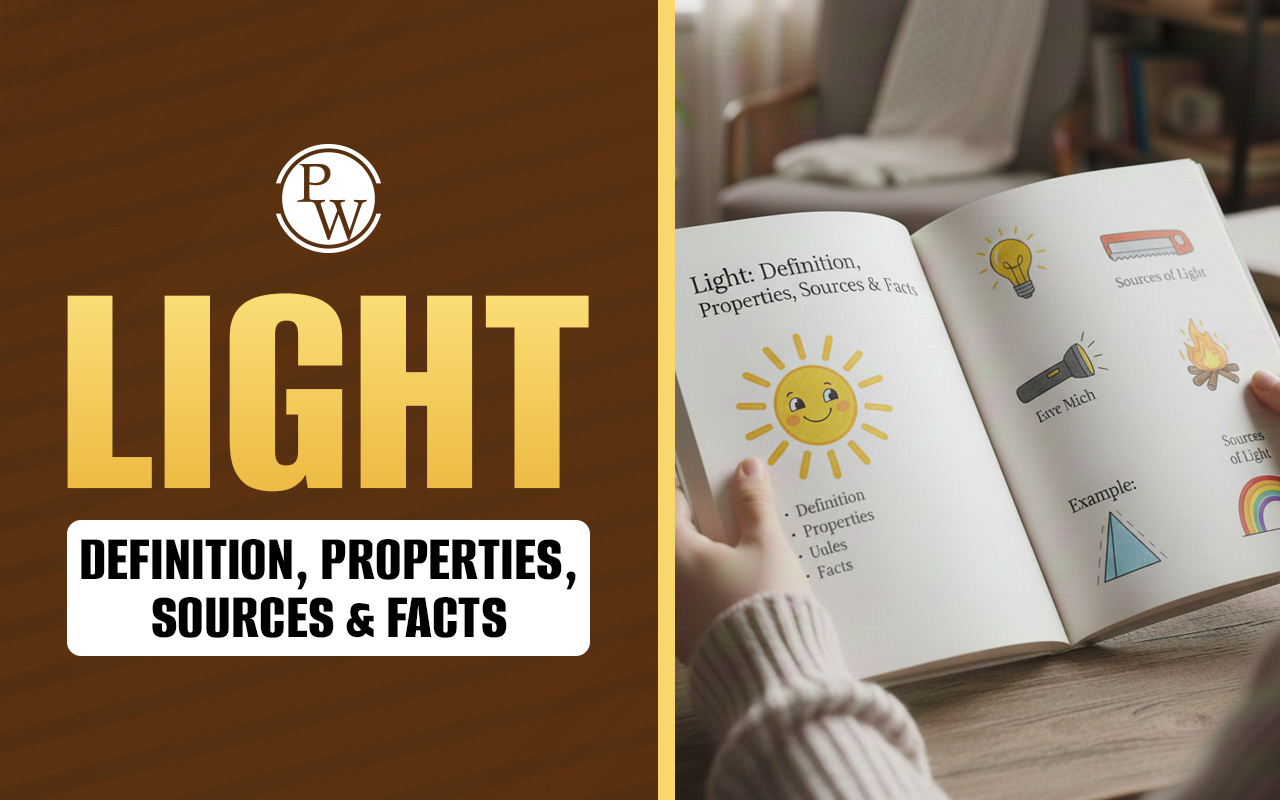

Light: Definition, Properties, Sources & Interesting Facts
 Shivam Singh28 Sept, 2026


What Is Light in Science?
Light is a form of electromagnetic radiation that can be detected by the human eye. It carries energy and allows us to see objects around us.
Simple Definition of Light
In simple words, light is a form of energy that helps us see objects.
Light can travel through empty space, so it does not need air, water or another material medium to travel.
For school-level learning, remember:
Light is a form of energy that enables us to see objects.
The scientific description is broader: visible light is the part of the electromagnetic spectrum that human eyes can detect.
Light Meaning
The word light can have different meanings depending on the context. In science, light refers to electromagnetic radiation, especially the visible part that can be detected by our eyes.
For example:
-
Sunlight helps us see during the day.
-
A lamp provides light in a dark room.
-
A torch produces light that can illuminate objects.
-
A rainbow shows different colours of visible light.
What Is Light Energy?
Light carries energy from one place to another. This is called light energy or radiant energy.
The Sun is the main natural source of light and energy for Earth. Solar energy supports many processes on our planet, including photosynthesis in plants.
Light energy is used in many everyday technologies, such as:
-
Solar panels
-
Cameras
-
Optical fibre communication
-
Projectors
-
Lasers
-
Digital screens
Read More: Parts of a Plant
Sources of Light
A source of light is an object that produces its own light.
Sources of light can be broadly divided into natural and artificial sources.
Natural Sources of Light
Natural sources occur in nature.
Examples include:
-
Sun: The Sun is Earth's most important natural source of visible light.
-
Stars: Stars produce their own light.
-
Lightning: Lightning produces a bright flash of light.
-
Fire: Flames can produce light.
-
Fireflies: Fireflies produce light through a process called bioluminescence.
-
Some marine organisms: Certain organisms in the ocean can produce light through bioluminescence.
The Moon is not a source of its own visible light. It appears bright because it reflects sunlight.
Artificial Sources of Light
Artificial sources are made or controlled by humans.
Examples include:
-
Electric bulbs
-
LED lamps
-
Tube lights
-
Torches
-
Candles
-
Street lights
-
Lamps
-
Laser devices
Artificial light is useful when natural light is unavailable or insufficient.
Properties of Light
The properties of light describe how light behaves and how it interacts with matter.
Here are five important properties of light for students.
1. Light Travels in Straight Lines
In a uniform medium, light generally travels in straight lines. This is called rectilinear propagation of light.
This property helps explain the formation of shadows.
For example, when an opaque object blocks light from a torch, a shadow can form behind the object.
2. Light Travels Very Fast
Light travels extremely fast.
In a vacuum, the speed of light is approximately:
3 × 10⁸ metres per second
This is about 300,000 kilometres per second.
Light from the Sun takes about 8 minutes and 20 seconds to reach Earth.
The speed of light is lower when it travels through materials such as glass or water.
3. Light Can Be Reflected
Reflection occurs when light strikes a surface and returns into the original medium.
A mirror is a common example.
When light falls on a mirror, it is reflected, allowing us to see an image.
Examples of reflection include:
-
Seeing yourself in a mirror
-
Seeing objects in calm water
-
Periscopes
-
Reflectors
4. Light Can Be Refracted
Refraction is the change in direction of light when it passes from one transparent medium to another because its speed changes.
For example, a pencil partly immersed in water may appear bent.
Refraction is also involved in:
-
Lenses
-
Spectacles
-
Cameras
-
Microscopes
-
Magnifying glasses
5. Light Can Be Absorbed
When light falls on a material, some of its energy may be absorbed by that material.
For example, dark-coloured surfaces often absorb more visible light and can become warmer in sunlight.
Absorption is important in solar panels, photography and many other applications.
Read More: Floating and Sinking
Other Important Characteristics of Light
In addition to the five basic properties above, light has several other important characteristics.
Light Can Travel Through a Vacuum
Unlike sound, light does not require a material medium to travel.
This is why sunlight can travel through the vacuum of space and reach Earth.
Light Can Travel Through Transparent Materials
Light can pass through transparent materials such as clear glass and some plastics.
The amount of light that passes through depends on the material and its properties.
Light Interacts With Matter
When light meets an object, it may be:
-
Reflected
-
Absorbed
-
Transmitted
-
Scattered
-
Refracted
The result depends on the material and the way light interacts with it.
Colours of Light
Visible light contains different wavelengths, which our eyes perceive as different colours.
Seven Colours of White Light
When white light passes through a prism, it can be separated into a spectrum of colours commonly remembered as:
VIBGYOR
-
V - Violet
-
I - Indigo
-
B - Blue
-
G - Green
-
Y - Yellow
-
O - Orange
-
R - Red
A rainbow is a natural example of the separation and dispersion of sunlight into its component colours.
The seven-colour description is useful for school science, although visible light actually forms a continuous spectrum rather than seven completely separate bands.
Primary Colours of Light
The primary colours used in additive colour mixing of light are:
-
Red
-
Green
-
Blue
These are commonly called RGB.
By combining red, green and blue light at different intensities, displays can produce a wide range of colours.
This is why RGB technology is used in:
-
Televisions
-
Computer monitors
-
Smartphones
-
Digital displays
How Do Humans See Light?
We see an object when light reaches our eyes from that object.
A simple sequence is:
Light source → Object → Reflected or transmitted light → Eye → Brain
For example:
-
A lamp produces light.
-
The light falls on a book.
-
Some light is reflected from the book.
-
The reflected light enters our eyes.
-
Our eyes send signals to the brain.
-
The brain helps us recognise the book.
Objects that produce their own light, such as the Sun or a bulb, can be seen because light from them reaches our eyes directly.
How Do We See Colours?
The colour we perceive depends on the wavelengths of visible light reaching our eyes.
For example, a red object under white light appears red because it reflects more red light toward our eyes and absorbs or scatters other wavelengths.
A white object generally reflects a broad range of visible wavelengths.
A black object absorbs most of the visible light falling on it, although real materials are rarely perfect absorbers.
Light and Shadows
A shadow forms when an opaque object blocks light from reaching a surface.
A simple shadow needs:
-
A source of light
-
An object that blocks the light
-
A surface on which the shadow can form
For example, when you stand between a lamp and a wall, your body can block the light and produce a shadow on the wall.
Light and Transparent, Translucent and Opaque Materials
Materials interact with light in different ways.
|
Type of Material |
What Happens to Light? |
Example |
|
Transparent |
Most light passes through |
Clear glass |
|
Translucent |
Some light passes through and is scattered |
Frosted glass |
|
Opaque |
Light does not pass through |
Wood |
This classification helps explain why we can see clearly through some materials but not others.
Light in Physics
In physics, light is studied as electromagnetic radiation.
Visible light is only a small part of the electromagnetic spectrum. Other types of electromagnetic radiation include:
-
Radio waves
-
Microwaves
-
Infrared radiation
-
Ultraviolet radiation
-
X-rays
-
Gamma rays
Visible light is the part of this spectrum that human eyes can detect.
Light for Class 1 and Class 2
For younger students, light can be explained simply:
Light helps us see things.
Examples of light sources include:
-
Sun
-
Bulb
-
Torch
-
Candle
-
Lamp
A simple activity is to observe what happens when you enter a dark room and switch on a torch.
Light for Class 3
Class 3 students can learn that:
-
Light helps us see objects.
-
The Sun is a natural source of light.
-
Bulbs and torches are artificial sources.
-
Light travels in straight lines.
-
Objects can block light and form shadows.
-
Mirrors reflect light.
Properties of Light for Class 6 and Class 7
For Classes 6 and 7, students can explore:
-
Straight-line propagation
-
Reflection
-
Refraction
-
Absorption
-
Transmission
-
Shadows
-
Transparent, translucent and opaque materials
-
Dispersion of white light
-
Speed of light
-
Sources of light
These concepts provide the foundation for studying optics and other areas of physics.
Examples of Light in Everyday Life
Light is involved in many things we do every day.
At Home
Bulbs, lamps and LEDs provide artificial light.
In Communication
Optical fibre systems use light to transmit information over long distances.
In Medicine
Light-based technologies are used in several medical instruments and treatments.
In Photography
Cameras detect light to create photographs.
In Solar Energy
Solar cells convert light energy from the Sun into electrical energy.
In Nature
Plants use light energy during photosynthesis to make food.
Interesting Facts About Light
-
Light travels through a vacuum.
-
The speed of light in a vacuum is about 300,000 km/s.
-
Sunlight takes about 8 minutes and 20 seconds to reach Earth.
-
Light can be reflected, refracted, absorbed and transmitted.
-
A prism can separate white light into a visible spectrum.
-
The Moon appears bright because it reflects sunlight.
-
Shadows form when an object blocks light.
-
Visible light is only a small part of the electromagnetic spectrum.
-
Red, green and blue are the primary colours in additive mixing of light.
-
Light is used in technologies such as cameras, lasers, optical fibres and solar cells.
CuriousJr helps students understand light, its sources, reflection, and everyday uses through simple explanations and examples.
Light: Quick Revision
|
Question |
Short Answer |
|
What is light? |
Light is electromagnetic radiation, including the visible radiation detected by human eyes. |
|
What is the simple definition of light? |
Light is a form of energy that helps us see objects. |
|
What are sources of light? |
Objects that produce their own light, such as the Sun, stars and bulbs. |
|
What are the main properties of light? |
Light can travel, reflect, refract, be absorbed and be transmitted. |
|
How fast does light travel? |
About 3 × 10⁸ m/s in a vacuum. |
|
What is reflection? |
The return of light from a surface into the original medium. |
|
What is refraction? |
The change in direction of light when it passes between different media. |
|
What are the primary colours of light? |
Red, green and blue. |
|
Why do we see objects? |
Light reaching our eyes from the objects allows us to see them. |