
Force: Push and Pull, Definition, Types and Examples
 Shivam Singh28 Sept, 2026


What Is Force?
A force is a push or a pull that can change the motion, direction, speed, or shape of an object.
In simple words, whenever you push or pull an object, you apply force.
For example:
-
Pushing a door can make it move.
-
Pulling a drawer can open it.
-
Kicking a football can change its motion.
-
Squeezing a sponge can change its shape.
-
Applying brakes can slow down a bicycle.
Force Definition
Force is a push or pull acting on an object that can change its state of motion, speed, direction, or shape.
The SI unit of force is the newton (N).
Force: Push and Pull
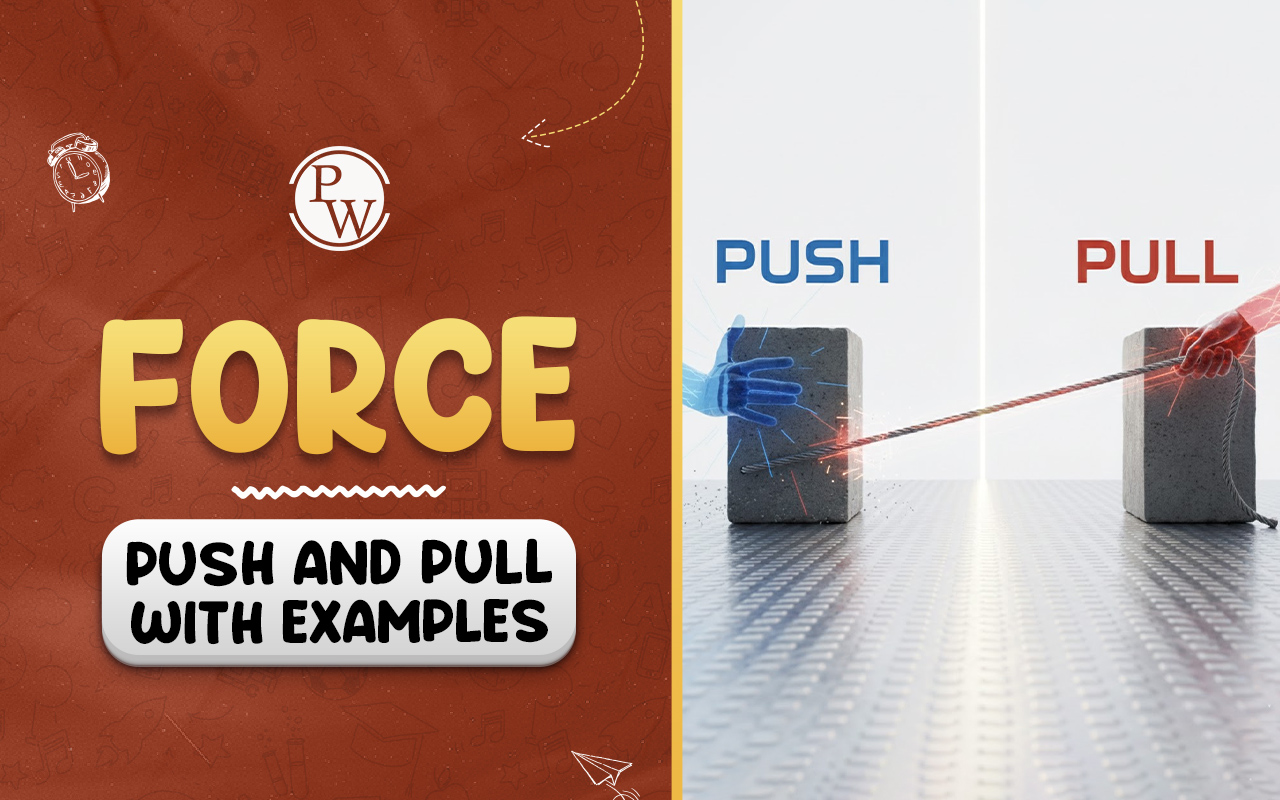
The two simple ways we commonly describe applying a force are push and pull.
What Is a Push?
A push is a force that tends to move an object away from the person or source applying the force.
Examples:
-
Pushing a door closed
-
Pushing a chair
-
Pushing a shopping cart
-
Kicking a football
-
Pushing a box
What Is a Pull?
A pull is a force that tends to move an object towards the person or source applying the force.
Examples:
-
Pulling a drawer open
-
Pulling a bucket from a well
-
Pulling a school bag
-
Pulling a rope
-
Pulling a kite string
Push and Pull Definition
Push: A force applied to move an object away.
Pull: A force applied to bring an object closer.
The effect depends on the direction in which the force is applied.
Push vs Pull
|
Push |
Pull |
|
Moves an object away from the source of force |
Moves an object towards the source of force |
|
Pushing a door closed |
Pulling a door open |
|
Pushing a box |
Pulling a box with a rope |
|
Pushing a shopping cart |
Pulling a drawer |
|
Kicking a ball |
Pulling a bucket from a well |
Difference Between Pushing and Pulling
The main difference is the direction of the applied force.
When you push an object, the force is directed away from you. When you pull an object, the force is directed towards you.
Some activities can involve both pushing and pulling. For example, opening or closing a door may involve either action depending on the direction of the force.
Read More: Good and Bad Conductors of Electricity
5 Examples of Push and Pull
Here are five simple examples:
-
Pushing a door closed
-
Pulling a drawer open
-
Pushing a shopping cart
-
Pulling a bucket from a well
-
Kicking a football
These examples show that push and pull forces are part of many everyday activities.
10 Examples of Push
Here are 10 examples of push force:
-
Pushing a chair
-
Pushing a door closed
-
Pushing a shopping cart
-
Pushing a box
-
Kicking a football
-
Pushing a swing
-
Pushing a table
-
Pressing a button
-
Pushing a toy car
-
Pushing a bicycle forward
10 Examples of Pull
Here are 10 examples of pull force:
-
Pulling a drawer
-
Pulling a school bag
-
Pulling a bucket from a well
-
Pulling a rope
-
Pulling a kite string
-
Pulling a suitcase
-
Pulling a curtain
-
Pulling a door open
-
Pulling a toy with a string
-
Pulling a wagon
20 Examples of Push and Pull
The following everyday activities show different examples of push and pull forces:
-
Pushing a door closed
-
Pulling a door open
-
Pushing a chair
-
Pulling a drawer
-
Pushing a shopping cart
-
Pulling a suitcase
-
Kicking a football
-
Pulling a bucket from a well
-
Pushing a swing
-
Pulling a kite string
-
Pushing a box
-
Pulling a curtain
-
Pressing a switch
-
Pulling a rope
-
Pushing a toy car
-
Pulling a wagon
-
Pushing a table
-
Pulling a school bag
-
Pushing a bicycle
-
Pulling a toy with a string
Read More: Components of Environment
Push and Pull Examples for Kids
Children use push and pull forces in many activities without always noticing them.
For example:
-
Push: moving a toy car forward
-
Pull: dragging a toy with a string
-
Push: kicking a ball
-
Pull: opening a drawer
-
Push: moving a swing
-
Pull: pulling a school bag
-
Push: pressing a button
-
Pull: opening a curtain
These simple activities make the idea of force easier to understand. Interactive examples on CuriousJr can help children connect everyday push and pull activities with the basic concept of force.
Push and Pull Objects
Objects can be moved by applying either a push or a pull.
|
Object |
Push Example |
Pull Example |
|
Door |
Push it closed |
Pull it open |
|
Drawer |
Push it shut |
Pull it open |
|
Box |
Push it forward |
Pull it with a rope |
|
Shopping cart |
Push it forward |
Pull it backward |
|
Curtain |
Push it aside |
Pull it aside |
|
Toy |
Push it forward |
Pull it with a string |
The same object can sometimes be moved by either a push or a pull, depending on how the force is applied.
How Does Force Affect an Object?
A force can produce different effects on an object.
1. Force Can Make an Object Move
A stationary football can start moving when you kick it.
2. Force Can Stop a Moving Object
The brakes of a bicycle apply forces that help slow down and stop the bicycle.
3. Force Can Change Speed
A stronger or differently directed force can change the speed of an object.
For example, pushing a toy car can make it move faster.
4. Force Can Change Direction
A force can change the direction of a moving object.
For example, hitting a moving football from the side can change its direction.
5. Force Can Change Shape
Some forces can change the shape of an object.
For example:
-
Squeezing a sponge
-
Stretching a rubber band
-
Pressing clay
So, force does not only make objects move. It can also change their motion or shape.
Types of Force
At a basic school level, forces can be classified according to whether objects need to touch.
The two broad types are:
-
Contact forces
-
Non-contact forces
Contact Force
A contact force acts when two objects or a person and an object are in physical contact.
Examples include:
-
Pushing a table
-
Kicking a football
-
Pulling a rope
-
Friction between a moving object and a surface
-
A person lifting an object
Examples of Contact Force
Pushing a box: Your hands touch the box while applying force.
Kicking a football: Your foot touches the football.
Pulling a rope: Your hand holds and pulls the rope.
Friction: Friction acts when two surfaces are in contact and oppose relative motion.
Non-Contact Force
A non-contact force acts on an object without direct physical contact.
Common examples are:
-
Gravitational force
-
Magnetic force
-
Electrostatic force
Gravitational Force
Earth attracts objects towards its centre. This is why objects released near Earth's surface fall towards the ground.
Magnetic Force
A magnet can attract or repel another magnet and can attract certain magnetic materials without directly touching them.
Electrostatic Force
Charged objects can attract or repel other charged objects without direct contact.
Push and Pull Force vs Contact and Non-Contact Force
Push and pull describe the direction or nature of an applied action, while contact and non-contact describe whether physical contact is needed for the force to act.
For example, pushing a box is a contact interaction because your hand touches the box.
Gravity is a non-contact force because Earth attracts an object without direct physical contact.
Therefore, push/pull and contact/non-contact are not exactly the same classification.
Why Is Force Important?
Force is involved in many activities around us.
We use forces to:
-
Walk and run
-
Open and close doors
-
Move objects
-
Ride bicycles
-
Play sports
-
Lift objects
-
Operate machines
-
Change the motion of vehicles
Even walking involves forces between your feet and the ground. These forces help you move forward.
Force in Everyday Life
Here are some everyday examples:
|
Activity |
Force involved |
|
Opening a drawer |
Pull |
|
Closing a drawer |
Push |
|
Kicking a football |
Push |
|
Pulling a suitcase |
Pull |
|
Braking a bicycle |
Contact forces including friction |
|
A ball falling to the ground |
Gravitational force |
|
A magnet attracting iron |
Magnetic force |
|
Stretching a rubber band |
Applied force |
How to Identify Push or Pull
When you see an action, ask:
Is the object being moved away from the source of force?
If yes, it is a push.
Is the object being moved towards the source of force?
If yes, it is a pull.
For example:
Pushing a chair: The chair moves away from the person applying the force.
Pulling a chair: The chair moves towards the person applying the force.
Common Mistakes About Push and Pull
Mistake 1: Thinking Every Force Requires Touch
Not all forces require physical contact. Gravity, magnetic force, and electrostatic force can act without direct contact.
Mistake 2: Thinking Push and Pull Are the Only Types of Force
Push and pull are simple ways of describing how a force is applied. Forces can also be classified as contact and non-contact forces.
Mistake 3: Assuming Force Always Makes an Object Move
A force can change motion, but an object may remain stationary if the forces acting on it are balanced.
For example, you can push a heavy wall without making the wall move.
Mistake 4: Thinking Force Only Changes Speed
A force can also change direction or shape and can help stop a moving object.
Quick Revision
-
Force is a push or pull that can affect an object's motion or shape.
-
A push tends to move an object away from the source of force.
-
A pull tends to move an object towards the source of force.
-
Contact force requires physical contact.
-
Non-contact force can act without direct contact.
-
Gravity, magnetism, and electrostatic interaction are examples of non-contact forces.
-
Force can change an object's speed, direction, motion, or shape.
-
The SI unit of force is the newton (N).