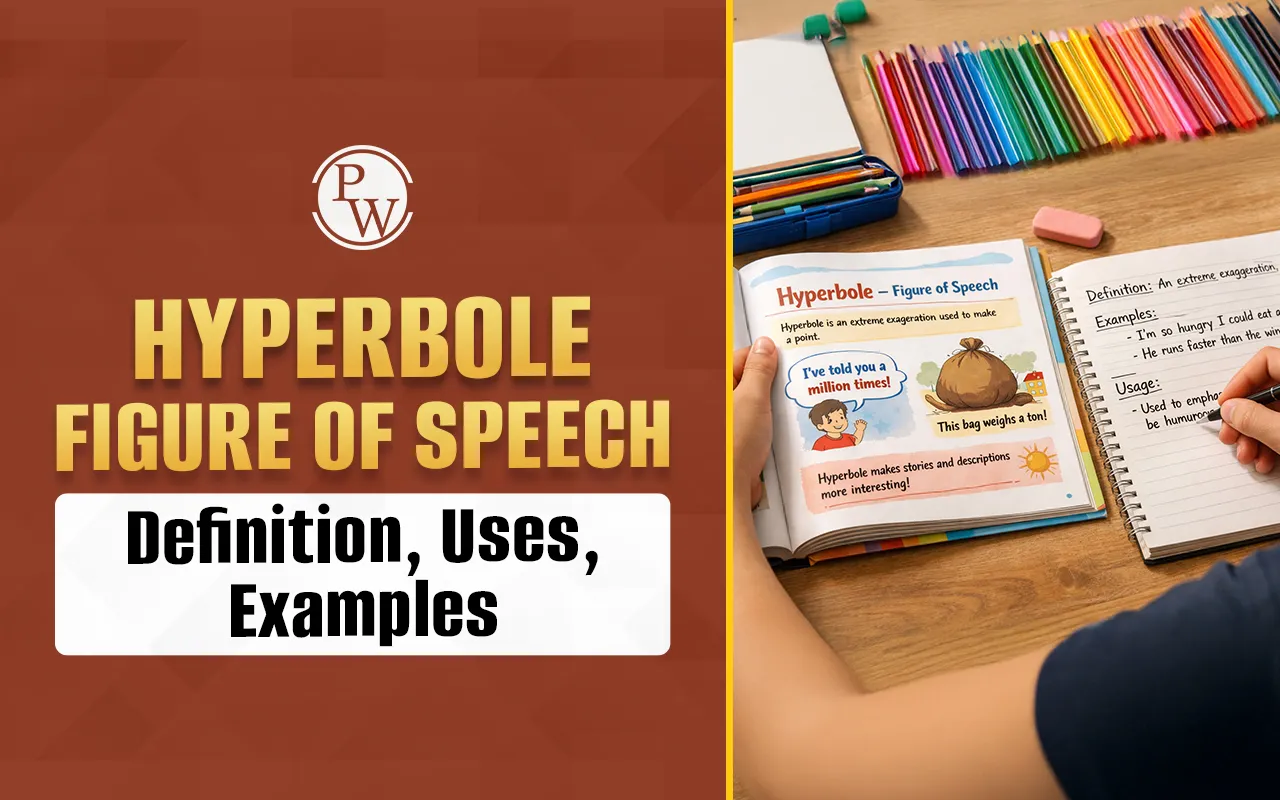
Hyperbole Figure of Speech - Definition, Uses, Examples
 Nikita Aggarwal8 Apr, 2026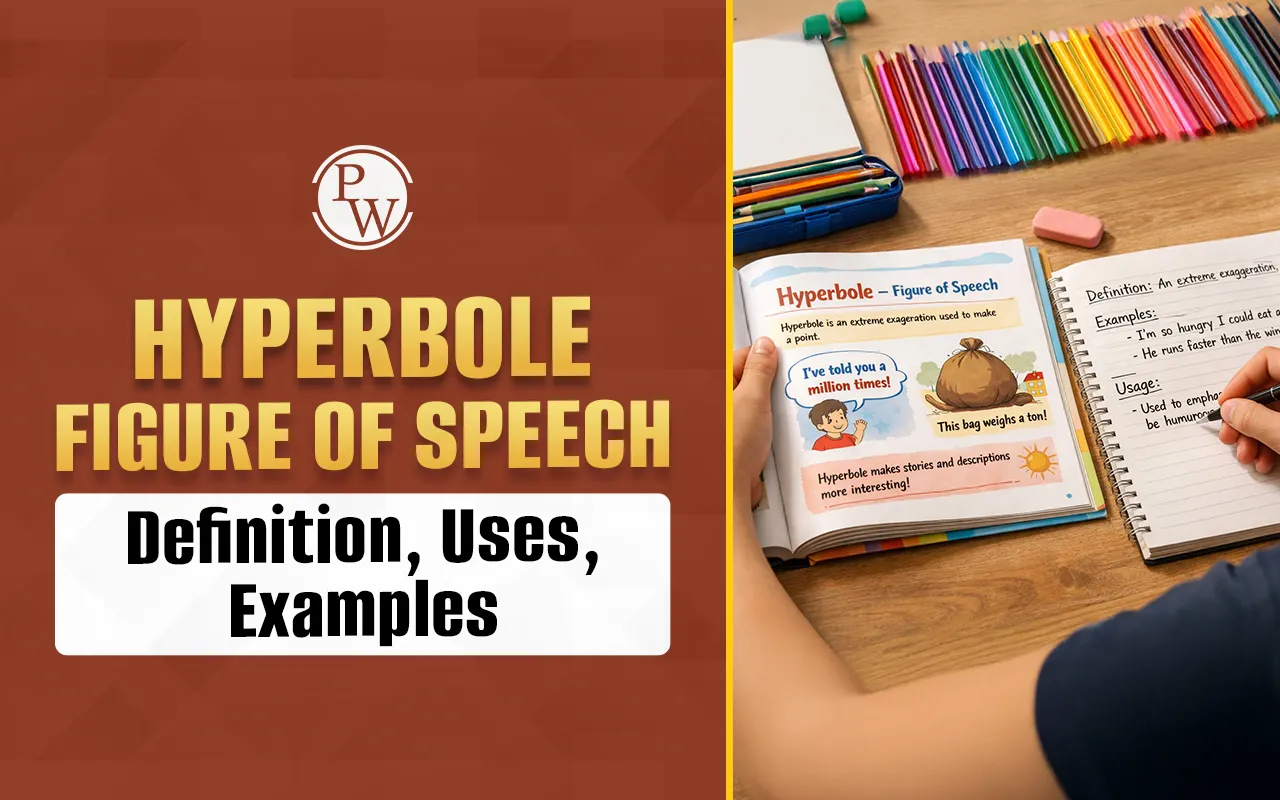
What is Hyperbole Figure of Speech in English?
To grasp the basics, we must look at the hyperbole figure of speech definition. Derived from the Greek word hyperbole meaning "excess," this literary device involves overstating a situation to catch the reader's attention.
It is a form of irony or a "bold" statement that represents things as much greater or less than they actually are. The key takeaway is that the audience knows the statement is physically impossible or highly unlikely, yet they understand the underlying emotion or intensity being conveyed.
Key Characteristics of Hyperbole
-
Intentionality: The speaker is aware they are exaggerating.
-
Non-literal: It should never be interpreted as a factual truth.
-
Emotional Weight: It is designed to stir up feelings like humour, frustration, or excitement.
-
Vivid Imagery: It helps the reader "see" the scale of the situation.
Importance of Hyperbole Figure of Speech
Hyperbole is not just about exaggeration—it works because it connects with the reader emotionally and makes communication more memorable.
-
Grabs Attention: Extreme statements stand out instantly.
-
Enhances Imagination: Readers can visualise the intensity more clearly.
-
Adds Drama and Emotion: Makes simple statements feel powerful.
-
Improves Recall: People are more likely to remember exaggerated expressions than plain sentences.
Common Hyperbole Figure of Speech Uses
Authors and speakers don't just use exaggeration for the sake of it. There are specific uses that help make language more engaging.
-
Adding Humour: Many jokes rely on over-the-top descriptions to make people laugh. By blowing a small problem out of proportion, you create a comedic effect.
-
Emphasising a Point: If you say "I’ve told you a thousand times", you are stressing your frustration rather than providing a literal count of your reminders.
-
Creating Contrast: Hyperbole can be used to show the difference between two things by making one seem incredibly large and the other incredibly small.
-
Setting the Mood: In poetry, hyperbole helps express deep love or intense sorrow that regular words cannot capture.
Hyperbole Figure of Speech Examples
Seeing this device in action is the best way to learn. Here are some everyday examples that you likely hear in school or at home:
-
"I am dying of shame." (You are actually alive, but very embarrassed.)
-
"This bag weighs a million pounds." (The bag is heavy, but certainly not a million pounds.)
-
"He is as skinny as a toothpick." (A person cannot be as thin as a small piece of wood.)
-
"I have a mountain of homework." (The papers might be a tall stack, but they do not form a geographical mountain.)
To understand the versatility of this figure of speech, here are some additional examples across different tones:
-
Funny: “I laughed so hard I fell off the planet.”
-
Emotional: “I cried a river after watching that movie.”
-
Dramatic: “Her smile was brighter than a thousand suns.”
-
Every day: “This queue is never going to end.”
Read More - Loud and Soft Sound: Meaning, Importance and Examples
Hyperbole Figure of Speech in Literature
Famous writers use hyperbole to breathe life into their stories. For instance, in "The People, Yes" by Carl Sandburg, he describes a man so tall he had to use a ladder to shave himself. This creates a lasting image in the reader’s mind that "he was very tall" simply cannot achieve.
Hyperbole in Everyday Life, Ads, and Speeches
Hyperbole is not limited to literature—it is widely used in modern communication:
-
Daily Conversations: “I’ve been waiting forever.”
-
Advertisements: “This product will change your life!”
-
Speeches: Speakers exaggerate to emphasise emotions and persuade audiences.
-
Social Media: “Best day ever!” or “This is the worst thing ever!”
Hyperbole vs. Simile and Metaphor
It is easy to get confused between different figures of speech. Use the table below to understand how hyperbole stands out.
|
Feature |
Hyperbole |
Simile |
Metaphor |
|
Purpose |
To exaggerate for effect. |
To compare using "like" or "as". |
To say one thing is another. |
|
Literal Truth |
Impossible/Unlikely. |
Suggests a similarity. |
Symbolic. |
|
Example |
I'm so tired I could sleep for a century. |
He is as brave as a lion. |
He is a lion in battle. |
|
Focus |
Intensity and Scale. |
Direct Comparison. |
Shared Characteristics. |
How to Write a Hyperbole Figure of Speech?
Creating a hyperbole is simple if you follow a few steps:
-
Start with a basic sentence: “I am very tired.”
-
Identify the emotion: Extreme tiredness
-
Exaggerate it creatively: “I am so tired I could sleep for a year.”
-
Use strong words: million, forever, endless, etc.
The key is to exaggerate without losing the original meaning.
Read More - Repetition Figure of Speech - Definition, Types with Examples
Common Mistakes to Avoid when Using Hyperbole
While hyperbole is fun to use, there are a few mistakes students should watch out for:
-
Overusing it: Too many exaggerations can make writing tiring.
-
Confusing with metaphor/simile: Hyperbole is exaggeration, not comparison.
-
Unclear exaggeration: If the meaning is lost, the hyperbole fails.
-
Using clichés repeatedly: Try to create fresh expressions instead of overused ones.
Importance of Hyperbole in Creative Writing
When you use a hyperbole in English, you are engaging the reader's imagination. Instead of saying "The desert was hot," you could say "The desert was so hot that the sun itself was sweating." This makes your writing stand out.
However, a professional tip for students: do not over-use it. If every sentence is an exaggeration, the reader will get exhausted. Use it like salt in a dish—just enough to enhance the flavour, but not so much that it ruins the meal.
Exercise to Improve Hyperbole
To truly understand what a hyperbole is, try these quick exercises:
-
Think of a time you were very happy. Instead of saying "I was happy," try to exaggerate it. (e.g., "I was walking on the clouds.")
-
Describe a slow car without using the word "slow." (e.g., "That car was being overtaken by a snail.")
-
Look through your favourite storybook and underline sentences that seem physically impossible. Chances are, you’ve found a hyperbole!
Hyperbole Rules
-
Keep it relevant: The exaggeration should match the emotion.
-
Know your audience: Make sure they understand you aren't being literal.
-
Be creative: Avoid clichés like "as old as the hills" and try to invent your own.