Binary Subtraction - Definition, Rules, Examples
 Nikita Aggarwal8 Apr, 2026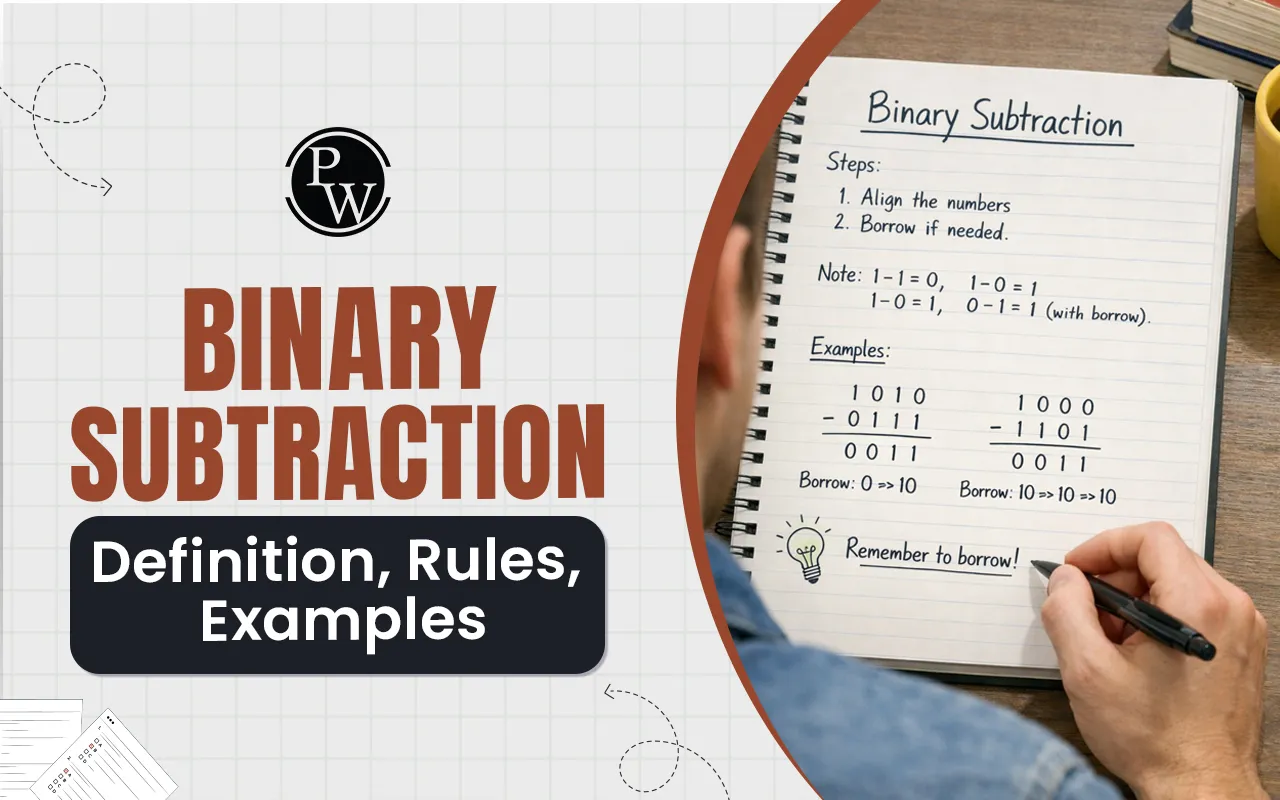
What is Binary Subtraction?
Binary subtraction is really just finding the difference between two numbers. This is relatively simple because binary only uses two digits, 0 and 1. So binary subtraction is actually pretty easy, even though it's similar to subtracting numbers. When we do subtraction in math, we have two binary numbers: the one we start with, called the minuend, and the one being subtracted, called the subtrahend.
Binary subtraction in maths is really crucial in circuits, especially in a processor's arithmetic logic unit. In the arithmetic logic unit, binary subtraction often uses methods like 1's complement or 2's complement. These methods help make the hardware work efficiently.
Binary Subtraction Rules
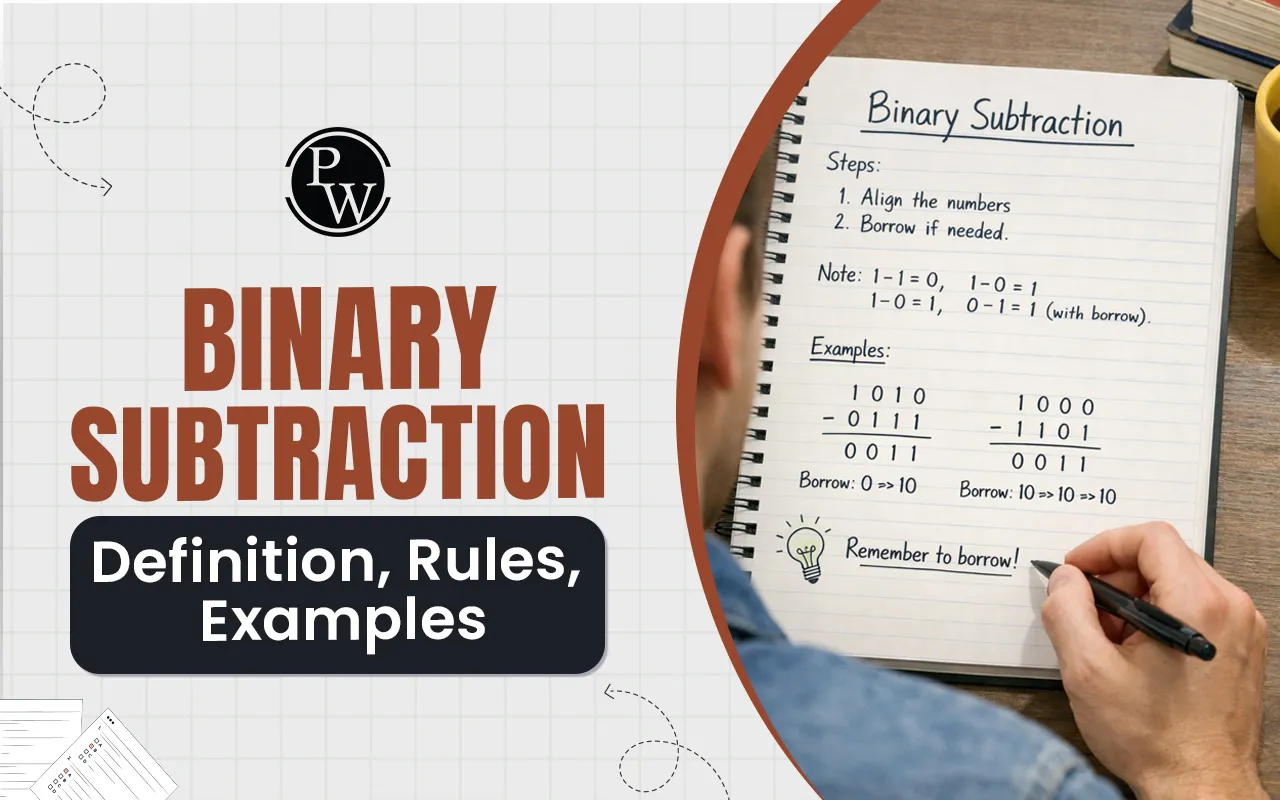
There are four rules to learn. These binary subtraction rules are essential because they help you solve problems. No matter how big the binary numbers are, you will use these rules to get the answer.
-
0 – 0 = 0: Subtracting zero from zero remains zero.
-
1 – 1 = 0: Subtracting a one from a one results in zero.
-
1 – 0 = 1: Subtracting zero from one leaves you with one.
-
0 – 1 = 1 (with a borrow of 1): This is the most important rule. Since you cannot take 1 from 0, you must borrow 1 from the next higher column (the left side). In binary, borrowing a 1 makes the current 0 become a 10 (which is 2 in decimal). So, 2 - 1 = 1.
Summary of Binary Subtraction Rules
|
Operation |
Result |
Borrow Needed? |
|
0 - 0 |
0 |
No |
|
1 - 0 |
1 |
No |
|
1 - 1 |
0 |
No |
|
0 - 1 |
1 |
Yes (from next bit) |
Read More - How to Subtract With and Without Borrowing
Binary Subtraction Step-by-Step
To master binary subtraction, it really helps to have a step-by-step approach. Let's see how to solve a problem using the “Borrow Method”.
Align the numbers: Write the numbers one on top of the other. Ensure the bits line up properly from right to left.
Start from the right: Begin with the bit, also known as the least significant bit, or LSB.
Apply the rules: There are four rules to keep in mind.
Handle the borrow: If you have to subtract 1 from 0, look at the bit to the left.
If the next bit is 1, change it to 0. Use 1 as a borrow in your current bit.
If the next bit is 0, keep moving left until you find a bit that's 1.
Change that 1 to 0. All the bits that are 0 and in between become 1.
The bit that is 0. You are looking at 10 in binary.
1’s and 2’s Complement in Binary Subtraction
Computers like to do things a different way, which is called complement arithmetic. This way the computer can do subtraction using the logic it uses for addition, and that makes the inside of the computer a little simpler.
1’s Complement Subtraction
To subtract using this method, you need to do one thing:
-
Find the 1’s complement of the number you are subtracting, which is like flipping all the zeros to ones and all the ones to zeros.
-
Then you add this number to the number you are starting with.
-
If you get a digit at the end, which is called a carryover, you need to add that to your result to get the final answer. The 1’s complement method is pretty handy for computers because it helps them do subtraction using addition logic, which is something they are really good at.
2’s Complement Subtraction
This method is used a lot in computers:
-
Find the 2’s complement of the number being subtracted, which is called the subtrahend. To do this, you flip all the bits of the subtrahend (this is the 1’s complement). Then add 1 to it.
-
Add the result to the number from which you are subtracting, which is called the minuend.
-
If you get a carry, just ignore it. The remaining bits are your answer.
Read More - Subtraction Property of Equality: Definition, Formula & Examples
Binary Subtraction Examples
Let’s look at some binary subtraction examples to see these rules in action.
Example 1: Simple Subtraction (No Borrow)
Problem: Subtract (10) from (11).
-
Column 1 (Right): 1 - 0 = 1.
-
Column 2 (Left): 1 - 1 = 0.
-
Result: 01 (which is 1 in decimal).
Example 2: Subtraction with a Borrow
Problem: Subtract (101) from (110).
-
Step 1: Right column is 0 - 1. We must borrow from the next column.
-
Step 2: The 1 in the second column becomes 0. The 0 in the first column becomes 10.
-
Step 3: 10 - 1 = 1.
-
Step 4: Move to the second column. Now it is 0 - 0 = 0.
-
Step 5: Third column is 1 - 1 = 0.
-
Result: 001 (which is 1 in decimal).
Mistakes to Avoid in Binary Subtraction
You can know the binary subtraction definition really well, but it is still easy to make mistakes when you are doing maths in your head. So you need to watch out for these things:
Forgetting the Borrow: Always make sure you mark your borrows clearly. If you borrow from a 1, please remember to change it to a 0. This is important for subtraction.
Alignment Issues: Make sure your columns are lined up perfectly. If one bit is not in place, your answer will be completely wrong.
Decimal Confusion: Remember how binary works. In binary, 1 plus 1 equals 10. So when you borrow, you are really bringing over a 2, not a 10 like you would with numbers.
Make Maths Easy and Enjoyable with CuriousJr
CuriousJr helps children build a strong foundation in maths by removing fear and boosting confidence. Our Mental Maths online classes for students from Classes 1 to 8 are designed to improve speed, accuracy, and logical thinking through simple techniques and interactive learning methods.
With our dual-mentor approach, students take part in engaging live sessions and receive dedicated support for doubt-solving after every class. Animated lessons, fun activities, and exciting challenges make maths easier to understand and more enjoyable to learn.
Parents get regular progress updates along with review sessions, ensuring complete clarity about their child’s learning journey.
Book a demo class today and discover how CuriousJr makes maths simple, engaging, and confidence-building for your child.