Direction Sense Mental Maths Tricks for Class 5
 Nikita Aggarwal29 May, 2026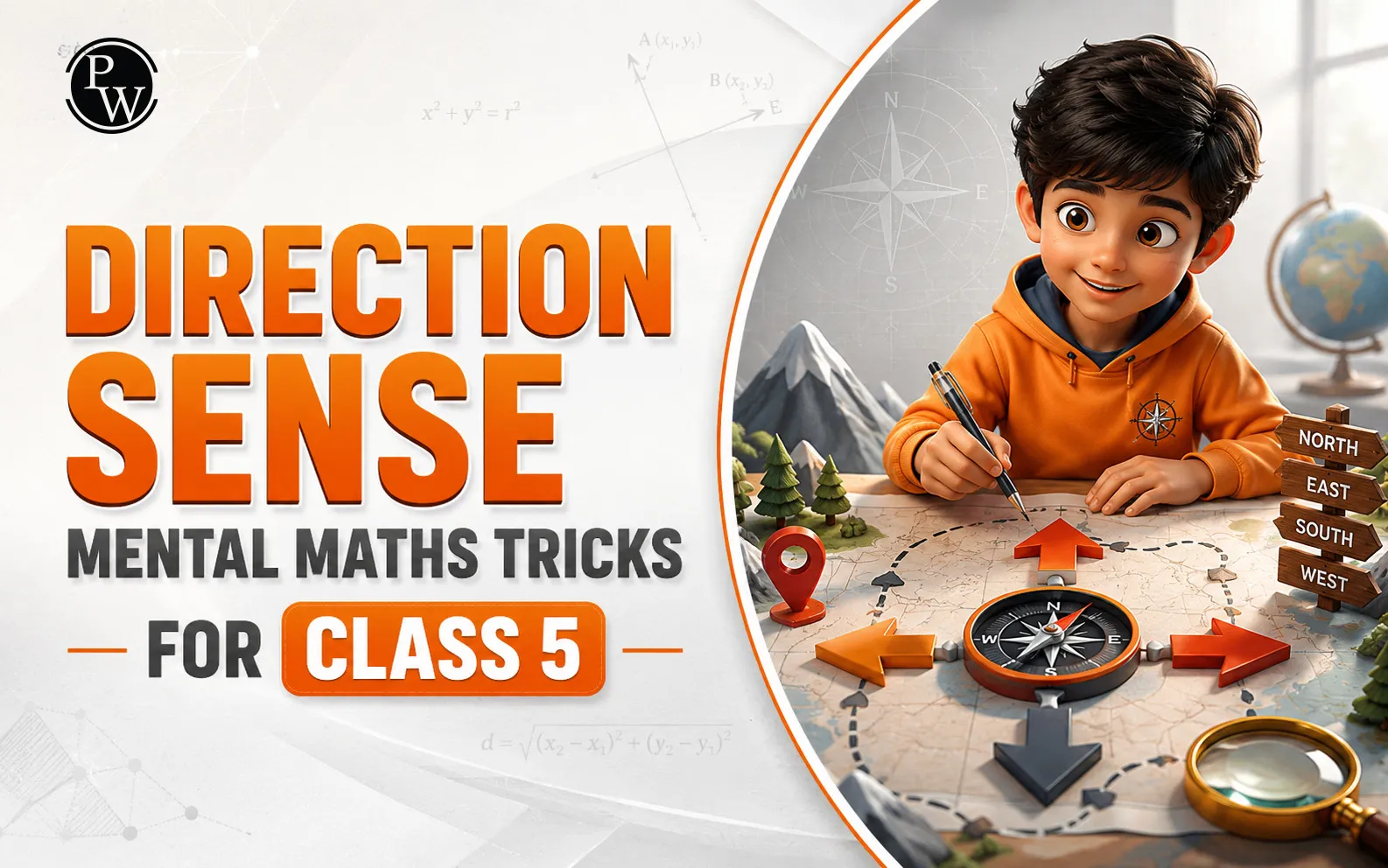
What is Direction Sense?
Direction sense is the knowledge and capacity to recognise, trace, and derive locations, ideally turning with respect to a continuous source of reference or origin. These mental ability reasoning questions grade 5 are generally framed in the form of a short story where an animal, person or vehicle moves along some path. You also need to compute their distance from the origin at the time they finish, or you can specify the exact direction they will be facing when they finish.
To establish that foundation, you will need to learn the general design map. The map has four primary cardinal directions and secondary sub-directions that make up the quarters of these main sections.
The 8 Key Directions for Class 5
-
North (N): Points directly upwards on a standard map page.
-
South (S): Points directly downwards, exactly opposite to north.
-
East (E): Points to the right side of the map, where the sun rises.
-
West (W): Points to the left side of the map, where the sun sets.
-
North-East (NE): The regional space located exactly midway between North and East.
-
North-West (NW): The regional space located exactly midway between North and West.
-
South-East (SE): The regional space located exactly midway between South and East.
-
South-West (SW): The regional space located exactly midway between South and West.
Simple Direction Sense Mental Maths Tricks
Once you stop guessing navigation and orientation solutions, it is easy to encode routing puzzles when ill-structured logic shortcuts are applied. These are the best direction sense for class 5 mental Maths tricks to get answers in seconds without any complex diagrams.
1. The Clockwise NESW String Shortcut
You can skip the step of sketching a huge compass cross on your scratch paper every time by memorising these four basic cardinal directions in continuous clockwise sequence:
N → E → S → W.
-
The Right-Turn Rule: A right turn takes you to your next (clockwise) position on the NESW string. If you are facing north, looking right means you are looking east. Get to turn right once more, but now face south.
-
The Left-Turn Rule: If there is a left turn, you move one step backwards (anti-clockwise) in the string. Now, if you turn left while facing north, you will be facing west.
This string remains constant. Starting from the right and moving left within the problem text, you go to whichever letter in NESW you go into next.
2. The Net Turn Cancellation Trick
If a problem pushes the character through several turns, resist keeping track of every single movement. It is easy to get muddled up. Otherwise, simply carry out the preliminary mental arithmetic and then perform your final turn calculation from that end state.
-
Treat every Right Turn (R) as a plus 90-degree shift.
-
Treat every left turn (L) as a minus 90-degree shift.
Just sum them up mentally. For instance, an item does a right turn followed by another right and then a left (R + R — L); one left can cancel each corresponding one due to the non-commutative property. So how do you still need one single right turn from the starting direction? Resultantly, this approach keeps your mindset clean and devoid of tracking madness.
Read More - Visual Reasoning Mental Maths Tricks for Class 5
3. The Left-Right Body Perspective Rule
Class 5 direction sense traps: forgetting that left and right change depending on the way one is walking. When you face south, your left hand points to the right side of the map. Have this easy mental checklist to verify accuracy:
|
If You Are Facing... |
Your left hand points... |
Your Right Hand Points... |
Movement Direction |
|
North |
West |
East |
Standard Map View |
|
South |
East |
West |
Reversed Map View |
|
East |
North |
South |
Clockwise Turn |
|
West |
South |
North |
Anti-Clockwise Turn |
4. The Quick Shadow Positioning Trick
Shadow questions are a common feature in competitive tests. Knowing how light works allows you to instantly solve them. Shadows are always cast on the opposite side of the source from which they came.
-
In the Morning (Sunrise): The sun sits firmly in the east, which means all shadows must fall toward the west.
-
In the Evening (Sunset): The sun sits firmly in the West, which means all shadows must fall toward the East.
-
At Noon (12:00 PM): The sun is directly overhead, so no visible shadow forms on the ground.
If a question states that Rohan's shadow is on his right during the morning, then you should understand that for this to happen, Rohan's right side must face west. That immediately tells you that he faces south.
Read More - Percentage Tricks Using Mental Maths for Class 5
5. Mental Triangles for Shortest Distance
If a question only requests the distance between the starting point and the ending point, then it is requesting straight-line displacement. If it bends at a right angle, think of the triangle in your mind. You can apply the timeless relationship between its three sides:
Side 1 squared + Side 2 squared = Shortest Distance squared
Memorise the key number triplets that always work in perfect harmony so you can make calculations very rapidly. If the two straight roads are 3 metres and 4 metres, then the adjacent road is automatically a hypotenuse of five metres because three squared (9) plus four squared (16) equals twenty-five, which equates to five. 6, 8 and 10 are also popular triplets to do a quick mental check on.
Benefits of Direction Sense Mental Maths Tricks
Instilling spatial awareness early on offers tremendous future academic benefits. These methods need to be practised regularly so that your brain learns to think and look beyond uninteresting information in exam texts.
-
Saves Critical Exam Time: Others who calculate orientations mentally during logical tests achieve answers faster than classmates painstakingly mapping out complex details. This preserves energy for more difficult calculations down the line.
-
Reduces Exam Stress: Familiar rules such as checking off turn cancellations before moving on, mitigate the unexpected panic when a question contains 4 or even 5 path changes. It replaces the guesswork with complete certainty.
-
Boosts Real-World Independence: Mastering basic map reading basics for kids to navigate larger parks, complex mall directories, and transit routes without needing to pick up their phones every time they need assistance.
-
Strengthens Higher-Level STEM Skills: Spatial reasoning lays the foundation for higher-level academic subjects needed later in school, like coordinate geometry, physics vectors and programming logic.
How Does CuriousJr Help with Class 5 Mental Maths Tricks?
To develop the best speed and accuracy, one must practise consistently with appropriate guidance. Textbook worksheets can sometimes become dull; as such, dynamic platforms help drive learning. Join CuriousJr online mental maths classes.
-
Gamified Practice Modules: CuriousJr adapts heavy subjects into quick, interactive challenges using gamification practices to keep kids immersed in the learning process.
-
Bite-Sized Lessons: The platform breaks down extensive syllabus concepts into manageable daily targets, preventing study fatigue.
-
Focus on Analytical Thinking: It avoids rote learning—teaching children the principle and logic behind a Maths or spatial reasoning problem.
-
Instant Performance Tracking: The students get real-time reports after each round, enabling them to identify and rectify their logical errors instantaneously.
-
Comprehensive Mental Math Coverage: Shortcuts for quick results and reasoning puzzles fully prepare you for word problems at school exams & competitive talent tests.