Percentage Tricks Using Mental Maths for Class 5
 Nikita Aggarwal24 May, 2026
Percentage Tricks for Class 5 Overview
Having said that, a percentage is basically a method of stating one number as a fraction of another, presented out of 100. Etymology The word itself is derived from the Latin "per centum", meaning literally "per every hundred". "Class 5 curriculum students move on to fractions, which are based upon the relationship between a number of parts and a whole."
At this level, the major problem is "fear of big numbers". Problems like "find 20% of 150" make students jump into writing long equations. But percentage tricks for Class 5 are based on the concept that numbers can be split into more friendly pieces. Mental maths class 5 is basically getting to the shortcuts that are based on logic and not on memorising.
And the core of these tricks are (those I promise):
-
Establishing the link between decimals, fractions and percentages.
-
Identifying "anchor percentages" like 1%, 10%, and 50%.
-
Using the commutative property (A% of B = B% of A).
Percentage Tricks for Class 5
To be good at mental maths, you need a bag of tricks. However, one trick could be faster than the other depending on the numbers you are working with. Well, here are the top 10 percentage hacks to make your homework fast.
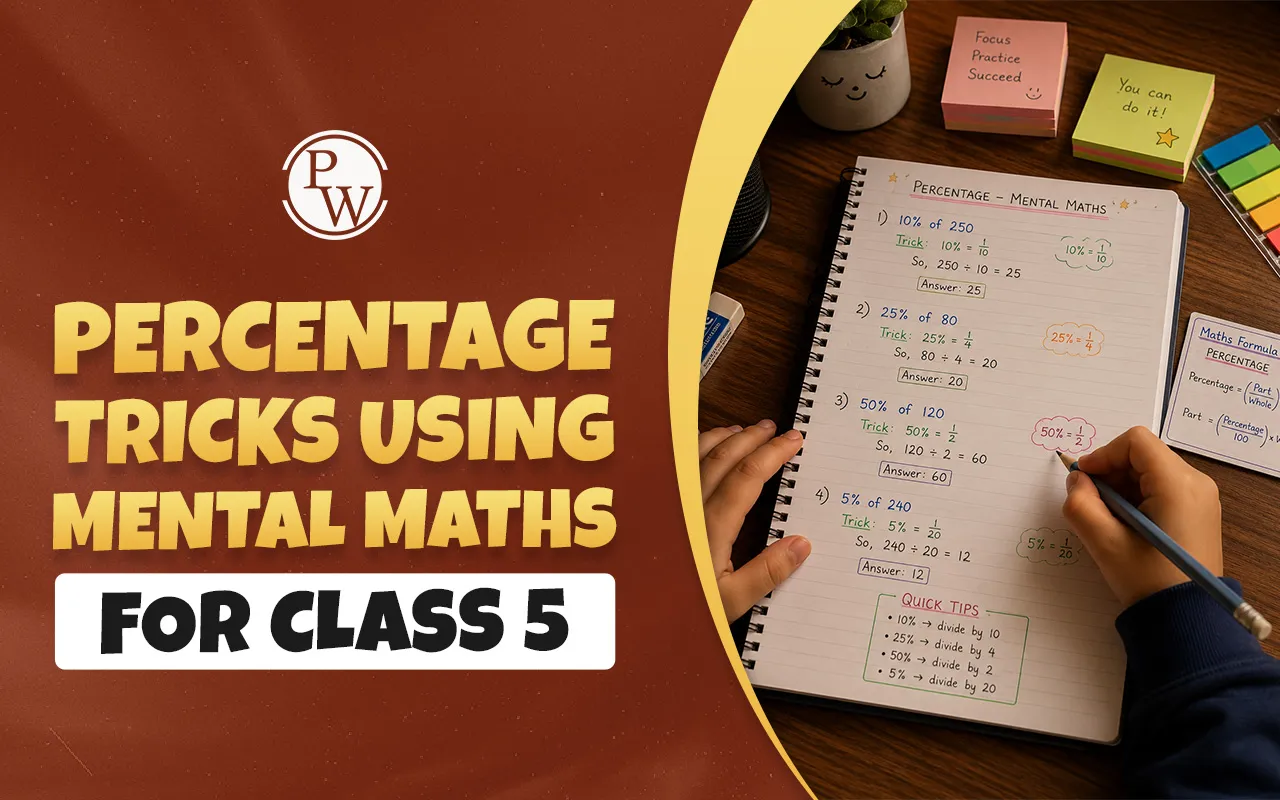
1. The "Out of 100" Trick
Per cent (literally "per 100"). This is your quite basic knowledge. Here, 50% means out of a hundred; that is, if somebody says it's 50%, he would mean in decimal form, this is 0.5.
-
Concept: 50% = 50/100 = 0.5.
-
Simple Logic: “50% of 200 = 100 (half of 200)."
2. The 10% Trick
Finding 10% of any number is the secret key to mental maths. To find 10% of a number, you simply divide it by 10 or remove one zero from the end.
-
Example: 10% of 80.
-
Action: Cancel out the zero or shift the decimal to the left one.
-
Result: 8.
3. The 5% Trick (Half of 10%)
Once you can find 10%, finding the 5% is a walk in the park. You simply take 10% and cut that result in half.
-
Example: 5% of 60.
-
Step 1: 10% of 60 is 6.
-
Step 2: Half of 6 is 3.
-
Result: 3.
4. The 1% Trick (The Ultimate Shortcut)
1% Trick: Great For Numbers And if you wanted to get 1%, then it would be dividing that number by a hundred, or essentially removing two zeroes from the end.
-
Example: 1% of 200.
-
Action: Remove two zeros or move the decimal two places left.
-
Result: 2.
5. The 25% Trick (The Quarter Trick)
Think of 25% as a quarter. In the same way that a quarter corresponds to 25%, we can say, in terms of fractions, that 1/4 = 25%. This implies that all you need to do is divide your grand total by 4.
-
Example: 25% of 80.
-
Action: 80 divided by 4.
-
Result: 20.
6. The 50% Trick (The Half Trick)
This is typically the first trick new students learn. 50% simply represents half of the whole. You simply divide the number by 2.
-
Example: 50% of 40.
-
Action: 40 divided by 2.
-
Result: 20.
7. The 20% Trick (Double of 10%)
Do not go for heavy multiplication if you require 20%. Get 10% first, then double that.
-
Example: 20% of 50.
-
Step 1: 10% of 50 is 5.
-
Step 2: Double 5 is 10.
-
Result: 10.
Read More - Mental Division Tricks for Class 5
8. The Combine Trick (The Split Method)
Here we have a tricky percentage because if you add the smaller ones together. Say you are looking for 15%: just combine the 10% trick and the 5%.
-
Example: 15% of 60.
-
Step 1: 10% of 60 = 6.
-
Step 2: 5% of 60 = 3.
-
Step 3: Add them (6 + 3).
-
Result: 9.
Percentage Tricks for Class 5 Practice Questions
Test your speed! So apply all the quick maths learning that you learnt right now, and let's do these questions.
Multiple Choice Questions (MCQs)
Q1. Using the 10% trick, what is 10% of 150?
a) 1.5
b) 15
c) 150
d) 0.15
Q2. What is 25% of 44? (Hint: Use the Quarter Trick)
a) 10
b) 22
c) 11
d) 4
Read More - Fractions to Decimals in Seconds for Class 5
Q3. If you need to find 20% of 70, what is the best first step?
a) Multiply 70 by 20
b) Find 10% of 70 (which is 7) and double it
c) Divide 70 by 100
d) Subtract 20 from 70
Q4. What is 5% of 80?
a) 8
b) 4
c) 40
d) 5
Q5. Solve 15% of 40 using the combined trick.
a) 4
b) 10
c) 6
d) 8
Short-Answer Questions
-
Calculate 50% of 124 using the Half Trick.
-
Find 1% of 700 by removing two zeros.
-
Use the split method to find 11% of 300 (Hint: Find 10% and then add 1%).
-
Find 30% of 90 using the Zero Cancellation method.
-
What is 25% of 200? (Hint: Half of 50%).
-
Find 5% of 240 using the "Half of 10%" logic.
-
Calculate 20% of 110 mentally.
-
Find 1% of 4500 quickly.
-
Calculate 15% of 80.
-
If a toy costs 500 and has a 10% discount, how much is the discount?
Percentage Tricks for Class 5 Benefits
But why would a student do these shortcuts when they have pen and paper to work it out? And these benefits extend well beyond getting the answer right.
-
Speed in Competitive Exams: Speed in these times, Olympiads and even entrance tests is timed. Percentage tricks allow you to save minutes that students can use for harder problems.
-
Reduced Cognitive Load: When you no longer have to worry about lengthy multiplication, your mind is freed up to concentrate on the reasoning of the word problem itself.
-
Improved Estimation Skills: Through mental maths, students develop a sense of "what looks right" when it comes to an answer. If a student understands that 10% of 400 is equal to 40, they will then automatically know any response saying the answer should be (4000) must not be right.
-
Confidence Boost: Solving a non-trivial maths problem and doing it in two seconds has its own pleasure. This fosters a good rapport with the subject and helps overcome maths anxiety.
-
Real-life Application: In a toy shop, finding out the price after providing a discount is written as 'P%' also marks in exams are shown in percentages. All of these tricks help supply a student to become "street smart" with basic numbers.
How Does CuriousJr Help with Class 5 Mental Math?
CuriousJr online mental maths class removes the friction from learning complex concepts. Textbooks are the what; CuriousJr seeks to be the how, in a format that is interactive and engaging.
Mental maths is more than just table memorisation for a Class 5 student; it also includes pattern recognition. Curious Jr helps by:
-
Gamified Learning: Ditch the boring worksheets and let students work through percentage tricks for class 5 using games that reward their speed + accuracy!
-
Bite-sized Lessons: The platform divides the various subjects into tiny, fragmented modules, which suits a child's attention span.
-
Logical Progression: Curious Jr ensures a student has mastered the simplest addition and multiplication shortcuts before moving into percentages.
-
Practical Context: To enhance long-term retention, the platform includes real-world scenarios to explain why students are studying tricks.