How Mental Maths Builds Concentration and Logical Thinking in Kids
 Nikita Aggarwal15 Jun, 2026
What is Mental Maths?
Essentially, mental maths simply means solving arithmetic problems in your head without using a pen and paper or any gadgets. It may appear as a rapid-fire act of arithmetic to the outside observer, but successful mental calculation is based on patterns, number sense (estimation), and practical visualization principles. Children are trained to observe the relationships between figures and select the most effective frameworks for solving specific problems, rather than just relying on rote memorisation.
This kind of pedagogy offers profound cognitive engagement and moves learners from inflexible rote memorisation to dynamic numerical flexibility. Instead of learning to add numbers sequentially using their fingers, a kid will learn splitting or grouping techniques in their head. Such visualization works internally, training the young mind to manipulate data rather than simply interpret it and making abstract mathematics more engaging and relatable with which we can interact.
Importance of Mental Maths for Concentration and Logical Thinking for Kids
It is during the formative years of childhood that mental maths for concentration and logical thinking need to be developed. The human brain typically develops rapidly in those first 5–13 years of life, rendering itself malleable and open to being exercised with exterior cognitive structure. The mental arithmetic practice makes use of both sides of the brain.
Building Sustained Focus and Concentration
To maintain focus requires training, not just mental stimulation. With mental calculations, children need to keep numbers in their working memory and manipulate them quickly using arithmetic operations. Students who practised mental calculations for 15 minutes daily showed improved concentration in multi-stage academic activities compared to those in the control group.
It reads like a brain workout, and this mental gymnastics teaches kids how to:
-
Filter out external environmental distractions.
-
Sustain a calm mind when confronted with multi-layered challenges.
-
Focus for longer periods without tuning out.
-
Calm processing of data under timed conditions.
Enhancing Logical Thinking and Problem-Solving
Logical thinking asks the child to analyse a scenario, picture possibilities and choose the best possible solution. This skill comes naturally with mental arithmetic. A 2022 study from the Journal of Educational Psychology showed that students who excelled at mental calculation completed problem-solving tasks in less time than their peers, those relying only on written methods.
When kids learn numerical flexibility, they transform their world view of numbers from immutable symbols into pliable elements. For example, suppose a child is presented with the calculation 98 × 5; mental arithmetic allows her to logically reformulate it as (100 - 2) × 5 = 500 - 10 = 490. Your capacity to decompose bigger, more complicated problems into those smaller strategic shortcuts forms the bedrock on which high-level analytical reasoning in algebra, geometry and competitive examinations (everything related to maths) stands.
Read More - Mental Maths vs Regular Maths Tuition: What's the Difference?
Activities to Improve Mental Maths for Concentration and Logical Thinking
Structured exercises are not a means to create an atmosphere similar to school, but instead, parents can provide structured learning activities during their child's day, keeping their minds active. Using easy, screen-free micro-routines allows parents to help kids stay academically sharp with their thinking habits so they do not decline over the summer.
-
Use Everyday Estimation Games to Build Mental Maths Skills: Ask your kid to find out the total cost of grocery items bought, work on exact time intervals between activities they do every day or maintain live scores while watching sports.
-
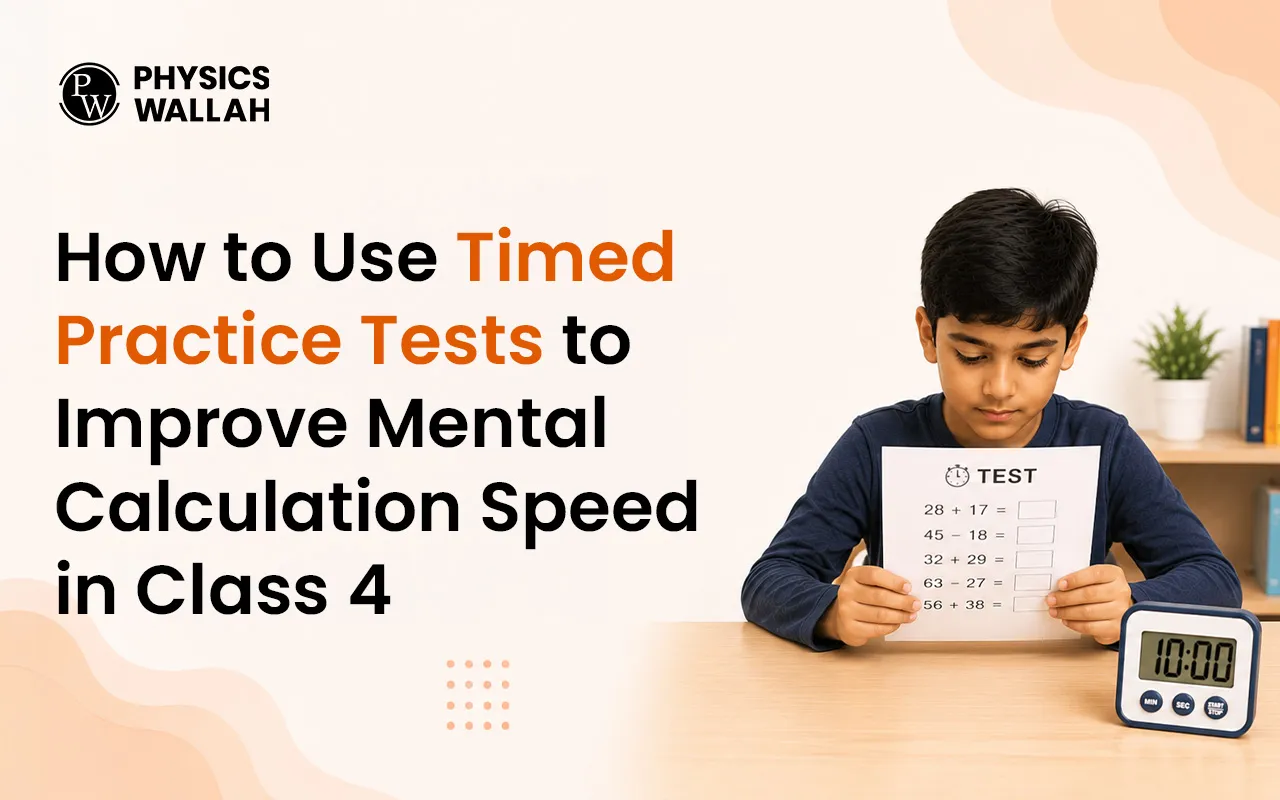
Try Timed Mental Maths Challenges at Home: Schedule short, 5-minute calculation exercises prior to homework sessions. If the brain is required to access numerical facts under mild time constraints, it prepares itself for a quicker retrieval.
-
Use Visualisation to Strengthen Mental Calculations: Have your child imagine an abacus or a collection of objects that are grouped in their mind. Ask them to visualise beads or objects and then answer addition and subtraction problems without any physical materials.
-
Practice Vedic Maths Tricks for Faster Thinking: Include fun patterns such as identifying complements to 10 (7 pairs with 3, for instance) that transform number manipulating into a natural and relaxed process.
Read More - What is Mental Maths? A Guide for Beginners
Benefits of Mental Maths for Concentration and Logical Thinking
The skills of visualisation and analysis gained through mental arithmetic provide significant long-term benefits to children that extends across their entire academic journey. Investing time in this training yields significant benefits in several key areas of development.
-
Speeds Up Cognitive Functioning: Daily practice enhances cognitive development through maths by boosting the brain's ability to access data, leading to faster information processing and allowing you to store and use more information.
-
Maximizes Classroom Efficiency: Strengthening mental math skills helps kids by allowing them to skip the tedious step of writing every individual calculation in detail, thereby conserving precious energy when faced with exams
-
Eradicates Academic Math Anxiety: Switching from basic finger counting to instant mental shortcuts completely pivots a child's view of numbers, trading fear for massive academic self-confidence.
-
Boosts Everyday Problem-Solving Skills: Helps children strengthen their logical skills and prepares them to analyse everyday problems effectively, rather than quitting.
-
Refines Listening and Observation Skills: As mental calculations depend on a child absorbing numbers spoken or read quickly at high speed, this activity elevates their prospects of improving auditory comprehension and concentration skills.
-
Supplements Core School Subjects: Regularly practising mental maths for school children ensures they have the basic numeracy skills needed to understand complex science and technology topics.
How CuriousJr Makes Mental Maths Fun and Effective for Kids
CuriousJr online mental maths class provides personalised interactive online mental maths classes for kids of grades 1st to 8th with an aim to make maths quicker, fun and fearless. The objective highlights the fundamental reasons children have trouble with school mathematics, replacing high-anxiety drills and teaching through stress-relief games and real-life instruction.
Mental Maths Programs for Every Grade Level
CuriousJr methodically navigates kids from slow finger counting to a rapid-fire mental track. It encompasses the entire journey across key academic milestones:
-
Mental Maths for Class 1: Concentrates on introductory skills regarding numbers aimed at children, including finger maths, skip counting patterns and grouping objects in addition to other pre-number concepts such as shapes or sequencing. No more hesitating in the classroom before moving on to advanced work
-
Mental Maths for Class 2: This level gets the student to handle larger numbers with simple add/subtract systems, some multiplying styles through repeated addition, and practical examples using time, money, etc. In this class decimals start appearing along with other simple measurement units also being introduced at a later stage.
-
Mental Maths for Class 3: This level prepares students for higher primary school operations by dissecting multi-digit multiplications and divisions, using partitive sharing and quotative measures with fractions, and introducing algebraic thinking basics along with more structured logic puzzles like Sudoku.
Proven Methodology and Teacher Support
CuriousJr uses proven speed maths tricks through a step-wise Vedic maths approach (left-to-right addition, doubling/halving numbers, number splitting, etc.).
Each interactive online meeting offers unique strengths:
-
The Two-Teacher Model: a Primary Educator, who provides clear visual explanations for calculation shortcuts and teaching content visibly throughout each session, keeps track of progress in real-time while a Personal Mentor stages continuous guidance.
-
Interactive Play-Based Tasks: Children solve problems, puzzles and pattern series in a gamified way by interacting with the program instead of watching it passively on a video screen.
-
Tailored Practice Solutions: Weekly strategies are reinforced through multiple practice sets designed specifically for learning styles to reduce errors in calculations over time.
-
24/7 Mentor and Homework Assistance: Students get real-time clarity on tough schoolwork, transforming maths from a daunting slog into an effortless daily ritual.




How Mental Maths Builds Concentration and Logical Thinking in Kids FAQs
How does practising mental maths for concentration and logical thinking help my child in school?
Can mental maths brain development help a child who currently dislikes mathematics?
What specific tools are used in online mental maths classes to improve child focus with maths?
Why should I choose mental maths for school children instead of relying on educational calculator apps?

Get Free Counselling Today
and Clear up all your Doubts
 Live & recorded classes available at easeDashboard for progress trackingLakhs of practice questions