
Mental Maths vs Regular Maths Tuition: What's the Difference?
 Nikita Aggarwal13 Jun, 2026
Mental Maths vs Regular Maths Tuition Overview
To decide between in-person and remote tuition, you first need to consider what each teaches and how it changes the way the student studies.
What is regular maths tuition?
Daily tuition serves as an extension of the regular classroom for your child. We focus first on helping students keep up with their syllabus, complete homework and score well in the school examinations.
-
Tools Used: The students use pencil and paper, certain geometric instruments, and a calculator.
-
Methodology: The tutor teaches basic textbook formulas. Students then copy these down to solve algebraic, geometric, or arithmetic problems.
-
Focus Area: It focuses on the test-orientated formulas, procedures and practising of subject-specific problems according to the syllabus.
What is mental maths?
Mental maths goes beyond simple calculations; it involves performing calculations while considering their meaning. It is a comprehensive training method that has students solve complex arithmetic problems solely in their heads.
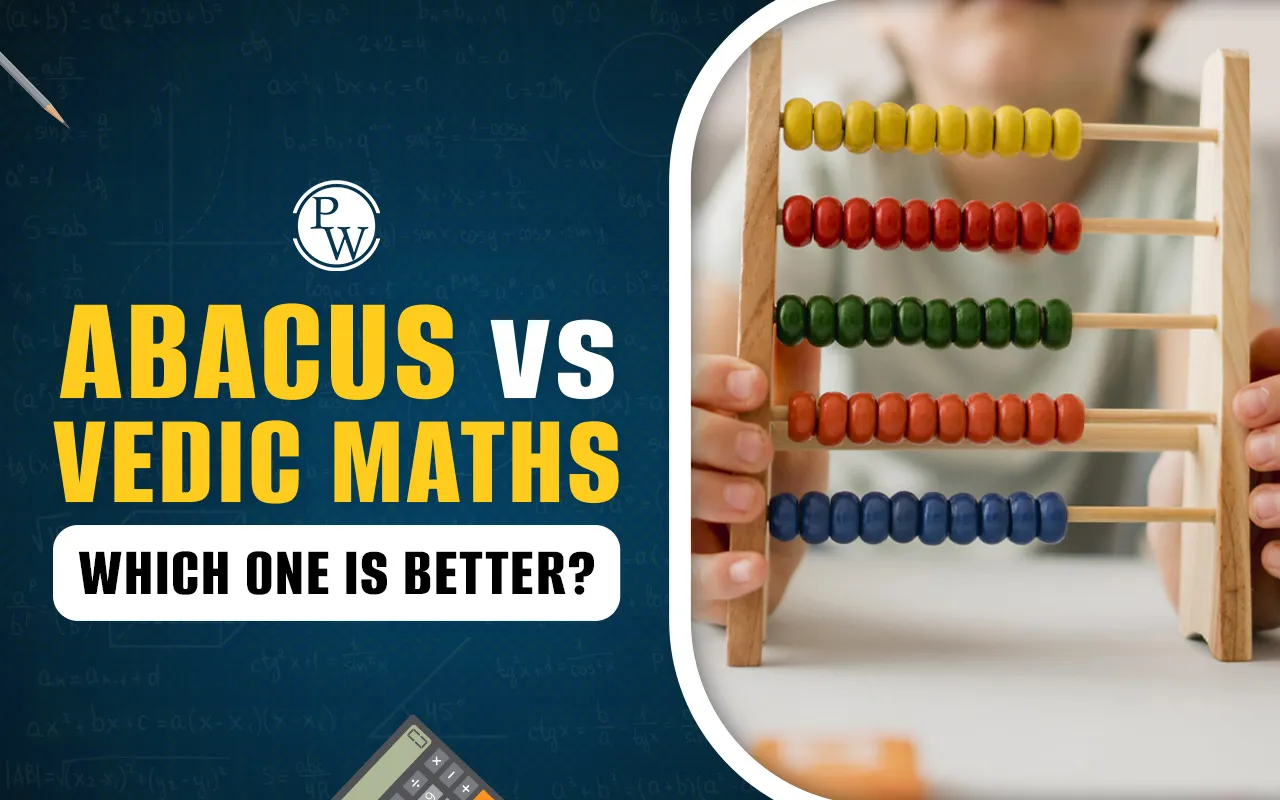
Instead of seeing numbers on a page as static symbols, students begin to visualise mathematical operations. Your training usually starts with visual examples such as the abacus. Students gradually disengage with the physical tool. They see the beads moving in their minds, allowing them to solve equations instantly.
How Mental Maths and Regular Maths Tuition Improves Calculation
The process through which your child deals with an arithmetic question tells you about the speed and logic of problem-solving as a whole. The methods offer entirely different pathways into numbers when analysing how mental maths and regular maths tuition enhance calculation skills.
-
Reducing Dependence on Written Methods: Children are used to finding a pen and paper here and there. To get to an answer, they need to write down each step that leads one after another. With mental maths training, students learn how to compute complicated numbers in their head without physical aids.
-
Calculation Processing Speed: In standard tuition, students use step-by-step methods that take time to write out. Mental maths enables students to recognise shortcuts and number patterns that help them compute answers more quickly than a calculator.
-
Working Memory vs Storage: Traditional tutoring involves writing down steps to repeat from scratch using a whiteboard. Kids learn quickly to hold and manipulate numerous digits in their minds through a deep visual memory grid that mental systems build.
-
Error Detection Ability: While a student in standard tuition very seldom finds themselves making errors, they may only realise there is a major error at the end of a long series of calculations that they have written down. Mental maths means students develop strong number sense so that they can immediately detect a logical flaw in a calculation.
-
Real-World Math Application: Handwriting matters because it trains students to write out long equations on a test and be assessed. As a result, mental training develops rapid calculation and helps kids solve everyday problems without fumbling for a pencil.
Read More - What is Mental Maths? A Guide for Beginners
Mental Maths vs Regular Maths Tuition Differences
Both systems teach arithmetic, but they differ fundamentally in their first principles, classroom design, and cognitive effects.
Tool Reliance and Brain Development
-
Conventional tuition can make students dependent on external help. Without it, a Students' aptitude for solving equations drastically declines. You learn how well your brain processes those numbers, which serves as some kind of accounting step for them.
-
The same principle applies to how our brains develop, not just to everything else. Traditional school tutoring focuses mainly on the left hemisphere, which controls logical sequencing and language comprehension of text.
-
In contrast, visualising number blocks or abacus patterns offsets this effect by engaging the right hemisphere, which handles spatial layouts and images. This activation of both hemispheres fosters balanced, persistent cognitive development.
Curriculum Pacing and Freedom
-
Regular math tuition is subject to the terms of school. If the child is working on fractions in his or her school classroom, then the tutor has to do divisions right away, even if 5 – 3 has still not been conquered.
-
Mental training follows skill levels, not age or school semesters. Only after attaining mastery of the previous level will students move on. This will ensure there are no confusing learning gaps as they move forward.
Read More - How Can I Help My Child Improve Their Mental Maths Without Extra Tuition?
Difference between vedic and school maths
Many parents search for advanced calculation options but wonder about the difference between Vedic and school maths. But school maths is about universal, formal steps. This method is a linear approach that students must follow when recording work for higher-level geometry and calculus in high school.
Vedic maths is based on sixteen 2000-year-old sutras or word formulas that do fast-math shortcuts. School maths requires a student to present all of their working out clearly for an examiner, but Vedic and abacus-based systems focus more on efficiency (good calculation techniques) and speed.
Benefits of Mental Maths vs Regular Maths Tuition for Students
If we compare mental maths and regular maths tuition, we must scrutinise the child's development holistically rather than merely the content. Each will give you advantages unique to whichever system your goals point to.
Key mental maths benefits for kids
-
Enhanced Working Memory: A child who learns to visualize numbers in their minds has an improved memory capacity which makes them more able to remember complicated information across different subjects at school.
-
Sharper Concentration: Doing maths also calls for complete, undivided attention, as there is no use of pen and paper to provide any assistance.
-
Spatial and Photographic Memory: Rearranging number blocks or abacus beads in your mind builds strong spatial awareness and photographic memory.
-
Eradication of Math Phobia: When a kid sees he/she can compute large sums faster than an adult with the help of a phone, then his/her phobia disappears.
The Formative Years Advantage: A child's early formative years are when brain development peaks. During this window, it cultivates neural pathways; so why not use them properly and teach basic mental arithmetic skills that will give somebody a life-long advantage.
Benefits of Regular Maths Tuition
-
Direct Curriculum Alignment: Assists students in achieving immediate score improvements on school exams and homework assignments.
-
Structured Homework Support: Tutors have students working through difficult schoolwork, which lowers stress on a daily basis
-
Deep Conceptual Analysis: Ordinary maths classes devote time to contemplating concepts and theorems in analysis, word problems from algebra, and geometry proofs.
How does CuriousJr help with mental maths?
Traditional tuition centres tend to rely on repetitive, mundane worksheets that make learning feel more repetitive than anything else. CuriousJr online mental maths class transforms this experience into a gamified adventure, so instead of training in set fields for mental arithmetic practice, students go to Curious Jr and turn rigorous preparation on its head!
Gamified and Interactive Learning
CuriousJr is one such online platform that makes learning interactive. Instead of memorising boring rules, children play educational games that transform the learning process into fun and challenging tasks through quick mental calculations. It alleviates tension and transforms the practice sessions into a daily fun routine.
Visualisation Techniques
It provides easy-to-understand visual models to children so that they view numbers differently as physical and movable objects rather than flat ink on paper. This enables children to lay down a strong, consistent internal maths grid so they can release the need for external counting tools far sooner than traditional programs.
Personalized Skill Progression
Each child learns at his/her speed. If your child would benefit from a little extra help with simple subtraction or is ready to work on advanced multiplication shortcuts, the program automatically adjusts so they get precisely the right level of challenge.




Mental Maths vs Regular Maths Tuition FAQs
What is the core difference in mental maths vs regular maths tuition?
Can a child enrol in a mental maths course online alongside schoolwork?
What are the main mental maths benefits for kids during exams?
How do mental maths online classes keep young children engaged?
At what age should a child start learning mental arithmetic for children?




Get Free Counselling Today
and Clear up all your Doubts
 Live & recorded classes available at easeDashboard for progress trackingLakhs of practice questions

